
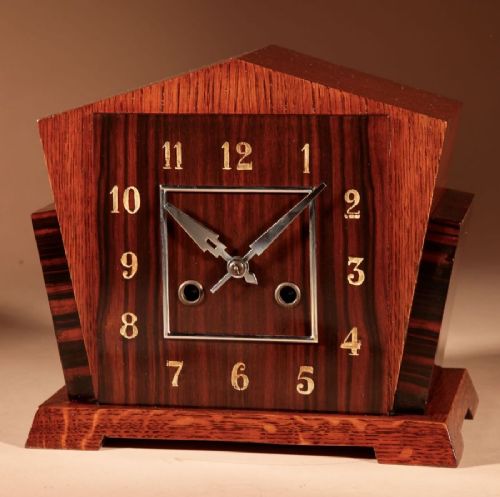


Ebony Table Clock
An ebony table clock brings dark wood and brass dialwork together into a compact timepiece built to command a room.
Ebony Table Clock
An ebony table clock combines architectural timber cases with precise mechanical movement, serving as both a functional timepiece and a decorative object. When you search for an ebony table clock, you find examples spanning multiple centuries from early English bracket designs to later continental interpretations.
The version most commonly met on this page is the seventeenth century basket top table clock, often veneered in rich ebony and mounted with gilt brass dial furniture. These early pieces reflect the height of classic clockmaking craftsmanship.
Later iterations shift into Regency, Georgian, and Art Deco Amsterdam School aesthetics, moving from solid dark woods and ebonised finishes into oak and macassar ebony combinations. Each period brings its own distinct proportion and dial arrangement to the form.
How they were made
Cabinetmakers constructed the foundational carcase from timbers like oak before applying fine veneers of ebony, macassar ebony, or ebonised wood to the exterior surfaces. This technique allowed workshops to display dense, dark grain patterns while maintaining structural stability across the clock housing.
Metalworkers cast and chased brass, ormolu, and silver mounts to frame the dials, spandrels, and carrying handles of the clock. These metallic elements provided crisp contrast against the dark timber veneers and protected vulnerable edges from wear.
Ebony Table Clock Retail Price Guide 2026
Typical asking prices for ebony table clock among the pieces listed under this phrase on Sellingantiques today, from the lower quarter to the upper quarter. They describe what is for sale here now, not the wider market.
Listings feature ebony table clocks spanning the seventeenth century through to the 1920s, utilising brass, oak, glass, and ormolu.
What varies in quality
The refinement of the dial engraving and the crispness of the brass mountings separate standard production from superior work. Makers who invested time in detailed silvered chapter rings and pierced spandrels achieved a higher level of visual depth.
The integrity of the timber veneer and the preservation of the original surface finish dictate the overall character of the piece. Timbers that retain their deep, natural dark tone without excessive restoration command closer attention from collectors.
Jonathon Lowndes·John Pepys London·Joseph Windmills·William Speakman·Henry Jones·Louis Recordon·James Evans·John Knibb
The Ebony Table Clock Glossary
- Basket top
- A distinctive domed or handle-mounted superstructure characteristic of seventeenth-century English table clocks. It sits atop the main case body.
- Ebonised wood
- Timber treated with a dark stain or finish to imitate the appearance of true ebony. It was widely utilised across various historical periods.
- Quarter repeating
- A complication mechanism that sounds the quarters and hours on demand when a cord is pulled. This adds mechanical complexity to the clock.
- Bracket clock
- A portable spring-driven clock originally designed to sit on a wall bracket or a tabletop. Many survive alongside their original matching brackets.
- Macassar ebony
- An exotic hardwood featuring distinctive warm brown and black striped grain patterns. It appears frequently in twentieth-century Amsterdam School designs.
Ebony Table Clock: Frequently Asked Questions
Where should I place an ebony table clock?
These clocks suit prominent locations on sturdy sideboards, mantelpieces, or dedicated wall brackets where their dark timber cases and brass mounts catch the light.
Because they rely on delicate mechanical movements, keep them away from direct sunlight, draughts, and damp environments to protect the wood and internal brasswork.
What is the difference between a table clock and a bracket clock?
Historically, the terms overlap significantly, though bracket clocks often feature specific architectural pediments and carrying handles designed to rest upon a matching wall shelf. Table clocks may sit directly on flat furniture surfaces without requiring a wall mount.
Both forms utilise spring-driven movements rather than falling weights, allowing them to remain portable within the home.
How do I identify a seventeenth century ebony table clock?
Seventeenth-century examples typically display square brass dials with cast spandrels, finely matted centres, and ebony-veneered oak carcases featuring basket tops. Signatures from notable makers are frequently engraved directly onto the dial plate.
Construction details such as hand-cut齿 wheels and verge escapements further point toward this early period of English horology.