


Caddy Top Clock
A caddy top clock is a table or bracket timepiece shaped by its stepped, domed superstructure, offering traditional craftsmanship for the home.
Caddy Top Clock
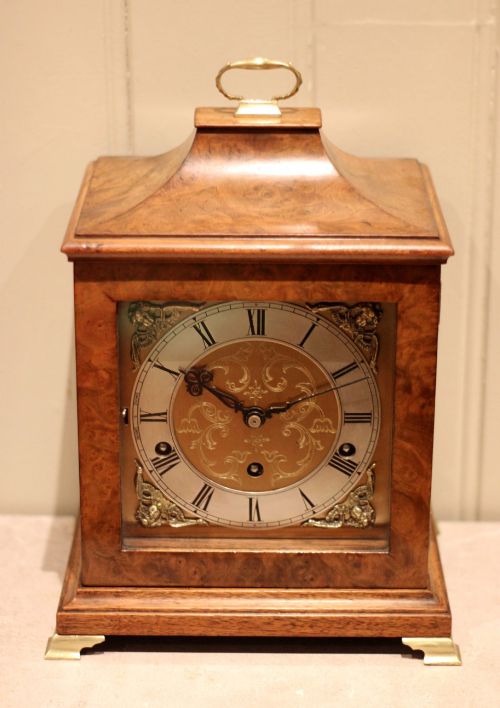
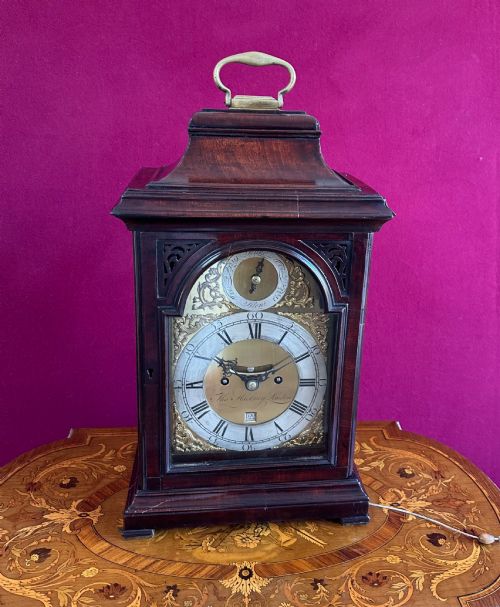
When you search for a caddy top clock, you are looking at timepieces defined by their distinctive domed or stepped tops, which echo the profile of tea caddies from the period. These objects appear primarily as bracket clocks and mantel clocks, housing mechanical movements inside substantial wooden cases.
The versions you are most likely to meet on this page span several centuries of design, originating mainly from the eighteenth and nineteenth centuries alongside revival pieces. You will find them in forms ranging from small mantel variants to grander bracket pieces designed to sit on furniture or dedicated wall brackets.
How they were made
Maker workshops constructed the cases using timber foundations of mahogany, walnut, burr walnut veneer, and ebony, often incorporating glass panels to reveal the dial and movement. Metal components in brass and gilded brass formed structural mounts, bezels, and intricate dial face details.
Internal mechanics relied on precision metalwork for verge and anchor escapements, driving striking trains and chime mechanisms such as Westminster chimes. Woodworkers shaped the signature caddy top profiles by hand, applying veneers and polishing the timber surfaces to a high lustre.
Listings feature mahogany, burr walnut veneer, ebony, and brass across bracket clocks, mantel clocks, and longcase clocks spanning multiple centuries.
What varies in quality
The distinction between ordinary examples and the finest pieces lies in the selection of cabinet timbers, such as figured burr walnut veneer or deep ebony, matched with crispness in the brass mounts and dial engraving. Superior execution is also evident in the handling of the caddy top proportions and the sophistication of the internal movement.
Mappin and Webb·Henry Jones·Lenzkirch·John Taylor·Watson London
The Caddy Top Clock Glossary
- Caddy top
- A stepped, domed architectural shape on the upper case of a clock, resembling a tea caddy. This form provides a distinct visual silhouette.
- Bracket clock
- A portable mechanical clock traditionally designed to sit on a wooden wall bracket or a table. Many incorporate carrying handles on top.
- Verge movement
- An early mechanical escapement regulating the speed of a clock using a crown wheel and pallet. It represents traditional horological construction.
- Chime
- An acoustic feature that sounds the quarters or hours using bells or gongs. Westminster variants are particularly well documented.
Caddy Top Clock: Frequently Asked Questions
What is a caddy top clock?
A caddy top clock is a portable timepiece featuring a distinctive stepped or domed wooden upper case. They were traditionally built as bracket or table clocks.
These pieces house mechanical movements designed to sit on furniture surfaces or dedicated wall brackets within a room.
How do I date a caddy top clock?
Dating involves examining the cabinet wood, the style of the dial, and the mechanical movement inside. Eighteenth-century examples often feature verge escapements and mahogany or ebony cases.
Later revival pieces from the nineteenth and twentieth centuries adopt earlier decorative styles while utilising updated manufacturing techniques.
Where should I place a bracket clock?
These clocks are designed for prominent placement on sturdy tables, mantelpieces, or traditional wall brackets. Their compact footprint allows them to sit securely on flat furniture surfaces.
Ensure the location is stable and away from direct sunlight or damp environments to protect the wood and internal mechanics.
What movements do they use?
The mechanisms range from simple time-only systems to complex striking and chiming trains. Eighteenth-century models frequently utilise verge movements.
Later examples incorporate quarter striking and Westminster chime capabilities driven by spring or weight-driven brass machinery.