
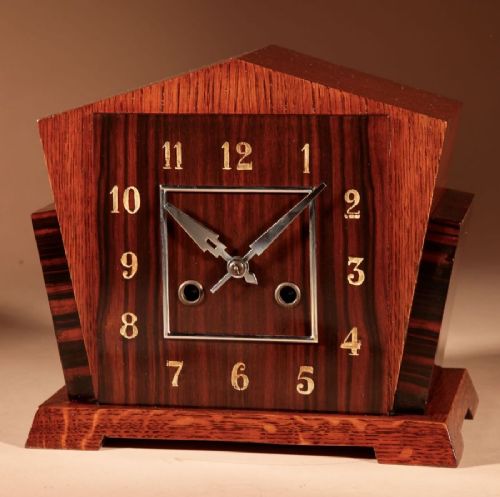


Ebony Mantel Clock
An ebony mantel clock brings solid presence to a room, trading in dark timber and crisp metal dials.
Ebony Mantel Clock
When you search for an ebony mantel clock, you are looking at timepieces cased in rich dark wood or ebonised timber, spanning from seventeenth century basket top designs to twentieth century Amsterdam School pieces. These objects range from compact table clocks housed beneath glass domes to substantial bracket clocks resting on brass feet.
The version you are most likely to meet on this page combines a heavy wooden carcass with contrasting dial mounts, often drawing on Regency, Victorian, or Art Deco styles. They sit squarely on a shelf or mantelpiece, built to anchor a room with steady proportions and visible mechanics.
How they were made
Cabinet makers built these cases using solid hardwoods or applied veneers of ebony, macassar ebony, and ebonised wood over an oak or mahogany core. The dark surfaces received detailed treatments, pairing the deep black grain with polished brass bezels, ormolu mounts, and silvered chapter rings.
Dial faces relied on white enamel or engraved brass plates behind thick protective glass doors. Movement plates and striking trains utilised brass components, fitted into square or arched wooden housings designed to project sound clearly.
Listings span from the seventeenth century through the Regency and Victorian eras into twentieth century Amsterdam School design.
What varies in quality
The distinction between ordinary and exceptional work lies in the precision of the timber veneer and the crispness of the cast brass ornaments. Finer examples show seamless matching of the ebony grain across complex bracket or portico shapes, while simpler pieces rely on plain ebonised surfaces.
Internal movement architecture further separates the range, where signed backplates from known makers command greater attention than unsigned commercial movements. The weight of the cast mounts and the integrity of the original glass elements complete the division.
L. Vick of Stroud·Jonathon Lowndes·John Pepys London·Joseph Windmills·William Speakman·Henry Jones·Louis Recordon·James Evans
The Ebony Mantel Clock Glossary
- Bracket clock
- A portable spring driven clock originally designed to sit on a wall bracket. These timepieces typically feature a carrying handle on top and a flat wooden base.
- Ebonised wood
- Timber treated with stain or paint to imitate true ebony. This technique allowed makers to achieve a deep black finish using standard hardwoods.
- Basket top
- A rounded, swelling upper case design found on seventeenth century clocks. The curved shape resembles an inverted wicker basket.
- Ormolu
- Gilded bronze used for decorative mounts and feet. The technique involves applying a gold amalgam to heated bronze.
- Chapter ring
- The metal ring on a clock dial that bears the hour numerals. These are frequently silvered and engraved for legibility.
Ebony Mantel Clock: Frequently Asked Questions
Where should I place a heavy wooden clock?
Select a stable, level surface such as a heavy mantelpiece, sideboard, or dedicated wall bracket away from direct sunlight.
Avoid placing timepieces near exterior doors or heating vents where temperature shifts can affect the wooden case.
What does a quarter repeating mechanism do?
A repeating train sounds the most recent hour and quarters on bells or gongs when a pull cord is activated.
This function allowed owners to check the time in dark bedchambers before the widespread use of artificial lighting.
How do I distinguish a seventeenth century clock case?
Early cases display square brass dial corners, basket top profiles, and fine ebony veneer over oak carcases.
Later Victorian and Edwardian interpretations adopt bolder aesthetic movement lines or simpler rectangular proportions without the early brass mount style.