


17th Century Table Clock
These 17th century table clock examples bring mechanical precision and dark wood cabinetry into a room, offering genuine historic domestic timekeeping.
17th Century Table Clock
A 17th century table clock is a portable domestic timepiece designed for placement on a desk, bracket or table rather than standing on the floor. When browsing this selection, buyers encounter authentic period works alongside later revival pieces.
The genuine 17th century pieces span lantern clocks and sophisticated basket top table clocks housed in dark woods. Revival interpretations from later eras emulate these earlier forms using similar materials and stylistic cues.
How they were made
Maker workshops constructed these timepieces using heavy brass and iron for internal movements and structural frames. Fine cabinet makers applied dark veneers such as ebony and burr walnut over wooden carcases.
Gilded brass, silver mounts and ormolu provided decorative contrast on dial plates, spandrels and mounts. Glass protected the delicate dials while steel components governed the ticking mechanism.
Listings include ebony, burr walnut veneer, brass, iron and ormolu across both authentic 17th century examples and later 20th century revivals.
What varies in quality
Quality in these clocks rests upon the sophistication of the mechanical movement and the integrity of the exterior case. Early work by named makers exhibits superior brass engraving and precise gear cutting.
The choice of fine veneers like ebony or burr walnut, combined with cast brass basket tops and silver mounts, distinguishes finer examples from simpler utilitarian brass lantern clocks.
Thomas Langley·Mappin & Webb·Jonathon Lowndes·John Pepys·Joseph Windmills·William Speakman·James Ogden Senior·Henry Jones·William Clement
The 17th Century Table Clock Glossary
- Basket top
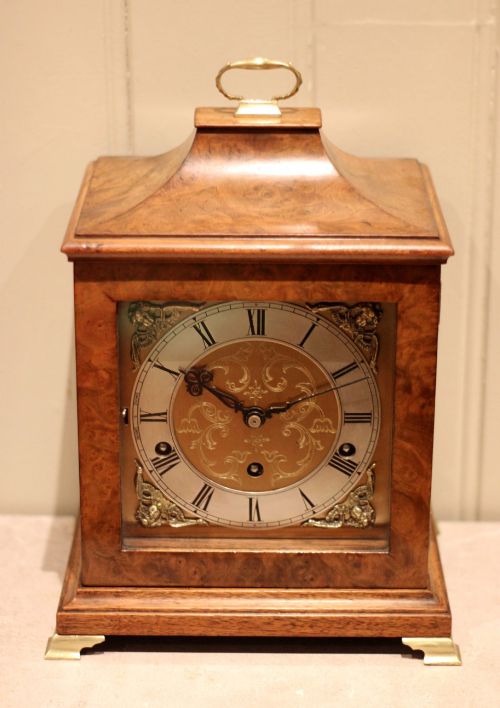
- A distinctive flared or domed wooden structure atop a table clock, often wrapped in brass frets to allow sound to escape.
- Lantern clock
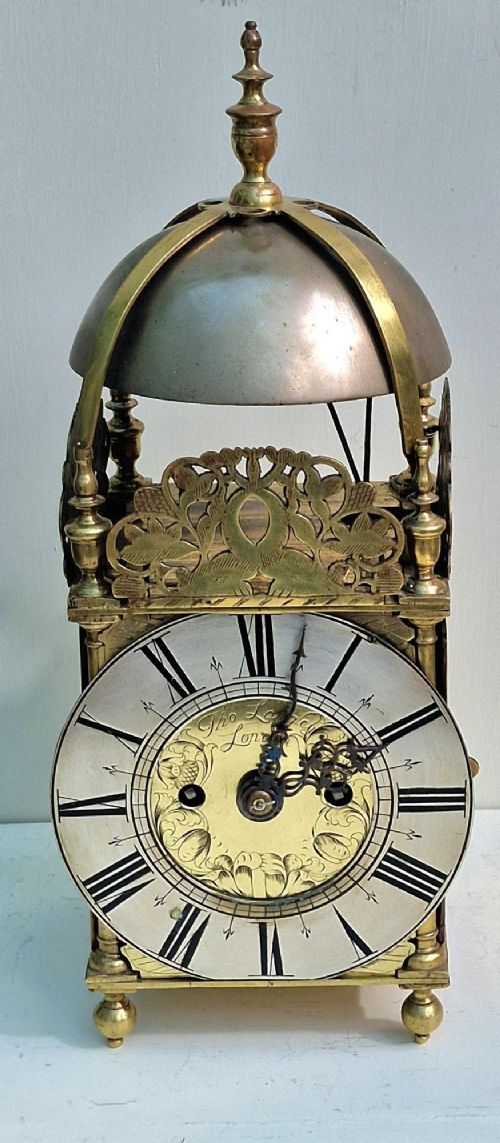
- An early brass chamber clock driven by weights or springs, featuring a hanging bell and ornamental strapwork.
- Spandrel
- The corner ornamentation on a clock dial, typically cast in brass and decorated with cherubs, foliage or scrollwork.
- Quarter repeating
- A complication mechanism that sounds the hours and quarters on bells when activated by a pull cord.
- Chinoiserie
- A decorative style employing imitation Chinese motifs, frequently applied to lacquered clock cases during revival periods.
17th Century Table Clock: Frequently Asked Questions
How do I wind a 17th century table clock?
Winding depends on whether the movement uses a spring barrel or hanging weights, requiring a matching key or careful tension adjustment.
Consult the specific mechanical requirements of the movement before attempting to wind the clock to prevent damage to the gear train.
Where should I place a table clock?
Position the clock on a sturdy, level surface such as a heavy wooden table, sideboard or a dedicated wall bracket.
Avoid areas subject to direct sunlight, dampness or strong vibrations that could disrupt the delicate pendulum or balance swing.
How do I distinguish a revival clock from a 17th century original?
Examine the construction methods of the movement plates, screw types and the ageing patterns of the wood and metal components.
Original 17th century pieces show hand-finished tool marks and period-specific framing, whereas revival clocks from later centuries display standardised machine work.
What is the difference between a lantern clock and a bracket clock?
Lantern clocks are typically wall-mounted or shelf-standing brass timepieces featuring an exposed bell on top and weight-driven chains.
Bracket clocks are housed in enclosed wooden cases with flat or basket tops, designed to sit securely on flat surfaces.