
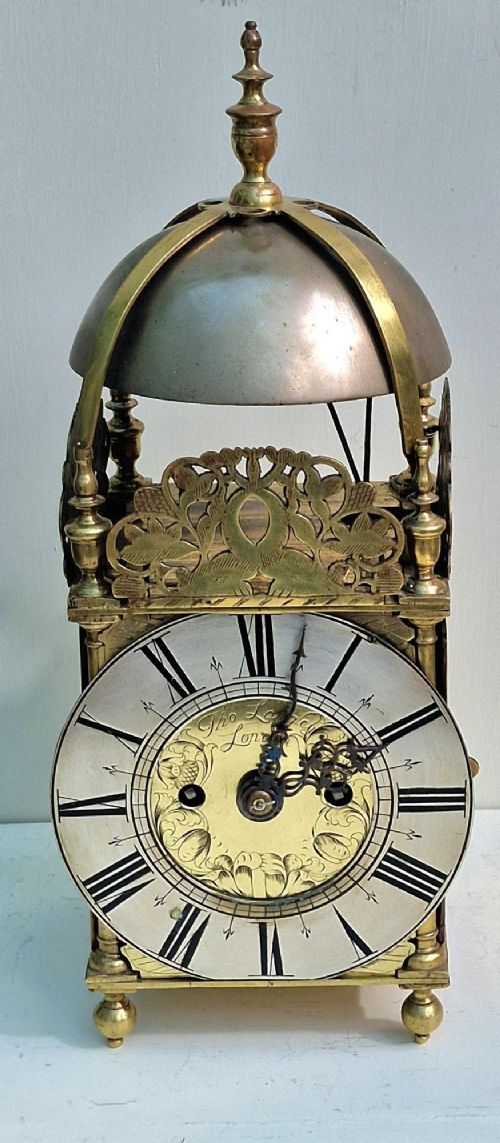


Seventeenth Century Clock
A seventeenth century clock brings the rigorous mechanics and quiet gravity of early horology directly into a room.
What a seventeenth century clock is
A seventeenth century clock encompasses lantern clocks, table clocks, and longcase clocks produced during this foundational era of British horology. These pieces originate from London makers and provincial workshops, reflecting the rapid evolution of domestic timekeeping.
The lantern clock stands as the earliest domestic form encountered here, alongside table clocks and tall longcase clocks housed in oak, walnut, or ebony veneer. Dial sizes and case heights vary, ranging from compact thirty-hour regional examples to eight-day London productions.
The style spans early English vernacular work to sophisticated William and Mary designs featuring basket tops and marquetry details. Each piece demonstrates the transition from weight-driven wall pieces to spring-driven table clocks and tall case formats.
How they were made
Makers utilised brass and steel for the intricate wheel trains, escapements, and dial plates, often incorporating lead weights and iron components within the movements. Lantern clocks rely on brass frames held together by pinned corner posts and top straps.
Cases demand skilled carpentry in oak and walnut, with specialised techniques applied to ebony veneering and marquetry decoration. Dials feature engraved brass chapter rings and hand-hammered details under protective glass.
Retail Price Guide 2026
Typical UK retail prices for seventeenth century clock, calculated from the Sellingantiques database of over a million retail prices indexed since 2003. This retail price guide relies exclusively on Sellingantiques data; no external sources or auction records are used, so the figures do not describe the wider market.
Listings feature brass, steel, oak, walnut, and ebony veneer across lantern, table, and longcase formats from the seventeenth century.
What varies in quality
The distinction between standard domestic production and top-tier work rests on the refinement of the movement and the sophistication of the signature. Prominent London makers executed delicate quarter repeating mechanisms and precise dial engraving that elevate the horological merit.
Cabinetwork further separates the range, where figured burr walnut and intricate marquetry display superior joinery compared to simple regional oak cases. The integrity of the original brass work and dial components dictates the overall standing of the piece.
Thomas Langley·John Spershott·Joseph Windmills·Peter Closon·Joseph Knibb·William Noke·Henry Massy
The Seventeenth Century Clock Glossary
- Lantern clock
- An early weight-driven brass clock designed to be hung on a wall or placed on a bracket. These domestic timekeepers feature exposed top bells and pierced frets.
- Longcase clock
- A tall pendulum clock housed in a wooden case designed to protect the weights and pendulum. They emerged in various wood types including oak and walnut during this period.
- Quarter repeating
- A mechanism that sounds the hours and quarters when a cord is pulled. This complex addition appears on sophisticated table clocks.
- Marquetry
- The art of applying pieces of veneer to a structure to form decorative patterns. This technique decorates the surfaces of high-status longcase clocks.
- Chapter ring
- The circular ring on a dial that bears the hour numerals. These are typically engraved on brass plates.
Frequently Asked Questions
How do I wind a seventeenth century clock?
Winding depends on whether the mechanism is driven by weights or springs, requiring careful attention to the key or cord. Each system demands a steady hand to engage the barrel or wind the line without straining the historic gear train.
Modern owners must understand the specific intervals for their clock, as thirty-hour movements differ entirely from eight-day duration pieces. Proper handling preserves the tension across the brass wheels and maintains the rhythm of the escapement.
Where should I place a longcase clock?
These tall clocks require a stable, dry interior wall away from direct heat sources and heavy vibrations. Securing the case firmly to the wall ensures the pendulum swings evenly and keeps accurate time.
Positioning the piece in a principal room allows the striking mechanism to be heard clearly without overwhelming the space. Floor stability remains essential for the correct operation of the pendulum and weight drops.
How do lantern clocks differ from longcase clocks?
Lantern clocks are compact brass timepieces originally designed to hang on walls or sit on specialised brackets. They rely on exposed weights and a bell mounted above the top frame.
Longcase clocks enclose the weights and pendulum within a tall wooden case, offering longer running durations and greater protection for the movement. While lantern clocks display an industrial brass aesthetic, longcase clocks showcase fine cabinetmaking.