


English Lantern Clock
An english lantern clock brings the mechanical mastery of the seventeenth and eighteenth centuries directly into a room.

What an english lantern clock is
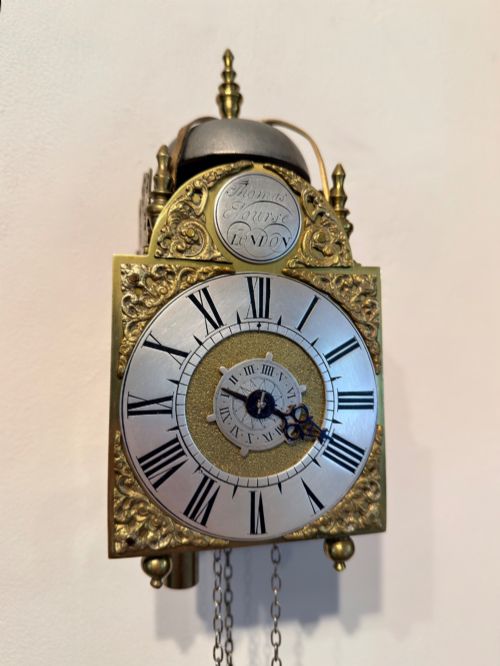
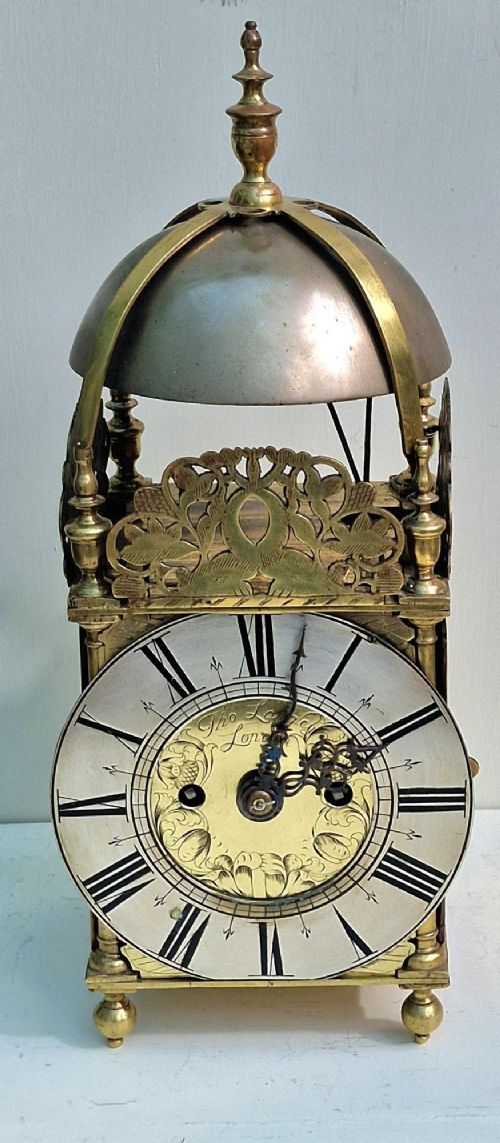
The english lantern clock is a wall-hanging timekeeper that evolved from domestic lighting frames into precise horological instruments. These pieces present a brass frame, often topped by a distinctive bell and pierced frets, representing centuries of workshop tradition.
Buyers meeting this search phrase encounter specimens spanning from the early seventeenth century through to nineteenth-century interpretations. The selection encompasses provincial makers from Lancashire, Cheshire and Wiltshire alongside master craftsmen based in London.
Most examples deploy traditional verge escapements, though twin fusee movements and quarter-striking complications appear among later or more ambitious pieces. Surviving forms include standard wall models alongside table clocks and mantel variations.
How they were made
Constructed primarily from cast and hammered brass, these clocks incorporate iron and steel for internal wheels, arbours and spring components. Wooden elements appear in later cases and bracket mounts.
Craftsmen shaped the brass plates by hand, piercing and engraving the front frets with heraldic or floral motifs. Dial chapters and indicator hands were meticulously hand-finished and pinned to the brass framework.
Retail Price Guide 2026
Typical UK retail prices for english lantern clock, calculated from the Sellingantiques database of over a million retail prices indexed since 2003. This retail price guide relies exclusively on Sellingantiques data; no external sources or auction records are used, so the figures do not describe the wider market.
Several provincial makers constructed robust timekeepers far from London, proving that rural blacksmiths could match metropolitan ambition.
What varies in quality
The distinction between standard works and masterpieces lies in the integrity of the brass casting and the depth of the hand-engraving on the dial and frets. London makers often achieved crisper execution, though provincial Northern English workshops produced robust variants with distinct regional character.
Survival of original mechanical components, such as verge escapements and early alarm mechanisms, elevates an example's historical standing. The presence of documented signatures from known makers establishes a firmer attribution than unsigned vernacular pieces.
Thomas Langley·Samuel Tinham·Peter Closon·John Waller·James Ogden Senior·William Barrow·Robert Harvey·Ignatius Huggeford·Charles Raymond·Thomas Bridge·Henry Burges Senior·John Knibb·Michael Bird·Robert Cutbush·Benjamin Brockhurst
The English Lantern Clock Glossary
- Fret
- The ornamental brass plate mounted at the top of the clock frame, often pierced with heraldic designs or motifs that help date the piece. These decorative elements frame the bell above.
- Verge escapement
- An early mechanical regulating mechanism that controls the speed of the clock using a crown wheel and a swinging pallet. It dictates the characteristic ticking rhythm of seventeenth-century horology.
- Fusee
- A conical drum used in spring-driven clocks to ensure even power delivery as the mainspring unwinds. This mechanism improves timekeeping consistency across the running duration.
- Quarter striking
- A complex striking train that chimes every quarter of the hour on additional bells. This feature indicates high mechanical ambition in domestic timekeepers.
- Dial chapter
- The outer ring on the face bearing the hour numerals, typically featuring engraved Roman numerals and minute markers. These rings are often silvered brass applied to the dial plate.
Frequently Asked Questions
How did people hang these clocks?
These clocks were traditionally hung on a wall using a sturdy iron spike driven into timber panelling or masonry, supported by hoop and spurs on the back.
Weight-driven versions required sufficient drop space below for the driving weights to descend freely during their running cycle.
What is a house clock?
A house clock is simply an alternative historical term for a domestic timekeeper used in seventeenth-century English dwellings.
These instruments served as the central auditory and visual reference for daily household routines before pocket watches became common.
How do you date an english lantern clock?
Dating relies on stylistic clues in the frets, the shape of the dial corners, and the evolution of the movement from early verge mechanisms to later anchor or fusee designs.
Signatures engraved on the dial plate also point to active working periods recorded for specific provincial and London makers.
Why do some have alarms?
Early mechanical alarms were essential for waking households or signalling the start of daily tasks at predetermined morning hours.
These systems used an internal disc and a separate hammer striking the top bell independently of the hourly train.