

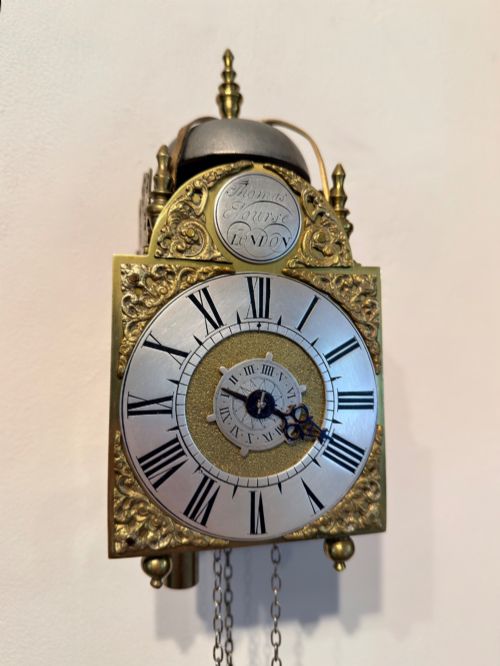


Brass Chamber Clock
These brass chamber clocks are mechanical timekeepers dating from the seventeenth, eighteenth, and nineteenth centuries, offering a distinct domestic antiquity for the wall or table.
Brass Chamber Clock
A brass chamber clock comprises wall and table timepieces, predominantly taking the form of lantern clocks spanning the seventeenth to nineteenth centuries. These pieces reflect historical English domestic timekeeping traditions, encompassing early seventeenth-century examples alongside Georgian revivals.
The lantern clock design forms the core of this grouping, featuring brass frameworks often displaying regional and London craftsmanship. Surviving specimens range from miniature hook and spike wall clocks to quarter-striking twin fusee variants.
Materials and construction
Makers constructed these clocks using brass for the primary frames and dials, supplemented by iron and steel internal mechanisms. Silvered metal frequently appears on the chapter rings to provide contrast against the yellow metal plates.
Movements incorporate verge escapements, alarms, and fusee gear trains, driven by weight or spring power depending on the period. Secondary materials like wood, copper, and lead appear in supporting structural and balancing roles.
Brass Chamber Clock Retail Price Guide 2026
Typical asking prices for brass chamber clock among the pieces listed under this phrase on Sellingantiques today, from the lower quarter to the upper quarter. They describe what is for sale here now, not the wider market.
The listings span the seventeenth, eighteenth, and nineteenth centuries, incorporating iron, steel, silvered metal, wood, copper, and lead alongside primary brass construction.
Factors of distinction
Quality rests upon the originality of the brass components and the integrity of the movement, distinguishing early signed examples from later interpretations. Clocks retaining their original verge escapements and authentic period parts command greater technical interest.
The precision of the engraving on the dial and the regional provenance shape the character of each piece. Maker attribution and documented historical signatures elevate the standing of individual specimens.
Thomas Langley·John Spershott·Windmills and Bennet·Samuel Tinham·Peter Closon·John Waller·James Ogden Senior·William Barrow·William Clement
The Brass Chamber Clock Glossary
- Verge escapement
- An early mechanical regulating device used in clocks to control the speed of the gear train. It works with a crown wheel to produce the characteristic ticking motion.
- Fusee
- A conical pulley used in spring-driven clocks to maintain equal power as the mainspring unwinds. This mechanism ensures more consistent timekeeping throughout the operational cycle.
- Chapter ring
- The circular band on the clock dial marked with hours and minutes. These rings are frequently constructed from silvered metal to stand out against the surrounding brass face.
Brass Chamber Clock: Frequently Asked Questions
How do I hang a lantern clock?
These wall-mounted timepieces typically hang from a sturdy hook or spike driven into a wall, supporting the weight by the iron hoop at the top and spikes at the rear.
The weights then suspend below the case, dropping freely to power the movement during operation.
Were these clocks used in bedrooms?
Chamber clocks gained their name from domestic chambers and private living spaces, serving as primary timekeepers for households before smaller pocket watches became common.
Many included alarms to rouse inhabitants at specific hours.
What is a third period lantern clock?
This classification refers to the chronological development of English lantern clocks, usually pointing towards specific configurations of dial layout and movement structure.
Such categorisations help specialists date the brass components and overall assembly.
Do all these clocks strike the hour?
Not all specimens include striking trains, as simpler variants function solely as timepieces without bells or quarter-striking gear.
More complex pieces incorporate intricate mechanisms to ring out the hours or drive an internal alarm.