
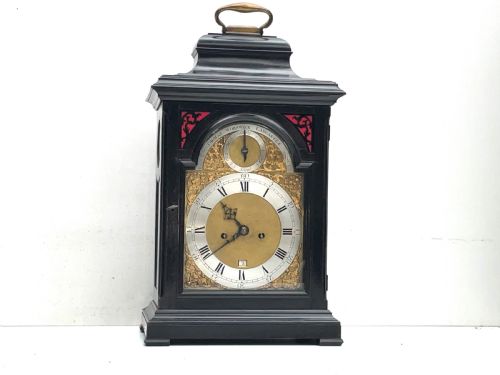


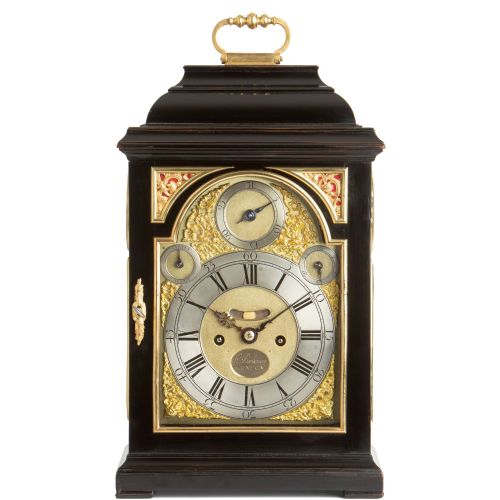


Bell Top Clock
A bell top clock is a table or bracket timekeeper housed in a distinct timber case, sought after for its mechanical complexity and period presence.
Bell Top Clock
A bell top clock sits firmly within the bracket and table clock category, taking its name from the domed profile of the timber case. The pieces appearing on this page span the 17th century, the Georgian era, the 18th century, and the 19th century, with occasional later examples from 1920.
Mahogany and ebonised wood dominate the housing materials for these bell top examples, alongside walnut and lacquered wood on specific variations. The form functions as a table timepiece, often featuring a verge escapement or fusee movement alongside the characteristic bell top silhouette.
Materials and movement
Makers construct these cases in mahogany, walnut, and ebonised wood, pairing timber bodies with brass dials, silvered metal chapters, and glass panels. Internal mechanics utilise iron and steel for components like verge escapements and twin chain automation fusee movements.
The characteristic shape relies on precise woodworking to form the curved dome summit. Metalwork components, including bells and hands, combine with brass dial plates to complete the mechanical structure.
Several makers named John Taylor operated in London, ensuring confusion for anyone trying to trace a single workshop.
Case and mechanism distinction
Distinction across these timepieces rests in the preservation of the original movement and the crispness of the timber case carving. Examples featuring signed brass dials by established makers hold greater distinction than anonymous pieces.
The complexity of the internal mechanism, such as quarter repeating functions or striking on multiple bells, separates standard timepieces from more intricate examples.
Samuel Tinham·Grey of Edinburgh·Somersall London·Andrew Marchant·William Withers·John Fletcher·John Taylor·Watson London·Benjamin Maud·Richard Peckover·James Evans·Isaac Hurley·Joseph Lum·Robert Brown·Comber of Lewes·John Richardson·Junghans
The Bell Top Clock Glossary
- Bell top
- A case style featuring a domed, bell-shaped upper section above the main body of the clock. This profile defines many Georgian table timepieces.
- Verge escapement
- An early type of clock mechanism regulating the speed using a crown wheel and pallet foliot or balance. It provides the traditional beat heard in 18th-century pieces.
- Fusee
- A conical pulley used in spring-driven clocks to maintain equal power as the mainspring unwinds. This mechanism ensures more accurate timekeeping throughout the daily run.
- Quarter repeating
- A complication mechanism that sounds the quarters and hours on demand via pull cords or levers. These movements require intricate internal gear trains.
Bell Top Clock: Frequently Asked Questions
What is a bell top clock?
A bell top clock is a portable table or bracket timepiece enclosed in a wooden case with a domed upper section. These pieces date primarily from the Georgian period and the eighteenth century.
The design allows the bell inside the dome to resonate clearly when the clock strikes the hours. Makers housed intricate verge or fusee movements within these distinct timber housings.
How do I identify a bell top clock?
Identification begins by examining the silhouette of the wooden case, specifically the curved, bell-shaped summit above the dial. Most examples utilise mahogany or ebonised wood.
Opening the case or checking the dial reveals signatures from makers such as John Taylor or Andrew Marchant. The presence of a brass dial with silvered metal details further confirms the period style.
Where were these clocks placed?
Owners placed these timepieces on brackets mounted to walls or directly onto table surfaces in principal rooms. Their portable nature allowed movement between rooms as needed.
Because they were designed to be viewed from multiple angles, the timber cases received fine finishing on all visible sides. The striking mechanism ensured the household could hear the time without needing to look at the dial.
What materials make up the cases?
Case construction relies heavily on mahogany, walnut, and ebonised wood, complemented by brass and glass elements. Interiors combine steel and iron for the gear trains and springs.
Some variations incorporate lacquered wood or Chinoiserie decoration. Dial faces typically combine brass backplates with silvered metal chapter rings for the numerals.