



Edwardian Marble Bust
These edwardian marble bust carvings bring classical presence and quiet dignity into a room, carved from fine stone with remarkable portrait detail.
Edwardian Marble Bust
When you search for an edwardian marble bust, you are looking at sculpted portraits created around the turn of the twentieth century. The pieces on this page span the 19th century, 1900, 1910, and the Edwardian period itself, capturing likenesses of young women, young ladies, gentlemen, and historical figures like Dante Alighieri and William Ewart Gladstone.
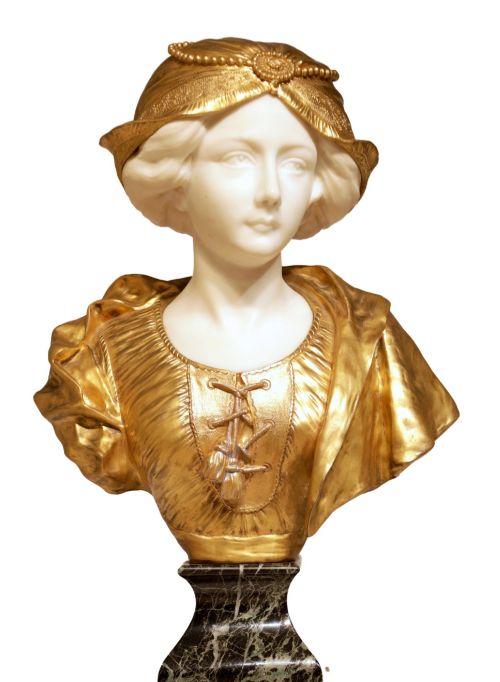
The form often includes a portrait head and shoulders mounted upon a stone or marble base, with some examples incorporating gilt bronze, ormolu, or contrasting onyx columns. Alongside solid marble, you will frequently encounter related materials such as alabaster, parian ware, bronze, and porcelain within these sculptural works.
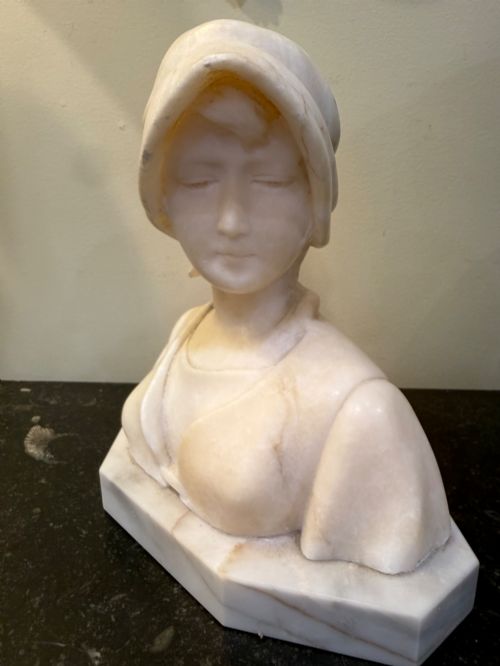
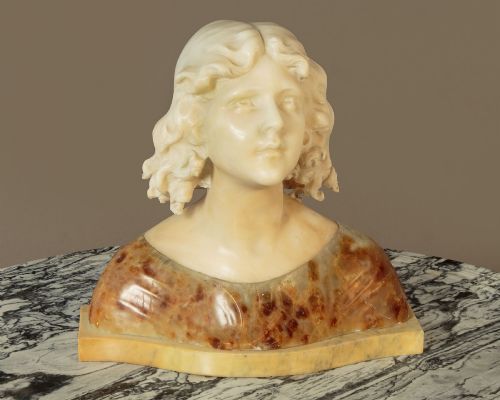
Stylistically, these pieces draw upon classical revival and neoclassical traditions, while others embrace Victorian, Arts and Crafts, or Art Nouveau sensibilities. You are most likely to meet delicate alabaster carvings of young women alongside more austere portrait busts of gentlemen from this era.
How they were made
Sculptors utilised traditional carving and chiselling techniques, sometimes pairing stone with cast metals or ceramic materials like parian ware and porcelain. The resulting portrait busts demonstrate a high degree of manual skill in finishing both the matte surfaces of the skin and the polished details of hair and drapery.
Edwardian Marble Bust Retail Price Guide 2026
Typical asking prices for edwardian marble bust among the pieces listed under this phrase on Sellingantiques today, from the lower quarter to the upper quarter. They describe what is for sale here now, not the wider market.
Dante Alighieri keeps a stony watch over proceedings, proving that even fourteenth-century poets appreciated a solid marble foundation.
What varies in quality
The distinction between a standard piece and a superior edwardian marble bust lies in the sensitivity of the carving and the subtlety of the facial expression. Master sculptors achieved a lifelike softness in the stone, whereas lesser examples can appear stiff or mechanical in their execution.
Material choice and base construction also influence the overall standard of the work, particularly where mixed media like gilt bronze, ormolu, and fine onyx columns are integrated. A well-balanced composition where the bust harmonises with its stone or marble base represents the upper tier of these sculptures.
Affortunato Gory·G.V. Vaerenbergh
The Edwardian Marble Bust Glossary
- Alabaster
- A fine-grained, translucent stone often used for sculptural portrait busts. It permits a soft handling of light across the carved surface.
- Ormolu
- Gilt bronze mounted onto or incorporated into sculptural works. This technique adds a warm metallic contrast to the pale stone.
- Parian Ware
- A fine-grained white porcelain developed in the nineteenth century to imitate carved marble. It was frequently used for portrait busts of public figures.
- Classical Revival
- An artistic movement drawing inspiration from ancient Greek and Roman art. Sculptures in this style often feature idealized forms and traditional drapery.
Edwardian Marble Bust: Frequently Asked Questions
What is an edwardian marble bust?
An edwardian marble bust is a carved sculptural portrait depicting a person's head, neck, and shoulders, produced around the early twentieth century. These pieces reflect classical traditions and portraiture styles popular during the Edwardian era.
They serve as decorative works of art, often displayed on pedestals, tabletops, or mantelpieces to add a touch of historical gravitas to an interior space.
How were these portrait busts displayed?
Historically, portrait busts were placed on dedicated columns, pedestals, or sturdy furniture to elevate them to eye level. This placement allowed viewers to appreciate the fine details of the carving from various angles.
In modern settings, they work well on strong wooden surfaces or dedicated stone plinths where their weight and sculptural form can be safely accommodated.
What materials are used besides marble?
While marble is prominent, these sculptures frequently utilise alabaster for a softer, translucent finish on portrait studies of young women and girls. Other examples incorporate bronze, gilt bronze, ormolu, onyx, parian ware, and porcelain.
Many pieces also pair the main carved bust with a contrasting stone base or column to provide structural support and visual balance.
How do I tell different periods apart?
Differentiating periods relies on observing stylistic cues, such as the flowing lines of Art Nouveau or the stricter symmetry of neoclassical and classical revival designs. Materials and costume details also offer clues, moving from Victorian severity toward Edwardian lightness.
Signatures or marks from makers inscribed on the stone or base can further help anchor a piece to a specific decade or workshop.