
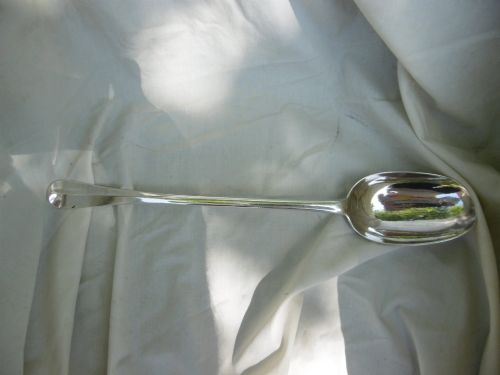


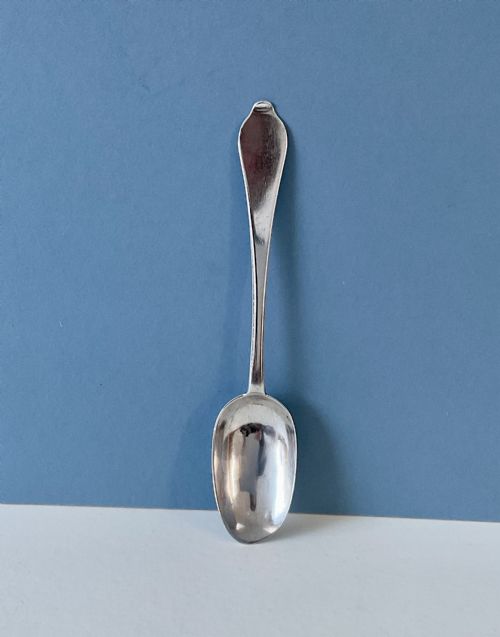


Early Georgian Silver Spoon
An early georgian silver spoon is a substantive piece of dining history, offering tactile connection to the domestic life of the eighteenth century through solid silver weight and classical proportion.
Early Georgian Silver Spoon
When you search for an early georgian silver spoon, you encounter objects spanning the reigns of Queen Anne, George I, and George II, alongside related items from the eighteenth century. These pieces include rat tail tablespoons, mote spoons, sifter spoons, marrow scoops, and large hash spoons made for formal dining.
The versions you are most likely to meet on this page range from plain provincial tablespoons to ornamented sifter spoons and marrow scoops. Origins stretch across English assay offices, including London, and extend to Scottish makers working in solid silver and Britannia standard metal.
Forms remain strictly utilitarian yet refined, following the evolution of flatware from early ridge-back designs to feather edge and Onslow patterns. Each object reflects the changing domestic requirements of wealthy households during the 1700s and early 1800s.
Materials and construction
An early georgian silver spoon is typically forged from sterling silver or the higher-purity Britannia silver standard mandated in the earlier decades of the eighteenth century. Metalsmiths hammered and shaped the solid silver ingots by hand, creating thick stems and reinforced bowls designed to withstand daily use.
Specialised forms such as rat tail tablespoons incorporate a distinctive reinforced ridge down the back of the bowl for structural strength. Piercing and chasing appear on later sifter spoons and berry serving spoons, executed with hand tools to achieve scallop shell motifs and feather edge borders.
Judging quality and integrity
The distinction between ordinary and superior pieces rests on the crispness of hallmarks, the retention of original bowl shape, and the degree of wear to the stem. Heavy gauge silver that resists bending at the narrowest point of the shank indicates a higher standard of manufacture.
Later embellishments, such as Victorian chasing applied to an earlier eighteenth-century spoon, alter the historical integrity of the piece. Surviving examples with legible maker's marks, original rat tails, and unthinned bowls represent the upper tier of what is available.
Andrew Archer·Jeremiah Lee·James Tait
The Early Georgian Silver Spoon Glossary
- Rat tail
- A narrow, tapering tongue of metal extending down the back of the spoon bowl from the handle, providing extra structural reinforcement.
- Britannia silver
- A higher standard of silver purity introduced by law in England, containing ninety-five point eight percent pure silver.
- Mote spoon
- A small eighteenth-century spoon with a pierced bowl used for skimming tea leaves, featuring a sharp pointed terminal.
- Sifter spoon
- A spoon with a perforated bowl designed for dusting sugar over food, frequently decorated with shell and feather edge motifs.
- Marrow scoop
- A narrow, double-ended spoon designed for extracting marrow from bones, common on formal eighteenth-century dining tables.
Early Georgian Silver Spoon: Frequently Asked Questions
How do I clean an old silver spoon?
Wash the silver gently in warm water using mild soap and a soft cloth, avoiding abrasive dips that strip the natural patina accumulated over centuries.
Dry the spoon thoroughly with a lint-free towel to prevent water spots and store it away from rubber or high-sulfur environments.
Were these spoons used for daily dining?
Wealthy households utilised these solid silver spoons for formal dining, tea service, and serving large portions of food at the table.
Their heavy gauge metal ensured they could endure regular service, though many survived due to being kept as household valuables.
What is the difference between Britannia and sterling silver?
Britannia silver contains a higher proportion of pure silver by weight than standard sterling silver, leading to a slightly softer metal.
Parliament mandated this higher standard for a period in the early eighteenth century to discourage the melting down of coinage.
How can I tell the date of a spoon?
Maker's marks, date letters, and assay office stamps struck directly into the metal provide the primary evidence for dating an eighteenth-century piece.
Stylistic shifts, such as the transition from rat tail bowls to feather edge handles, also help narrow down the period of manufacture.