
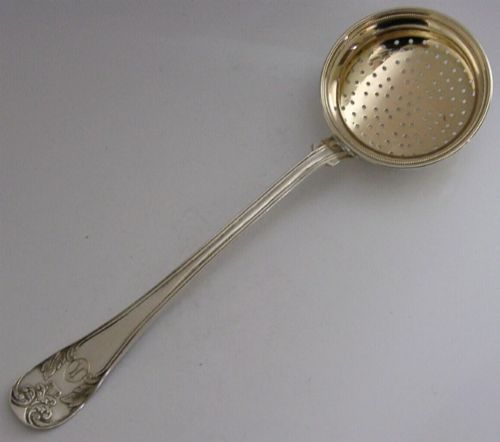


Silver Strainer Spoon
These silver strainer spoon examples combine functional liquid separation with period craftsmanship, offering collectors both historical table utility and fine metalwork.
Silver Strainer Spoon
A silver strainer spoon is a specialised piece of tableware designed to separate solids from liquids during service, appearing across Georgian, Victorian, and later periods. These utensils combine the properties of a standard spoon with a pierced bowl or an inserted strainer mechanism, serving functions ranging from tea preparation to gravy and sugar sifting.
The most common forms you will encounter on this page include mote spoons from the eighteenth century, large basting and serving strainers from the Georgian era, and various tea infuser spoons. They appear in sterling silver, solid silver, and silver plate, reflecting the shifting dining and beverage customs of British, Irish, continental European, and Scandinavian makers.
How they were made
Makers fashioned these pieces primarily from sterling silver, solid silver, and silver gilt using traditional smithing techniques such as hammering, casting, and piercing. Bowls were meticulously hand-pierced with slotted, floral, or geometric patterns to allow liquid to pass while retaining tea leaves, fruit, or sugar crystals.
Handles and stems often utilised the Old English or Celtic pattern, sometimes featuring fancy backs on eighteenth-century examples. Surface enrichment included partial gilt or vermeil finishes, particularly on continental European tea and serving sets from the nineteenth century.
Listings feature items spanning the eighteenth, nineteenth, and twentieth centuries, including Georgian and Victorian periods.
What varies in quality
The quality of a silver strainer spoon is determined by the crispness of the hand-pierced work in the bowl and the preservation of original hallmarks and makers' marks. Fine examples display uniform piercing patterns that remain structurally sound without distortion from heavy use or aggressive cleaning over centuries.
Substantial gauge metal, balanced weight in the hand, and well-defined decorative motifs such as fancy backs or engraved crests distinguish superior pieces from standard utilitarian wares. The survival of original gilding on silver gilt items also significantly elevates the desirability of the piece.
Jeremiah Lee·Philippe Berthier Paris·Liberty and Co
The Silver Strainer Spoon Glossary
- Mote spoon
- An eighteenth-century narrow spoon with a pierced bowl used to clear tea leaves from the cup, often featuring a pointed tip for cleaning the spout of a teapot.
- Basting spoon
- A large serving utensil adapted with a strainer partition or pierced bowl to separate pan juices from solid elements during meat service.
- Silver gilt
- Silver objects that have been coated with a thin layer of gold on the surface, also known as vermeil.
- Fancy back
- A decorative motif cast or embossed on the reverse of the spoon bowl junction, popular on Georgian flatware.
- Old English pattern
- A traditional eighteenth-century flatware design characterised by a rounded end curving downwards and a distinct drop where the stem joins the bowl.
Silver Strainer Spoon: Frequently Asked Questions
What is a silver strainer spoon used for?
These spoons served specific culinary tasks like skimming tea leaves, straining gravy, or sifting sugar. Their pierced bowls allowed liquid to drain while retaining solid ingredients at the table.
Different designs corresponded to evolving dining habits. Smaller mote and infuser spoons handled tea service, while larger basting spoons managed roasted meats.
How do I date an antique silver strainer spoon?
Dating relies heavily on official hallmarks stamped into the metal, which indicate assay offices, production years, and maker marks. Stylistic clues such as handle patterns and bowl shapes also help narrow down the period.
Eighteenth-century examples often feature mote designs and fancy backs, whereas Victorian and Edwardian pieces show different manufacturing stamps and heavier gauges.
Are silver strainer spoons safe to use?
Most solid silver and sterling items remain structurally robust for gentle modern use, provided they receive proper hand washing. Avoid abrasive cleaners that can wear down delicate pierced bowl designs.
Collectors often balance occasional functional use with careful preservation, especially for fragile silver gilt or eighteenth-century pieces.
What is the difference between a strainer spoon and a tea strainer?
A strainer spoon combines the function of a ladle or spoon with an integrated pierced bowl for dual-purpose serving and straining. A traditional tea strainer is typically a standalone mesh basket resting on a cup.
Many Victorian and Edwardian dining sets included spoons alongside separate strainers, while specialised infuser spoons combined both functions into one tool.