
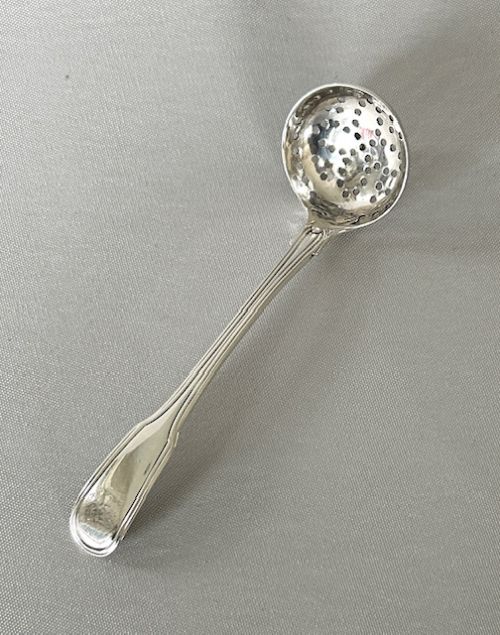
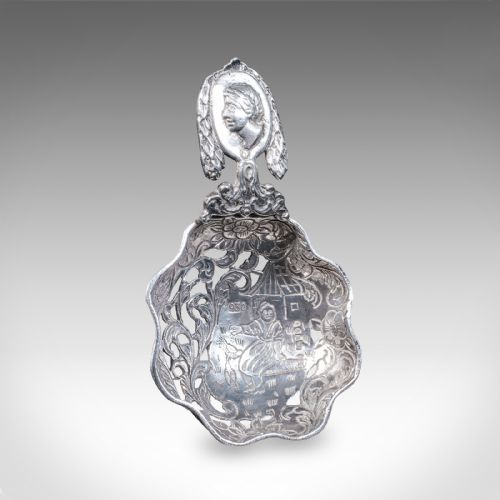


Antique Pierced Sifter Spoon
An antique pierced sifter spoon is a functional piece of tableware designed for dusting powdered sugar or spices, prized for its decorative bowl perforations.
Antique Pierced Sifter Spoon
When you search for an antique pierced sifter spoon, you encounter small serving implements designed specifically for scattering sugar, spice or fruit. These items appear across Georgian, Regency and Victorian periods, taking forms such as spice sifting spoons, sugar casting spoons and caddy spoons.
The versions most commonly met on this page include sterling silver and silver plate examples originating from London, Chester and continental European centres like Paris and the Netherlands. Certain pieces are accompanied by glass bowls, leather cases lined with velvet and silk, or gold gilt finishes.
Makers and silversmiths shaped these tools to handle dry pantry goods during tea service and dessert courses. The presence of import hallmarks and specific assay office marks helps date the work to distinct decades between the eighteenth and twentieth centuries.
How they were made
Silversmiths forged these implements using sterling silver and silver plate, frequently incorporating gold gilt to line the bowls of the spoons. Piercing work was executed by hand, sawing intricate patterns into the metal bowl to allow fine powders or juices to pass through.
Some groupings include complementary materials such as cranberry glass for bowls, alongside fitted cases finished in leather, velvet and silk. These protective housings indicate how carefully the cutlery was stored between formal dining occasions.
What varies in quality
The standard of the metalwork defines the upper tier of these spoons, particularly the precision and symmetry of the hand-pierced bowl design. Crisp hallmarks stamped clearly by assay offices indicate formal manufacturing oversight.
Completeness also dictates value, where an antique pierced sifter spoon retaining its original fitted leather and velvet case ranks distinctly above a loose utensil. The integration of high-grade materials like gold gilt and coloured glass elevates individual examples.
The Antique Pierced Sifter Spoon Glossary
- Pierced
- Perforated with holes or slots cut into the metal. This technique allows powders like sugar or spices to sift evenly over food.
- Sterling silver
- An alloy containing ninety-two point five percent silver and seven point five percent other metals, usually copper. It provides durability for fine tableware.
- Hallmark
- An official stamp or series of marks applied to precious metals. It indicates the maker, standard of purity, assay office and year of production.
- Caddy spoon
- A short-handled spoon specifically sized to measure loose tea leaves from a canister. Many share forms with spice sifting implements.
- Gold gilt
- A thin layer of gold applied to the surface of silver. It protects the base metal from tarnishing when exposed to acidic foods.
Antique Pierced Sifter Spoon: Frequently Asked Questions
What is an antique pierced sifter spoon used for?
These spoons were utilised at the dining table to sprinkle powdered sugar onto desserts, fruit or pastries. They were also employed for dusting dry spices from small containers.
The perforated bowl held back larger lumps while letting the fine powder sift through evenly.
How do I date a silver sifter spoon?
Dating relies heavily on the assay office hallmarks stamped into the metal surface. Different letter codes and shapes correspond to specific years of manufacture.
Stylistic cues such as Georgian curves or Victorian ornamentation also help narrow down the period.
Are caddy spoons the same as sifter spoons?
While both are small antique spoons, caddy spoons were made to measure loose tea leaves. Sifter spoons feature perforated bowls designed explicitly for scattering powder.
Some historical examples overlap in size and form due to similar domestic uses.
How should I display silver sifter spoons?
These small utensils store neatly inside glass-fronted cabinets or flatware trays lined with protective cloth. Some examples are displayed alongside matching sugar bowls in fitted presentation cases.
Keeping them away from damp environments prevents tarnishing of the silver.
What periods do these silver spoons come from?
The listings span several distinct eras including the Georgian, Regency and Victorian periods. Pieces range chronologically from the late eighteenth century into the early twentieth century.
European workshops from France, the Netherlands and Britain contributed to this variety.