
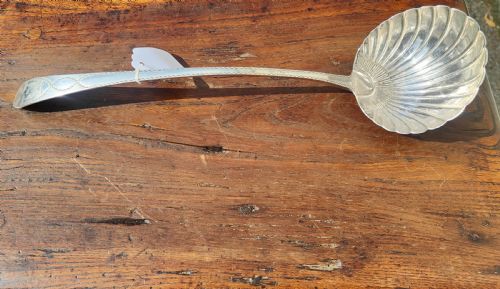


Silver Shell Ladle
These silver shell ladles combine practical serving utility with fine decorative bowls, forming a traditional addition to any dining table.
Silver Shell Ladle
A silver shell ladle serves various liquids and dry items at the table, taking the form of soup ladles, sauce ladles, gravy ladles, caddy spoons, and sifter spoons. The bowl typically resembles a scallop shell, providing both function and a distinct coastal or classical motif.
Examples originate from the 18th century, the Georgian period, the Victorian era, the Edwardian period, and French Restoration contexts. Makers utilised patterns such as Onslow, Colonial, and Fiddle, Thread & Shell alongside plain or scrollwork handles.
Buyers will encounter items ranging from early Georgian soup ladles dated to the 1700s up to later Victorian and Edwardian serving utensils. Irish and English pieces appear frequently, alongside French silver sifter spoons from the early nineteenth century.
How they were made
Silversmiths constructed these utensils primarily from sterling silver, solid silver, or silver plate, hammering and shaping the metal to form the bowl and handle. The shell bowls often feature detailed fluting or chased lines radiating from the base.
Handles were cast or hand-wrought, incorporating patterns like Fiddle, Thread & Shell or Onslow motifs soldered securely to the bowl. Piercing was applied to sifter spoons and strainer spoons to allow liquids to drain during service.
Some Victorian sifter spoons possess pierced bowls intended to leave behind tea leaves while letting the fragrant liquid pass through.
What varies in quality
The weight of the metal and the crispness of the chasing separate standard items from heavier, presentation-grade pieces. Soup ladles carrying maker marks from prominent workshops display superior balance and more intricate handle detailing.
The definition within the shell bowl fluting and the sharpness of engraved crests or scrollwork indicate the skill of the original silversmith. Pieces retaining clear hallmarks and robust handle joins represent the higher end of the range.
Michael Smith·TIFFANY & CO.·Paul Storr·Chawner & Co
The Silver Shell Ladle Glossary
- Sifter spoon
- A spoon with a pierced bowl used for dusting sugar or straining solids from liquids. These often appear in Victorian and Edwardian serving sets.
- Caddy spoon
- A short spoon designed for measuring tea leaves from a caddy. Georgian examples frequently feature shell-shaped bowls.
- Onslow pattern
- A silver handle design featuring a scrolled scroll terminal that curls over backwards. This style dates back to the Georgian period.
- Fiddle, Thread & Shell
- A traditional cutlery pattern featuring a fiddle-shaped stem, a raised thread border, and a shell motif at the terminal. It appears on numerous Victorian gravy and soup ladles.
- Hallmark
- An official stamp applied to silver items indicating the assay office, standard of purity, and date of manufacture. These marks help verify the period of origin.
Silver Shell Ladle: Frequently Asked Questions
What is a silver shell ladle used for?
These utensils serve soups, gravies, sauces, or dry items like tea and sugar depending on the specific bowl shape and size. Soup variants handle liquids at the dining table, while smaller caddy or sifter versions manage condiments.
The shell-shaped bowl assists with pouring and transferring portions neatly from a tureen or dish to a plate.
How do I identify a Georgian silver ladle?
Georgian pieces carry hallmarks indicating manufacture during the reigns of the Georges, typically between 1714 and 1830. Look for clear town marks, lion passants, and date letters stamped into the silver.
Stylistic elements like Onslow patterns or feather edging also point toward this 18th-century period of production.
Can I use antique silver ladles daily?
Solid silver and sterling silver utensils are durable enough for regular dining use provided they receive proper hand washing. Avoid harsh detergents and abrasive scourers to preserve the surface finish and hallmarks.
Storing them in soft rolls prevents scratching against other cutlery in the drawer.