
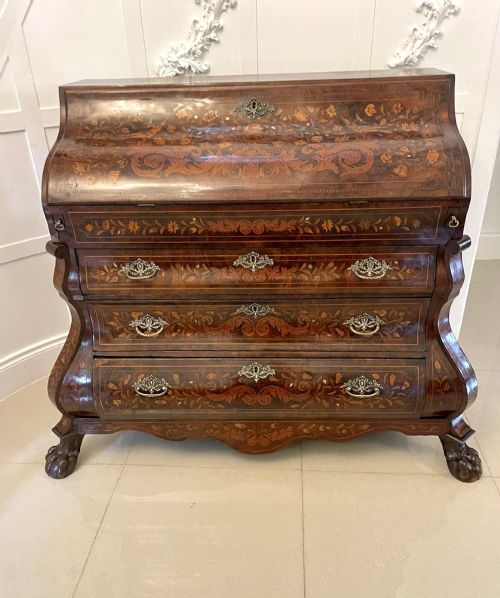
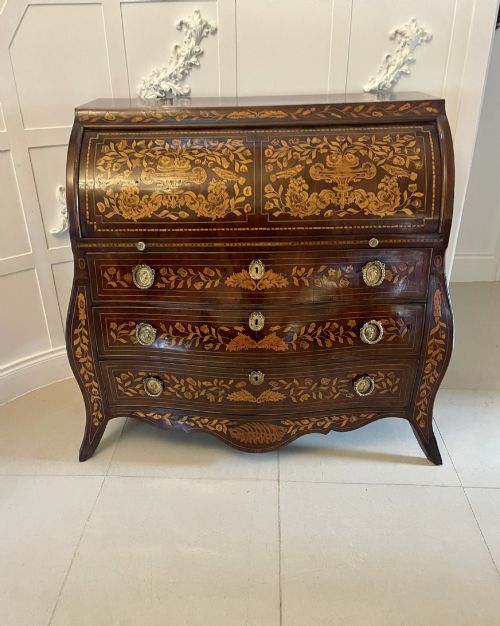

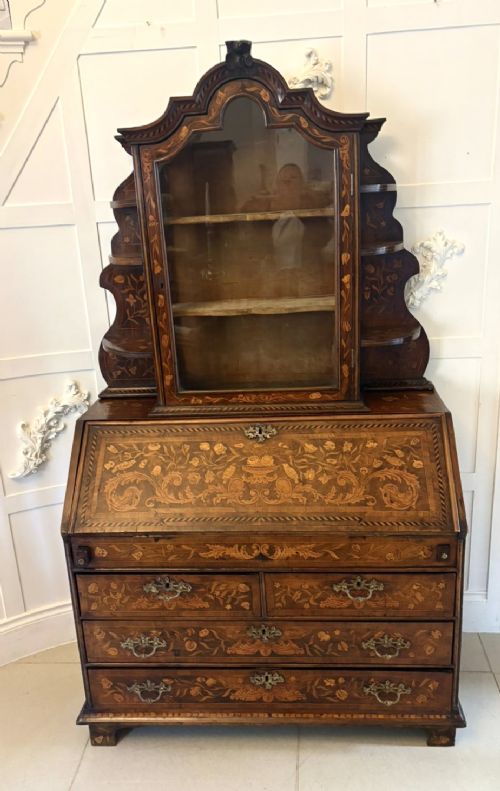


Dutch Inlaid Writing Cabinet
These dutch inlaid writing cabinet pieces combine architectural presence with intricate floral marquetry, offering a serious workspace wrapped in exceptional artistry.
Dutch Inlaid Writing Cabinet
A dutch inlaid writing cabinet brings together substantial storage and a dedicated writing surface, most frequently appearing as a bureau bookcase or fall front escritoire. The pieces on this page span the eighteenth century into the nineteenth century, showing forms from bombe fronted shapes to straight block front carcases. Walnut and burr walnut dominate the structural timbers, providing a dark, richly grained canvas for lighter decorative work.
The decorative identity of a dutch inlaid writing cabinet rests entirely on elaborate floral marquetry executed in fruitwood. Makers set these botanical designs across sloping falls, drawer fronts, and tall bookcase doors, creating a dense pattern of leaves and blooms. Forms range from compact desks to towering bureau bookcases designed to command an entire wall.
Dating primarily from the eighteenth century, these items also include later nineteenth-century interpretations and early twentieth-century examples. The underlying construction relies on solid oak and mahogany for carcases and interior fittings alongside the primary walnut veneers. Buyers encounter both simple sloping bureau desks and complex secretaire cabinets equipped with multiple internal compartments.
Materials and construction
The foundational carcase of a dutch inlaid writing cabinet relies on sturdy timber such as oak or mahogany to support heavy book collections and internal drawers. Walnut and burr walnut form the principal visible surfaces, chosen for their deep tone and lively grain patterns. Fruitwood provides the contrasting medium for detailed floral inlay work, offering pale tones that stand out sharply against the darker background veneer.
Marquetry technique involves painstakingly cutting fine slices of fruitwood and fitting them together into complex floral motifs before gluing them onto the cabinet exterior. Cabinetmakers shape structural elements like the characteristic bombe profile by layering timber and shaping the curves of the front and sides. Brass hardware, including keyplates and drop handles, finishes the construction and secures the fall fronts and cabinet doors.
Listings feature walnut, burr walnut, and mahogany carcases decorated with fruitwood marquetry, spanning the eighteenth and nineteenth centuries.
Judging quality and execution
Quality in a dutch inlaid writing cabinet lies in the density and precision of the fruitwood marquetry across the entire elevation. Superior examples display crisp floral shading and tight joints within the veneer work, whilst lesser pieces show simpler, sparse inlay patterns. The depth and visual movement of the burr walnut ground further separate standard items from the finest cabinetwork.
Architectural proportion and structural ambition dictate the upper tier of these pieces, particularly where bombe shaping meets intricate internal stationery fittings. The preservation of original brass mounts and the crispness of carved mouldings around bookcase doors indicate higher standards of workshop production. A successful composition balances the heavy visual weight of the floral decoration with clean lines in the primary carcase.
The Dutch Inlaid Writing Cabinet Glossary
- Marquetry
- Decorative veneer work assembled from pieces of wood to form pictorial or floral designs on a furniture surface. This technique distinguishes the elaborate fronts of these cabinets.
- Bombe
- A swollen or bulging profile characteristic of certain eighteenth-century furniture forms. This curved shaping adds significant volume and visual drama to the lower section of a bureau.
- Escritoire
- A writing cabinet featuring a fall-front writing surface that conceals small drawers and pigeonholes. It serves as a refined alternative to the standard bureau desk.
- Bureau bookcase
- A dual-purpose furniture form combining a sloping desk base with an upper glazed or panelled shelving unit. These tall structures dominate domestic interiors.
- Fruitwood
- Dense, fine-grained timber derived from fruit-bearing trees, used extensively for contrasting inlay work. Its pale colour allows for clear pictorial detailing against darker veneers.
Dutch Inlaid Writing Cabinet: Frequently Asked Questions
How do I use a bureau desk safely?
Open the sloping fall front cautiously, ensuring the internal support lopers are fully extended to bear the weight of the writing surface. Avoid placing heavy objects near the outer edges of the open flap.
Keep the timber conditioned by placing the cabinet away from direct heat sources and sudden temperature fluctuations. Regular dusting with a dry, soft cloth preserves the delicate fruitwood marquetry.
What is a bombe front?
A bombe front describes a furniture design where the wood curves outward in a pronounced swelling shape from top to bottom. This technique requires expert carpentry to ensure the drawers operate smoothly within the curved carcase.
Cabinetmakers working in the eighteenth century utilised this form to create a sense of movement and volume. It remains a defining feature of high-status Dutch case furniture.
How do I distinguish eighteenth-century pieces?
Examine the secondary timbers inside the drawers, where eighteenth-century examples typically employ solid oak rather than later pine or modern boards. Hand-cut dovetails and irregular plank widths also signal early construction methods.
The complexity and natural fading of the walnut and fruitwood marquetry provide further clues to age. Later nineteenth-century revivals often display brighter, more uniform stain colours across the timber.
Where should I place a bureau bookcase?
Position the cabinet against a sturdy interior wall away from direct sunlight to prevent fading of the burr walnut and fruitwood veneers. Because these pieces are tall and deep, ensure the floor surface is level for stability.
Allow sufficient clearance in front of the piece for the writing flap to open fully and for a chair to fit comfortably. A room with stable humidity levels helps protect the historical joints and marquetry.