


Decorative Oriental Plaque
A decorative oriental plaque brings striking colour and meticulous craftsmanship into a room, offering a rich window into nineteenth-century Japanese and Chinese artistry.
Decorative Oriental Plaque
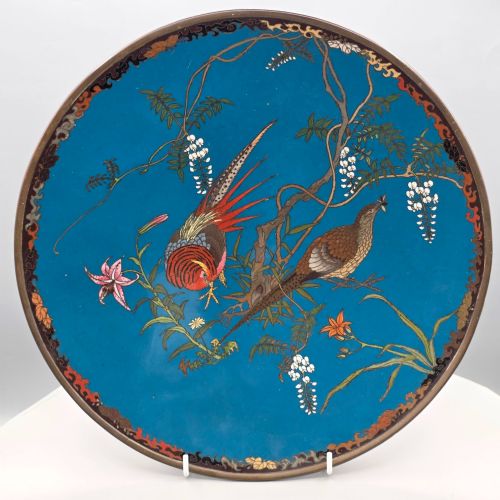
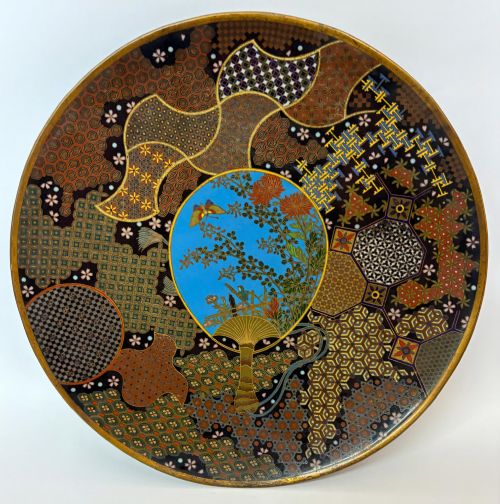
A decorative oriental plaque encompasses an array of chargers, trays, dishes, and wall panels originating from Japan and China. The selection on this page leans heavily towards Japanese cloisonné enamel chargers from the Meiji period, alongside Chinese lacquered panels, carved wooden plaques, and Imari porcelain plates.
Forms range from compact dishes measuring a modest width up to massive chargers spanning fifty centimetres across. Buyers will find items designed for display, including pieces bearing signatures, workshop styles such as Komai, and period marks that trace back through Victorian times into the Qing dynasty.
The subjects depicted on these surfaces draw heavily from the natural world and traditional folklore. Birds, fish such as leaping koi, dragons, samurai, and auspicious symbols appear frequently across copper, bronze, brass, and porcelain bodies.
How they were made
Cloisonné enamel pieces rely on fine metal wires soldered onto copper or brass bases to form delicate cells, which are then filled with coloured vitreous pastes and fired. This technique allows for intricate depictions of flora and fauna, such as chrysanthemums and ibis, held within crisp metallic outlines.
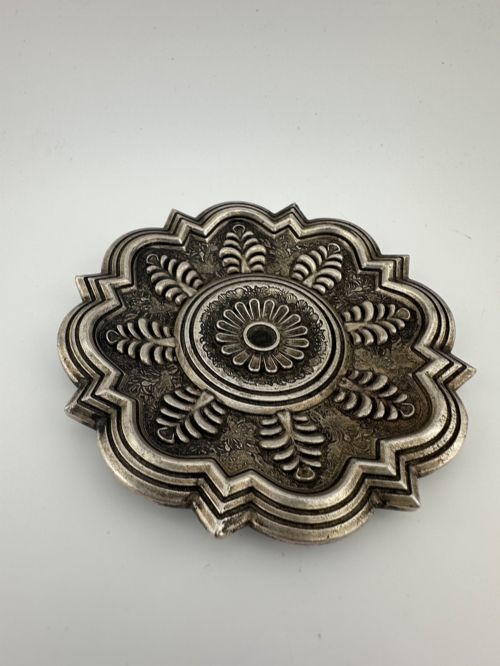
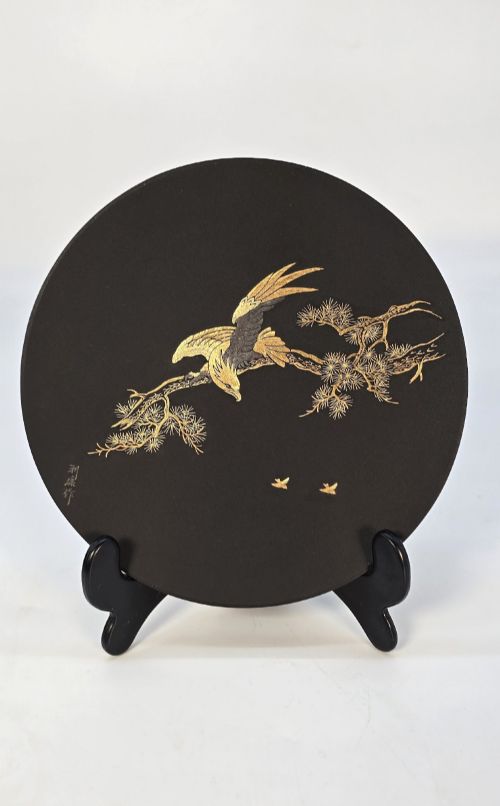
Lacquered and wooden panels employ intricate carving and inlay techniques, often incorporating mother-of-pearl, abalone, and metal foil to build up layered pictorial scenes. Meanwhile, metalwork items utilise patinated iron, bronze, or white metal enriched with gold and silver inlay.
Porcelain and pottery chargers are hand-painted under and over glaze, seen clearly in the deep cobalt blues and iron reds characteristic of Imari wares. Each medium demands high technical discipline from the artisan, whether working with molten enamel, hardening lacquer, or high-fired ceramic.
Listings feature works in cloisonne enamel, copper, brass, bronze, porcelain, wood, and lacquer, spanning the Victorian era, Meiji period, and Qing dynasty.
What varies in quality
The mastery of the artisan dictates the clarity and depth of the finished design. In cloisonné work, the thinness and precision of the wirework alongside the evenness of the polished enamel surface separate standard output from exceptional output.
Surface detailing and material richness also define the upper tier of these objects. Pieces featuring complex mixed-metal inlays, meticulous hand-painting, or signed maker details demonstrate a higher level of workshop commitment than mass-produced export goods.
Condition and scale influence desirability, particularly with large chargers and matched pairs of panels. Surviving examples that retain their original patination, vibrant enamel without major loss, and crisp wood carving command greater attention from collectors.
The Decorative Oriental Plaque Glossary
- Cloisonne Enamel
- A metalwork technique where fine wires create raised compartments on a base to hold coloured glass pastes before firing. This method produces intricate, colourful designs across chargers and plates.
- Charger
- A large decorative plate or dish traditionally intended for display on a sideboard or wall rather than for dining use. These large surfaces often showcase the most ambitious artistic work.
- Imari
- A style of Japanese porcelain featuring distinctive underglaze blue and overglaze iron red and gold decoration. These colourful plates and chargers were widely exported to the West.
- Meiji Period
- The era in Japanese history spanning from eighteen sixty-eight to nineteen twelve, noted for opening trade with the West and producing exceptional metalwork and enamel pieces. Works from this time display extraordinary technical ambition.
- Patinated Iron
- Metal treated with chemical solutions to produce an aged or coloured surface finish. Artisans often combined this dark ground with gold and silver inlay.
Decorative Oriental Plaque: Frequently Asked Questions
How do I hang a heavy charger?
Large chargers require robust wall mounting systems that distribute weight safely across the rim or base. Adjustable spring-loaded brass wall hangers designed specifically for heavy plates are commonly utilised by collectors.
Ensure the fixing engages securely with a wall stud or appropriate anchor to support heavy bronze or cloisonne pieces safely.
What does Meiji period mean?
The Meiji period refers to the era of Japanese history under Emperor Meiji lasting from eighteen sixty-eight to nineteen twelve. This period saw a flourishing of decorative arts aimed at international export exhibitions.
Objects from this era, particularly cloisonne and mixed-metal work, are celebrated for their supreme technical precision and intricate detail.
How do I clean antique enamel?
Antique enamel benefits from gentle dusting with a soft, dry microfibre cloth to remove surface particles. Avoid chemical cleaning agents, abrasive cloths, or immersion in water, which can damage exposed metal wires or aged backing materials.
Maintaining a stable indoor humidity helps protect both the metallic and vitreous components of the piece over time.