
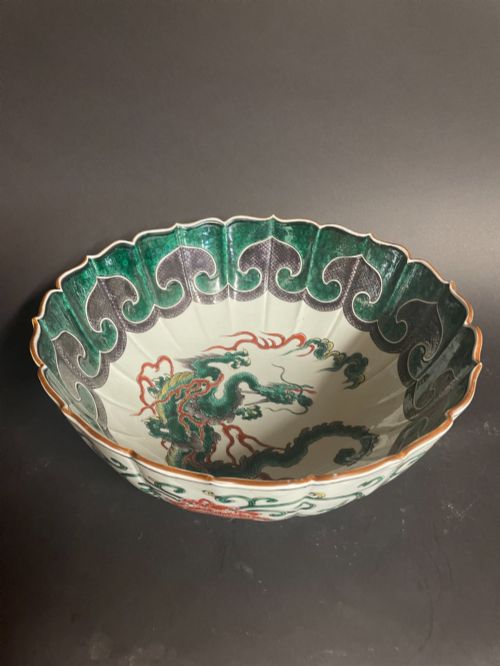


Japanese Dragon Dish
A Japanese dragon dish brings fierce mythological energy to a room, rendered in cloisonne enamel, porcelain, or mixed metal.
Japanese Dragon Dish
A Japanese dragon dish represents a traditional decorative form featuring coiled dragons, created primarily as chargers, plates, trays, and bowls. When you search for a Japanese dragon dish, you encounter substantial decorative chargers and smaller cabinet pieces spanning the late Edo period through the Meiji period and Victorian era.
The objects on this page bridge several distinct aesthetic traditions, from Imari porcelain to intricate cloisonne enamel worked with brass or silver wire. Most examples originate from the latter half of the nineteenth century, showcasing the meticulous metalwork and ceramic painting typical of Japanese export arts from that era.
How they were made
Makers constructed cloisonne enamel pieces by soldering delicate brass wire or silver wire to a copper or bronze base to outline the dragon motif, then filling the resulting cells with coloured enamel pastes before firing and polishing. Other examples employ porcelain bodies painted in traditional Imari palettes, or utilise mixed-metal inlays on brass.
The technical execution required immense precision, particularly when fusing enamel across large surface areas like chargers or forming intricate single-dragon compositions without surface flaws.
The listings show materials spanning copper, brass, porcelain, and bronze, dominated by cloisonne enamel works from the Meiji and late Edo periods.
What varies in quality
Quality in these pieces rests upon the crispness of the wirework and the depth of the enamel colours, alongside the naturalistic movement of the dragon itself. Master-level works display complex scaling and tightly controlled cell-work that commands the eye across the entire charger.
Scale and ambition separate standard decorative wares from exceptional productions, with larger signed chargers and pieces employing mixed-metal techniques showing superior artistic commitment.
The Japanese Dragon Dish Glossary
- Charger
- A large decorative plate or dish intended for display on a wall or stand rather than for dining. These substantial pieces often measure over thirty centimetres across.
- Cloisonne Enamel
- A technique where metal wires are applied to a metal body to create compartmentalized cells filled with vitreous enamel. The piece is subsequently fired and polished to a smooth finish.
- Imari
- A style of Japanese porcelain decorated in underglaze blue and overglaze red, gold, and green. This palette originated during the Edo period and remained popular through the Meiji era.
- Meiji Period
- The era of Japanese history lasting from 1868 to 1912, marked by the opening of trade with the West and a flourishing of decorative arts. Many export pieces date from this time.
- Mixed-Metal
- An alloy technique combining metals such as brass, bronze, and copper to create varied colour contrasts within a single decorative scene. It appears on specialised trays and dishes.
Japanese Dragon Dish: Frequently Asked Questions
How do I display a large dragon charger?
These decorative chargers suit heavy-duty wall brackets or sturdy tabletop stands that support their substantial weight.
Ensure the mounting hardware secures the rim safely without obscuring the dragon motif across the centre.
Are these dishes meant for food use?
Antique examples function strictly as decorative objects rather than tableware.
Enamel surfaces and older ceramic bodies can sustain damage from moisture, cutlery, and acidic foods.
How do I distinguish Meiji period pieces?
Meiji pieces date from 1868 onwards, coinciding with a surge in Japanese export manufacturing.
They frequently feature highly detailed cloisonne enamel work and complex dragon iconography tailored for Western collectors.
What is the significance of the dragon motif?
Dragons in Japanese art symbolize water, rain, wisdom, and benevolent power.
Artists rendered them coiled dynamically across dishes to convey movement and spiritual protection within the home.