


Claw Foot Settee
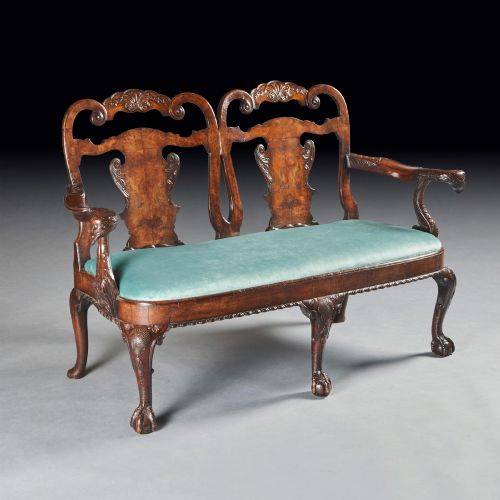
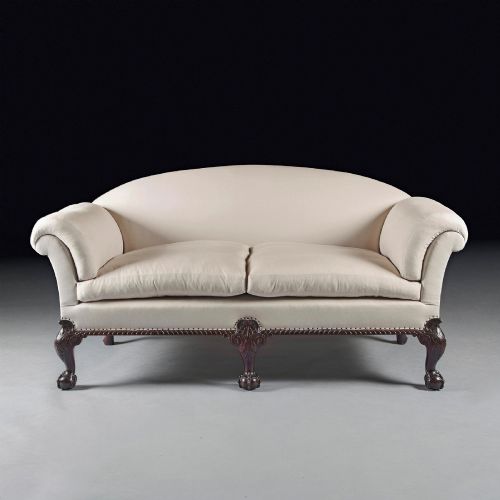
These claw foot settee examples bring robust timber frames and carved animal foot supports into a room.
Claw Foot Settee
A claw foot settee combines seating frames with carved foot terminals shaped like talons or paws, spanning forms from single-bench settees to expansive lounge suites. Buyers searching for a claw foot settee encounter pieces dating from the eighteenth century through to the early twentieth century.
Makers such as Howard and Sons appear among the listings, often paired with deep-seated constructions and upholstered finishes in cotton calico, leather, velvet, and damask fabric. The typical form rests securely on ball and claw or lion paw feet carved directly into the wooden framework.
How they were made
Makers shaped these settees from solid hardwoods including mahogany and walnut, employing hand-carving techniques to detail the wooden frames and terminal feet. Craftsmen translated traditional George II and Chippendale motifs into structural supports that bear the weight of the seating.
Upholstery methods involved securing supportive layers beneath fabrics such as leather, velvet, damask, and cotton calico. Structural joins and carved ball and claw or lion paw details demanded precise woodworking skills to ensure stability across double-seat and multi-back sofa configurations.
Listings feature mahogany and walnut timbers paired with leather, velvet, and cotton calico upholstery across Victorian and Edwardian periods.
What varies in quality
The standard of carving defines the distinction between standard production and top-tier examples, particularly in the execution of the claw and ball or lion paw feet. Crisp detail in the wooden talons and substantial timber thickness elevate the overall presence of the settee.
The integrity of the original wood and the quality of the chosen upholstery materials, whether fine leather, damask, or velvet, shape the physical weight and visual balance of the suite. Superior construction ensures the frame remains rigid and supportive across the arms and backrests.
Howard and Sons
The Claw Foot Settee Glossary
- Chippendale
- A style originating from eighteenth-century design traditions featuring intricate wood carving and classical proportions. This aesthetic reappears in various nineteenth-century revival pieces.
- Ball and claw
- A foot motif where carved talons grasp a spherical ball, commonly rendered in mahogany or walnut. This detail anchors the base of many period settees.
- Aesthetic Movement
- A late nineteenth-century design approach prioritising visual and artistic qualities over strict historical revival. Pieces from this movement often incorporate distinctive fabrics and decorative schemes.
- Cotton calico
- A plain-woven cotton textile frequently utilised as an underlying upholstery layer or primary covering on period seating. It provides a durable foundation for more decorative outer fabrics.
- Damask
- A reversible figured fabric woven with patterns that catch the light, often selected for formal Victorian and Edwardian upholstery. It adds a textured surface to lounge suites.
Claw Foot Settee: Frequently Asked Questions
What periods do these settees span?
The listings encompass items from the eighteenth, nineteenth, and early twentieth centuries, capturing various revival movements.
Victorian and Edwardian interpretations sit alongside earlier Georgian-inspired designs and later mahogany pieces.
How do ball and claw feet differ from lion paws?
Ball and claw motifs feature avian talons clasping a wooden sphere, inspired by Eastern design influences adopted by European cabinetmakers.
Lion paw feet present a heavy feline form with distinct toe carving, frequently seen on robust Victorian walnut frames.
What fabrics are used for upholstery?
Original and period-appropriate coverings include cotton calico, stamped damask, smooth leather, and rich velvet.
Chinoiserie textiles also appear on select Aesthetic Movement pieces alongside standard woven fabrics.
Are these settees part of larger suites?
Several entries comprise complete lounge suites containing matching armchairs alongside the main sofa.
Other listings offer standalone twin-chair back settees or double-seater library sofas designed for individual placement.