

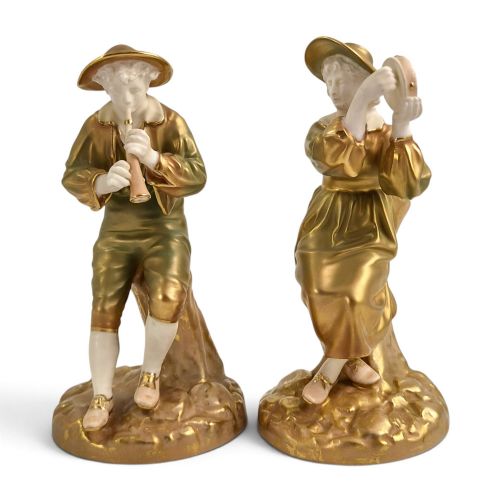
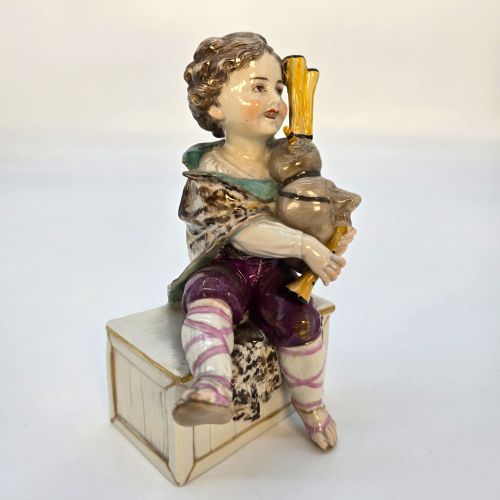

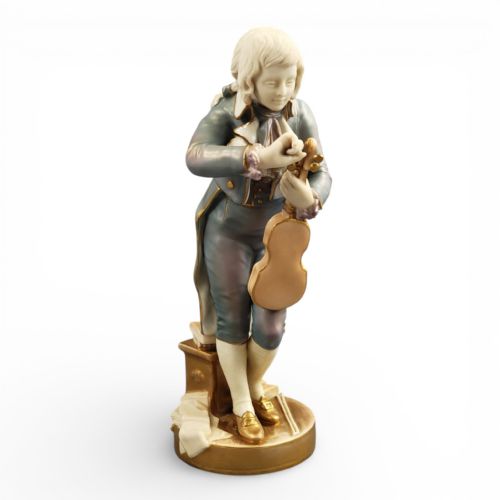


Ceramic Musician Figurine
A ceramic musician figurine brings the lively charm of centuries past directly to your mantelpiece through finely modelled figures caught mid-performance.
Ceramic Musician Figurine
A ceramic musician figurine captures players of bagpipes, hurdy-gurdies, drums, and mandolins across various historical eras and origins. You are most likely to encounter 18th-century English and continental porcelain figures, alongside robust Victorian earthenware and delicate late 19th-century German models.
These pieces range from single soloists and paired candlestick figures framed in floral bocage to elaborate multi-figure bands styled after Tang Dynasty traditions. Makers executed them as table ornaments, mantle decorations, and functional candle holders designed to entertain the eye.
The selection draws together soft-paste and hard-paste porcelain, earthenware, and bisque finishes reflecting styles spanning rococo whimsy, Victorian orientalism, and neoclassical restraint. Each figure preserves a distinct snapshot of period fashion and musical history through modelled clay and pigment.
Materials and construction
Potters shaped these figures using soft-paste or hard-paste porcelain, earthenware, and bisque, often building complex compositions in sectional moulds before hand-finishing details like delicate fingers and leafy bocage backgrounds. Artisans applied liquid glazes and enamels, occasionally incorporating gold leaf and rich gilding to highlight garments and musical instruments.
Kiln firing methods dictated the final vitrification of the clay, with porcelain bodies achieving a translucent crispness while earthenware versions offered a heavier, opaque finish. Painters then added overglaze enamels by hand, fixing the pigments in secondary low-temperature firings to secure the vibrant colours seen on the musicians' costumes.
Ceramic Musician Figurine Retail Price Guide 2026
Typical asking prices for ceramic musician figurine among the pieces listed under this phrase on Sellingantiques today, from the lower quarter to the upper quarter. They describe what is for sale here now, not the wider market.
Listings feature hard-paste porcelain, soft-paste porcelain, earthenware, and bisque bodies decorated with enamel and gold leaf.
Distinctions in craftsmanship
Quality rests heavily on the crispness of the moulding and the sensitivity of the hand-modelling, particularly in the rendering of facial expressions, fingers, and the intricate folds of fabric. Superior pieces display fluid naturalism in the posture of the musician and careful placement of applied elements like floral backdrops.
The precision of the enamel painting and the brilliance of the gilding further divide the output, separating hurried production work from pieces where the decorator took time to shade garments and define instrument details. The prestige of the originating factory, from Meissen and Derby to Volkstedt and Royal Worcester, underpins the artistic ambition of the modelled form.
Volkstedt Rudolstadt Factory·Meissen·Derby·Royal Worcester·Samson Paris·Eichwald Royal Dux·Fürstenberg·Bow
The Ceramic Musician Figurine Glossary
- Bocage
- An applied background of leaves, flowers, and branches common in 18th-century porcelain figures. It frames the musician and adds a decorative, garden-like setting to the composition.
- Bisque
- Unglazed ceramic fired once to create a matte, porous white surface resembling marble. It became popular for capturing fine sculptural detail without the sheen of a clear glaze.
- Enamel
- Opaque glass-based colours painted onto fired ceramics over the glaze. These pigments require a secondary low-temperature firing to fuse permanently with the surface.
- Soft-paste porcelain
- An artificial porcelain mixture of clay, glass, and frit developed in Europe before the discovery of true hard-paste ingredients. It possesses a warm, slightly creamy body and a distinctive vitreous glaze.
- Gilding
- The application of gold leaf or powdered gold suspended in a medium to the surface of a ceramic. It highlights trim, bases, and instrument details with metallic brilliance.
Ceramic Musician Figurine: Frequently Asked Questions
What periods do these figurines come from?
The selection spans from mid-18th-century Georgian pieces up to late Victorian and Edwardian works.
You will find figures representing specific manufacturing spans like the Derby patch-mark period alongside 19th-century revival pieces.
How were these figures used originally?
They served as decorative ornaments on dining tables, mantelpieces, and drawing-room sideboards.
Some variants incorporated candle sockets to function as elegant figural candlesticks illuminating evening gatherings.
Are these figures made of porcelain or pottery?
Makers utilised various ceramic bodies including soft-paste porcelain, hard-paste porcelain, earthenware, and bisque.
Each material provides a different weight, translucency, and surface texture suited to the maker's regional tradition.
How do I identify different factory styles?
Factory attribution relies on characteristic modelling traits, paste types, and painted base marks such as Derby patch marks.
Continental works often display distinct modelling conventions and enamel palettes compared to English counterparts from Bow or Worcester.