
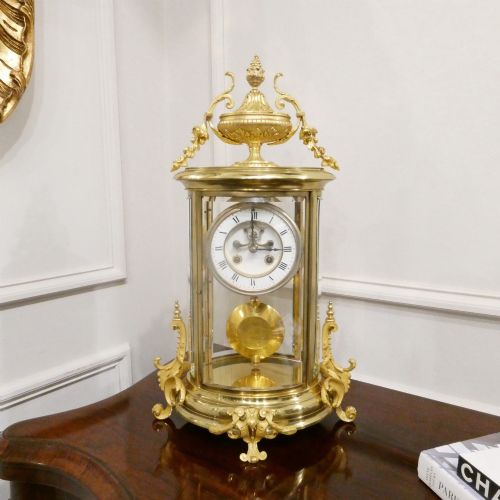
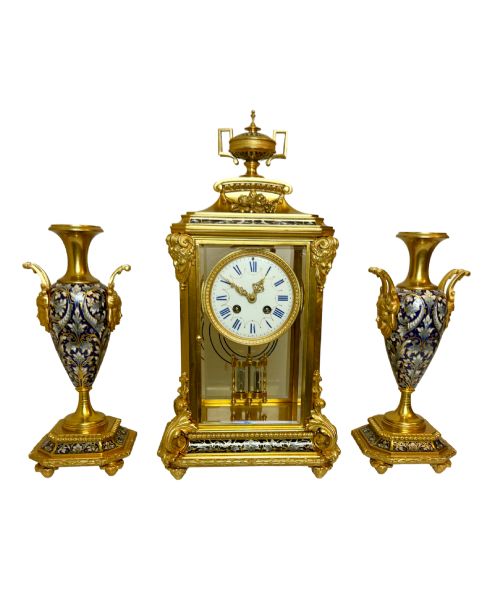
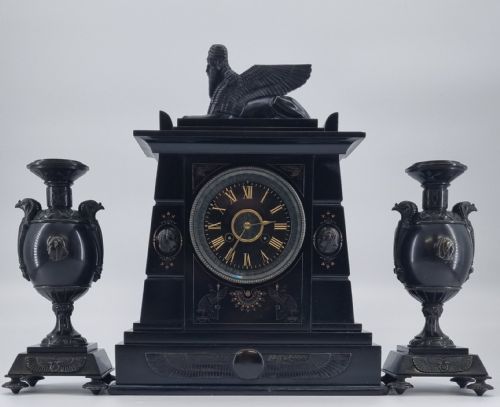


Bronze Urn Clock
These bronze urn clocks combine classical architecture with mechanical precision, offering a striking centrepiece for a mantel or table.
Bronze Urn Clock
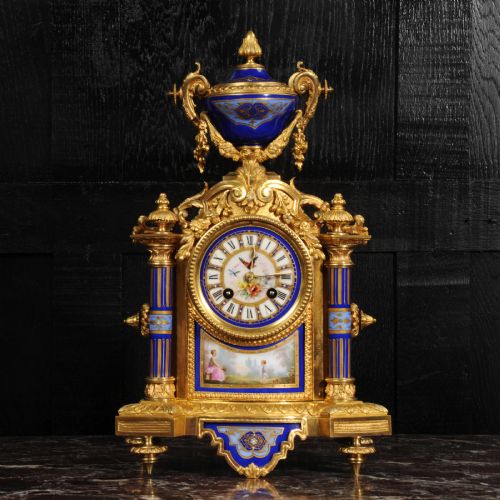
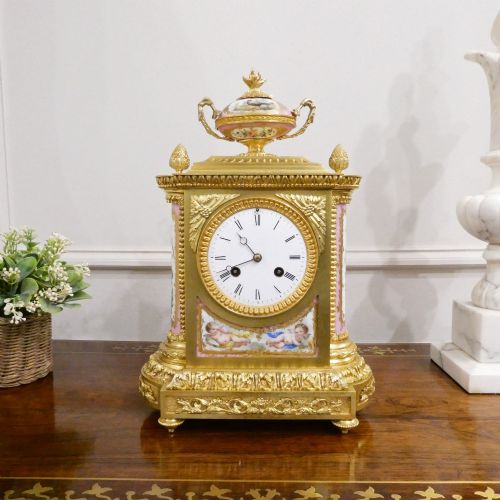
A bronze urn clock integrates a timekeeping movement within an urn-shaped vessel, standing as a principal decorative object on nineteenth-century mantelpieces. Buyers encounter these pieces primarily in French regional styles spanning the Victorian era, often accompanied by matching garniture sets.
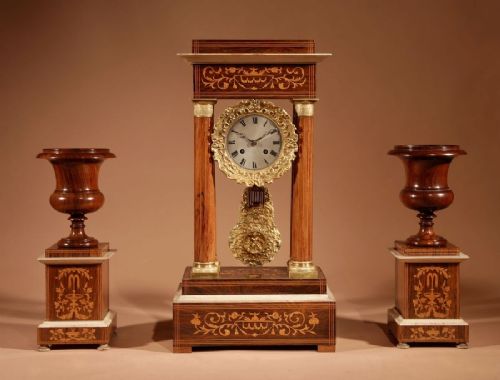
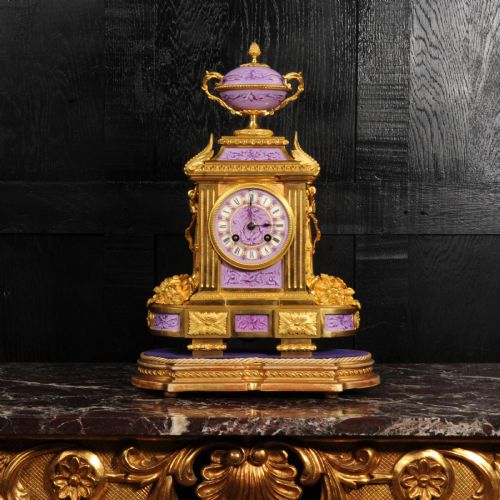
The design draws heavily from classical antiquity and later revival aesthetics, manifesting in forms such as portico frames and drum head cases. Most examples integrate porcelain plaques or painted panels alongside the metalwork to soften the heavy cast bronze.
Garniture sets frequently complete the arrangement, pairing the central timepiece with matching decorative vases or candelabra. These groups dominate the selection, bringing symmetry and proportion to period interiors.
Materials and construction
Foundry work relies on cast bronze and brass, frequently treated with mercury gilding to produce a durable ormolu finish. This surface layer gives the metal a warm, golden lustre that catches ambient light.
Enamel and porcelain insert into the metal framework for dials and decorative panels, demanding careful kiln firing. Artisans mount these fragile components alongside heavy stone bases fashioned from marble, onyx, or slate.
Assessing quality and execution
The crispness of the chased decoration separates standard production from superior examples, as skilled metalworkers hand-finished cast details with punches and gravers. Softer, blurred foliage or sluggish casting reveals a rushed workshop output.
The movement itself indicates the tier of the piece, with reputable makers signing their brass plates to denote reliable escapements and striking trains. Dial painting quality, particularly the fine script on porcelain chapters, also marks the distinction between ordinary and exceptional clocks.
Japy Freres·Jean-Baptiste Delettrez·Achille Brocot·Samuel Marti·Louis Goret·Pons de Paul·A.D Mougin·Vincenti of Paris
The Bronze Urn Clock Glossary
- Ormolu
- Gilded bronze produced by applying a mercury and gold amalgam to a cast bronze object and heating it until the mercury vaporises. This technique leaves a rich, golden finish characteristic of French decorative arts.
- Garniture
- A set of matching decorative objects, typically comprising a central clock flanked by two matching vases or candelabra. These sets create a balanced arrangement on a mantelpiece.
- Portico clock
- A clock featuring a architectural case supported by four columns, resembling a classical temple facade. This architectural style gained popularity during the nineteenth century.
- Champlevé enamel
- A technique where troughs or cells are hollowed out of a metal surface and filled with vitreous enamel powder before firing. The resulting surface displays coloured patterns flush with the metal partitions.
- Movement
- The mechanical inner workings of a clock, comprising gears, springs, escapements, and striking trains. Quality movements bear maker signatures on the brass backplates.
Bronze Urn Clock: Frequently Asked Questions
How do I wind a bronze urn clock?
Use the appropriate key on the winding arbors found on the dial face, turning gently until you feel resistance. Avoid over-winding to protect the mainsprings.
Ensure you set the time by moving the minute hand forward rather than backward, which safeguards the striking mechanism gears.
What is a clock garniture set?
A garniture set consists of a central timepiece accompanied by two matching side pieces, such as vases or urns. These items were designed to sit together on a mantelpiece to create visual symmetry.
Many surviving sets maintain their original matching pedestals and glass domes from the nineteenth century.
How do I identify the period of these clocks?
Examine the style motifs, such as Louis XVI revival details or Egyptian Revival ornamentation, alongside the materials like ormolu and Sevres-style porcelain. Maker signatures stamped on the brass movement plates offer a precise indicator of the production era.
Cast marks and dial construction also help distinguish mid-nineteenth-century examples from later Victorian pieces.
Where should I place a heavy marble clock?
Position the clock on a sturdy, level surface capable of supporting considerable weight, such as a substantial mantelpiece or low console table. Marble and bronze combinations require stable foundations to prevent tipping.
Keep the piece away from direct sunlight and heat sources to protect the delicate enamel dials and gilt finishes.