


Black Slate Timepiece
These heavy black slate timepiece designs deliver monumental architectural presence to a room, offering the dependable weight and imposing scale of the nineteenth century.
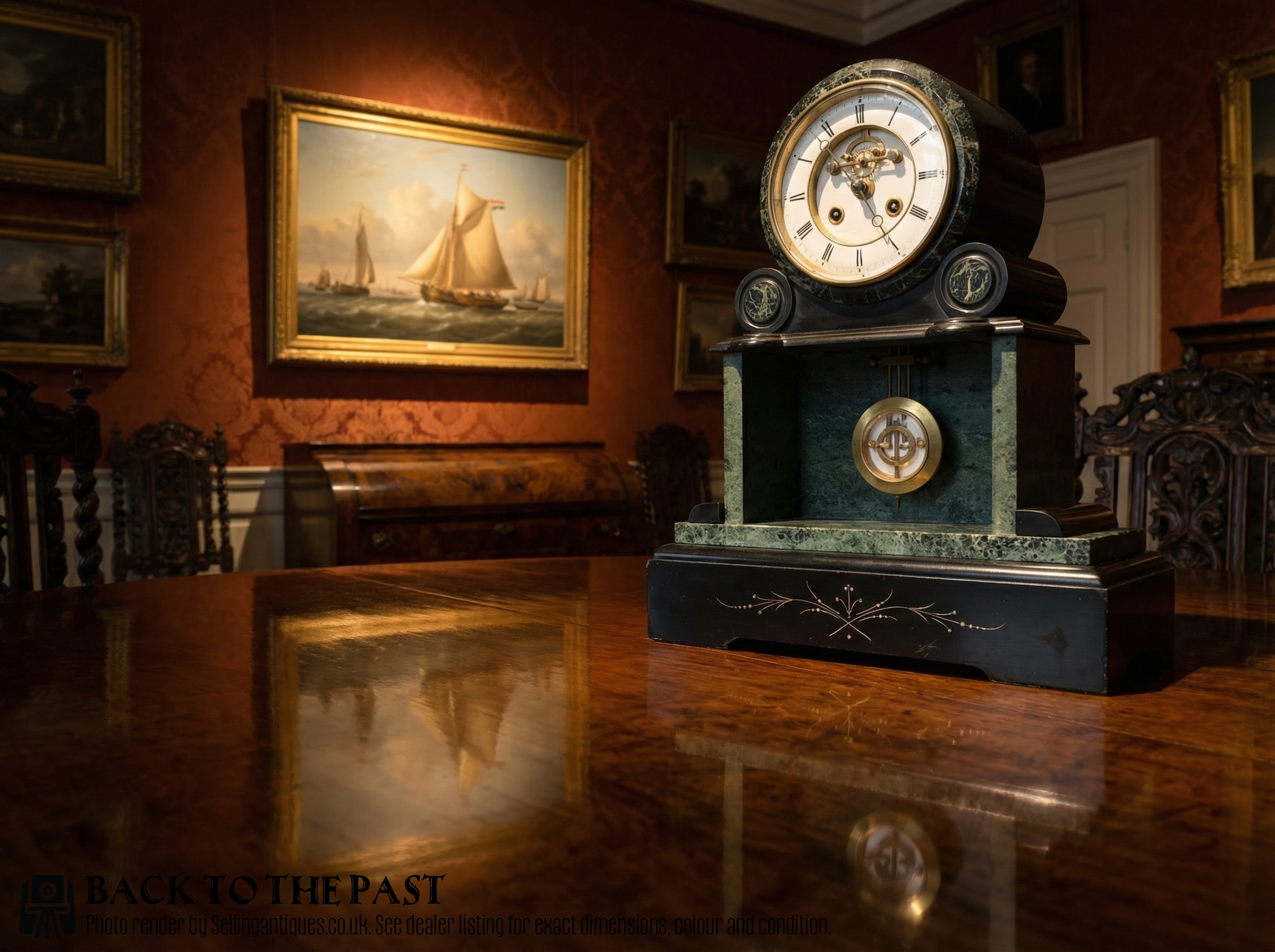
Black Slate Timepiece
A black slate timepiece stands as a solid, architectural statement piece for a mantelpiece or shelf. The pieces available here draw heavily from the Victorian era, spanning the decades from eighteen sixty to the end of the nineteenth century.
Most examples combine dense black slate with contrasting marble, occasionally incorporating bronze or brass mounts to achieve neoclassical, Egyptian revival, or architectural styles. Buyers encounter drumhead clocks and large mantel clock garniture sets alongside standard mantel clock forms.
Originating frequently from French workshops and British Victorian makers, these heavy stone clocks were built to command attention in grand domestic interiors. Their enduring appeal lies in their substantial heft and severe, classical geometry.
Construction and materials
Makers fashioned these clocks primarily from thick slabs of black slate, often pairing the dark stone with veined coloured marble for architectural contrast. Enamel dials protected by glass panels display the hours, driven by mechanical eight-day movements housed within the stone cases.
Workshops added decorative weight through cast bronze and brass mounts, utilising patinated bronze figures or classical ornamentation to enrich the austere slate bodies. Skilled masons cut and polished the heavy stone to mimic ancient architectural facades and temple fronts.
Owning one of these monumental stone clocks means your mantelpiece now shares the exact geological heft of a Victorian railway terminus.
Assessing quality in stone clocks
Superior examples distinguish themselves through ambitious architectural mass, intricate multi-coloured marble inlays, and the inclusion of cast bronze or patinated bronze sculptural elements. Simpler drumhead designs rely purely on the clean contrast of polished black stone without auxiliary ornaments.
The refinement of the dial enamel, the crispness of the stone bevelling, and the presence of specialised mechanical complications such as perpetual calendars elevate certain pieces far above standard production models. The integration of matching side pieces in a garniture set also alters the scope and ambition of the object.
Philippes Paris·Achille Brocot
The Black Slate Timepiece Glossary
- Garniture
- A set consisting of a central clock flanked by matching decorative ornaments such as urns or vases. These matched sets created a balanced centrepiece for a grand mantel.
- Drumhead clock
- A timepiece featuring a circular clock case mounted atop a rectangular stone plinth or base. The shape resembles the cross-section of a drum.
- Egyptian Revival
- A nineteenth-century decorative style inspired by ancient Egyptian art and architecture. It introduces motifs such as sphinxes, obelisks, and hieroglyphic patterns to the stone case.
- Eight-day movement
- A mechanical clock movement that requires winding only once every eight days. This reliable mechanism was standard in better-quality domestic clocks of the period.
- Neoclassical
- An artistic style drawing on classical antiquity, featuring symmetry, columns, and architectural pediments. Slate and marble proved ideal materials for replicating ancient stone buildings in miniature.
Black Slate Timepiece: Frequently Asked Questions
How heavy is a typical black slate timepiece?
These clocks possess substantial physical weight due to their solid stone and marble construction. Buyers must ensure the supporting shelf or mantelpiece is robust enough to bear the heavy load safely.
Because the materials consist entirely of dense slate, marble, and metal movements, even moderately sized examples require two people to lift and position them correctly.
What styles are common in these stone clocks?
Victorian architectural designs dominate the selection, often mimicking classical temples, Greek pediments, and Roman monuments. Makers also applied Egyptian Revival motifs, incorporating bronze sphinxes or hieroglyphic details onto the dark stone.
Neoclassical influences appear regularly through symmetrical columns, pilasters, and contrasting marble accents. These severe styles reflect the Victorian appetite for imposing, serious household ornamentation.
How do I wind an eight-day movement?
An eight-day movement requires a specialised winding key inserted into the dial holes to tension the internal springs. Owners turn the key gently until resistance indicates the mainspring is fully wound.
Care must be taken not to overwind the mechanism, as this can strain the internal brass gears. Regular winding every week maintains steady timekeeping for the mechanical movement.
What is a clock garniture?
A clock garniture is a matched set comprising a central mantel timepiece accompanied by two matching side ornaments, typically urns or vases. These matching pieces share the same black slate and marble materials to create a unified display.
Placed across a grand fireplace mantel, the garniture provided symmetrical balance favoured in nineteenth-century interior design. The side ornaments mirror the architectural details found on the main clock case.