
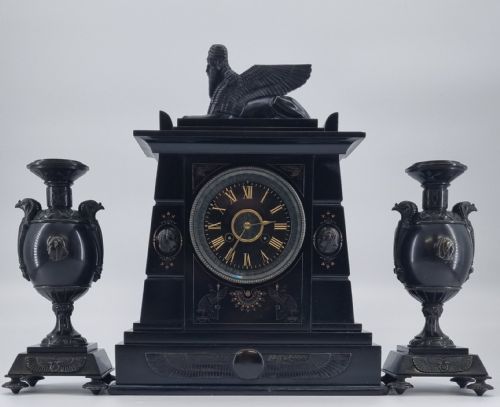
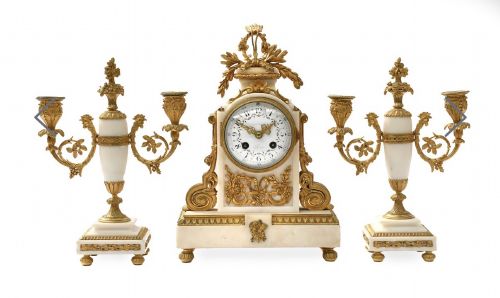
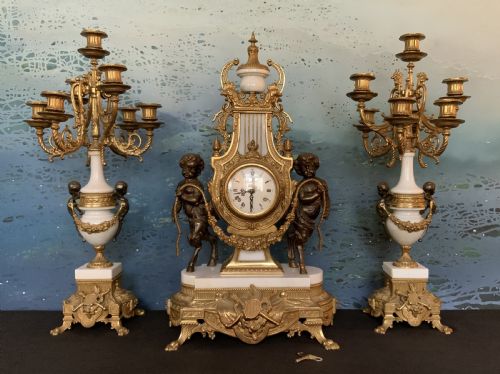


Bronze Mantel Clock Set
A bronze mantel clock set brings symmetry and striking presence to a room, pairing a central timepiece with matching garnitures.
Bronze Mantel Clock Set
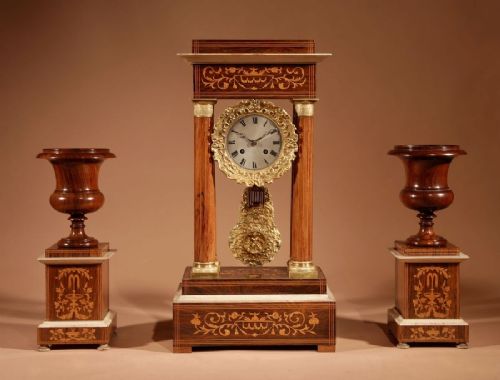
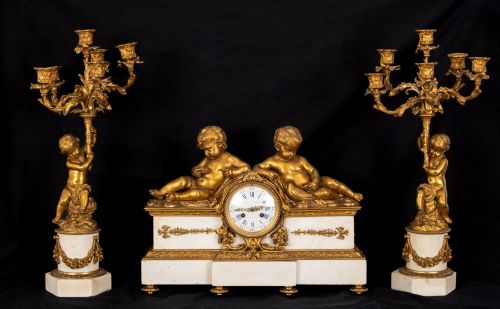
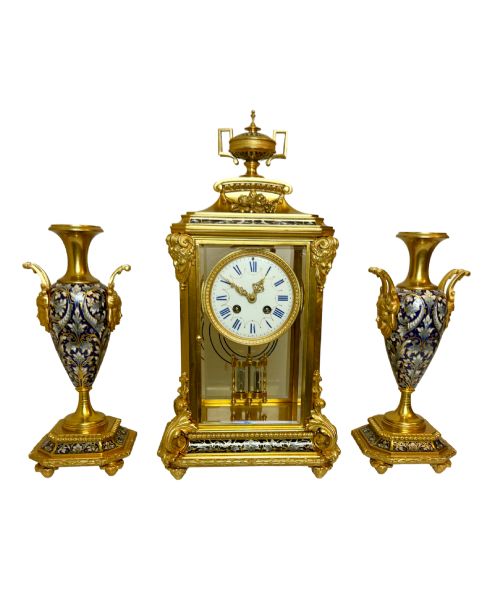
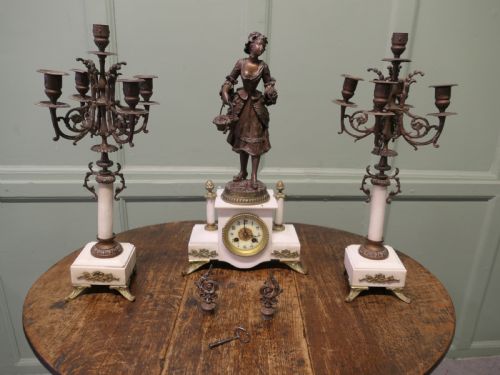
A bronze mantel clock set comprises a central timepiece accompanied by matching sidepieces such as candelabras or urns, forming a unified decorative group for a chimney piece or sideboard. These assemblies originate predominantly from nineteenth-century France, spanning periods from the Victorian era through the early decades of the twentieth century. The dominant iterations encountered here include French clock garnitures styled in Louis XVI Revival, Second Empire, and Art Deco designs.
Buyers encounter various configurations, from portico clock garnitures with white marble columns to ornate sets featuring cherubs, greyhounds, or porcelain lyre forms under glass domes. Materials range from gilt bronze and ormolu to onyx, brass, and champleve enamel, reflecting diverse aesthetic preferences of the nineteenth and twentieth centuries.
What varies in quality
The sophistication of the bronze casting and the crispness of the hand-chased surface details set superior examples apart from standard production pieces. Finer sets display deep, articulate relief work on figural elements like cherubs or classical mounts, whereas lesser examples show softer definition and simpler finishing.
The integration of materials dictates overall visual success, particularly the quality of the marble or onyx bases and the harmony between the central clock and its flanking garnitures. Signed movements by notable makers or retailers indicate higher workshop standards and greater horological precision.
Several bronze clock sets include watchful greyhounds or cherubs keeping time beside the dial.
Henry Dasson·A.D Mougin·Japy Freres
The Bronze Mantel Clock Set Glossary
- Garniture
- A set of matching ornamental vessels or candelabras designed to flank a central clock on a mantelpiece.
- Ormolu
- Gilt bronze produced by applying a finely ground high-carat gold and mercury amalgam to a bronze object before heating.
- Champleve
- An enamelling technique where troughs or cells are hollowed out of the metal surface and filled with vitreous enamel before firing.
- Lyre clock
- A timepiece shaped in the symmetrical outline of a stringed musical instrument, frequently decorated with porcelain or gilt mounts.
Bronze Mantel Clock Set: Frequently Asked Questions
What is a clock garniture?
A clock garniture is a matched set consisting of a central mantel clock and two accompanying decorative objects, such as candelabras, urns, or vases. These pieces are designed to be displayed together on a fireplace mantel or sideboard to create a balanced decorative arrangement.
Historically, these sets were manufactured as complete suites to unify the aesthetic of a grand interior room. The sidepieces often echo the materials, architectural motifs, and sculptural themes of the main timepiece.
How do I maintain an antique clock set?
Maintaining an antique clock set involves regular winding of the eight-day movement and occasional professional servicing to ensure the mechanical gears remain clean and lubricated. Avoid placing the clock in direct sunlight or near sudden temperature fluctuations to protect the delicate marble, enamel, and gilded surfaces.
Cleaning should be performed gently with a dry, soft cloth, avoiding abrasive polishes that can wear away the thin ormolu or gilt bronze layers. Glass domes, where present, should be lifted carefully using both hands when cleaning the interior components.
Are these clock sets loud?
Most of these antique clocks feature eight-day mechanical movements with a strike train that chimes on the hour and half-hour, producing a distinct acoustic tone. The volume depends on the specific bell or gong housed inside the bronze case.
If the striking sound is unwanted, many movements can be left un-wound on the strike side while keeping the timekeeping train running. Professional clockmakers can also adjust or silence the striking mechanism during routine maintenance.
How can I date a French bronze clock set?
Dating a French bronze clock set requires examining the stylistic clues, such as whether the piece follows Louis XVI Revival, Second Empire, or Art Deco design vocabulary. Inscriptions on the enamel dials or stamped maker marks on the backplate of the movement often reveal the workshop or retailer.
Material choices also offer chronological guidance, as bright ormolu combined with white marble frequently points to nineteenth-century Victorian production, whereas streamlined forms and greyhounds indicate twentieth-century Art Deco manufacture.