




Ornate Brass Clock Set
An ornate brass clock set brings sculptural weight and polished metallic presence to a mantelpiece, combining intricate metalwork with timekeeping.
Ornate Brass Clock Set
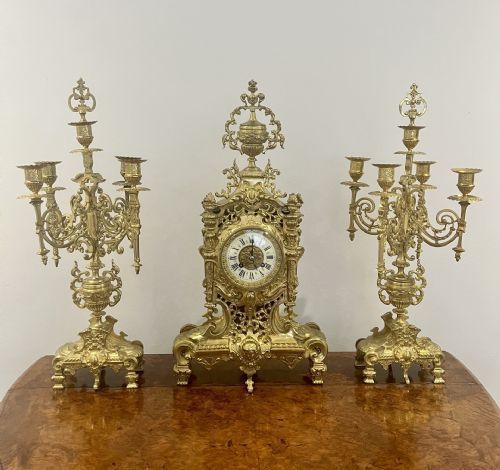
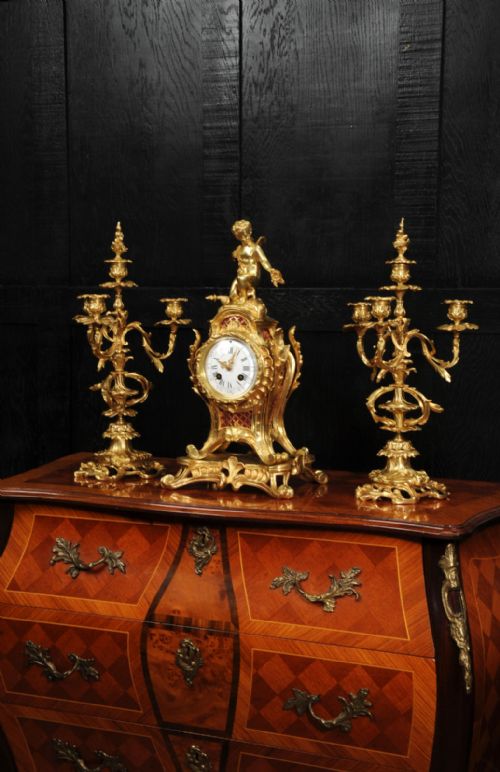
An ornate brass clock set comprises a central mantel timepiece accompanied by matching garnitures or side pieces, forming a unified decorative arrangement for a room. These ensembles typically date from the Victorian era and the nineteenth century, drawing heavily on French design traditions.
The objects take several distinct forms, including multi-piece garniture sets, desk clocks, and marble or onyx clock sets. Most examples encountered here reflect continental manufacturing styles such as French Rococo, Napoleon III, and Neo-Classical.
Makers and designers from this period utilised rich materials alongside the core brass framework to create visually dense decorative objects. Buyers seeking an ornate brass clock set will find pieces ranging from sculptural gilt bronze to combinations of enamel, marble, and porcelain.
How they were made
The construction of these sets relies upon heavy cast brass, ormolu, and gilt bronze, often shaped into elaborate Rococo scrolls or Neo-Classical architectural motifs. Skilled metalworkers cast and chased these components by hand to achieve crisp surface detail before applying fire gilding or polished finishes.
Many dials and decorative panels incorporate enamelwork, champleve enamel, or hand-painted porcelain insert sections. These delicate ceramic and glass elements are fitted directly into the heavy metal housing, contrasting colourful glazed surfaces against polished brass or dark marble bases.
Some nineteenth century desk clocks feature tiny chaff-cutter escapements, proving that industrial innovation found its way into the smallest domestic timepieces.
What varies in quality
Quality in an ornate brass clock set lies in the depth and sharpness of the metal chasing rather than mere surface shine. Finer castings display crisp relief work along the Rococo scrolls and figurative elements, whereas simpler pieces show softer, shallower detailing from worn moulds.
The choice of supporting materials significantly affects the overall grade of the set. Dense bases of green onyx or contrasting marble, combined with intricate champleve enamel dials and complete three-piece garnitures, elevate the visual impact above standard brass-only desk clocks.
Seth Thomas·Moser
The Ornate Brass Clock Set Glossary
- Clock garniture
- A matching set of decorative ornaments, usually comprising a central clock flanked by two matching vases, urns, or candelabra. These sets were designed to sit harmoniously on a mantelpiece.
- Ormolu
- Finely chopped or powdered high-karat gold applied to a bronze or brass object using a mercury amalgam technique. This historic process yields a warm, durable metallic lustre.
- Champleve enamel
- A technique where troughs or cells are hollowed out of a metal surface and filled with vitreous enamel powder before firing. The resulting coloured glass designs sit flush with the surrounding brass.
- Napoleon III
- A nineteenth century French design style spanning the reign of Louis-Napoleon Bonaparte, characterised by eclectic revivals of Rococo, Renaissance, and Louis XVI aesthetics.
- Escapement
- The internal mechanism that controls the release of the gear train to regulate the movement of the clock hands. Various specialised escapements govern the precision of these nineteenth century movements.
Ornate Brass Clock Set: Frequently Asked Questions
What is included in an ornate brass clock set?
These assemblies typically consist of a primary mantel clock paired with matching side ornaments known as garnitures. The complete groupings are designed to be displayed together on a mantelpiece or sideboard.
Additional pieces in the set frequently take the form of matching urns or candelabra, sharing the same brass, marble, or enamel decorative motifs as the central clock.
How do I date an antique clock set?
Dating relies on stylistic markers such as French Rococo Revival or Neo-Classical design traits, alongside material choices like champleve enamel and gilt bronze. Most surviving examples originate from the Victorian period and the nineteenth century.
Internal escapement mechanisms and signature stamps from makers also provide clues to the exact decade of manufacture, aligning with production periods seen around eighteen sixty to eighteen eighty.
Where should I place a clock garniture?
A complete three piece set requires a wide surface, such as a large mantelpiece, a heavy sideboard, or a dedicated pier table. The central clock anchors the arrangement, flanked symmetrically by the matching side pieces.
Because these objects combine heavy brass, marble, and glass components, they need a sturdy, level surface that can safely support their substantial combined weight.
How do I care for antique brass and enamel?
Maintenance involves gentle dusting with a soft, dry cloth to protect exposed enamel dials and delicate gilt surfaces. Abrasive metal cleaners should be avoided, as they can strip historical patination and damage fine ormolu.
Movable internal mechanical parts benefit from professional servicing by a clock restorer to keep the escapement functioning correctly without altering the original housing.