




Antique Desk Clock Garniture
These antique desk clock garniture sets bring matched sculptural presence to a mantelpiece, combining a central timepiece with flanking ornaments.
Antique Desk Clock Garniture
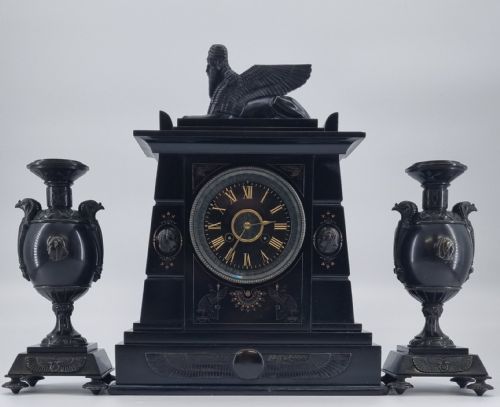
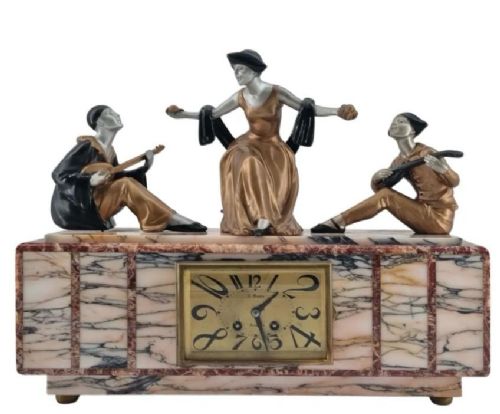
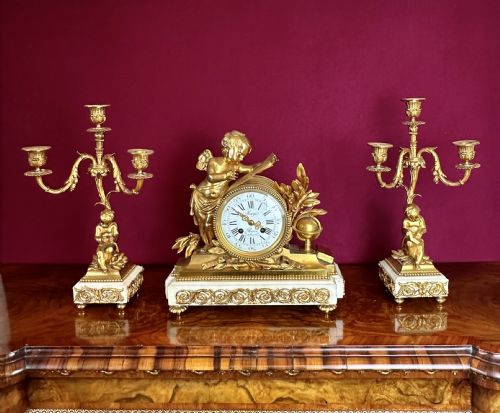
An antique desk clock garniture typically comprises a central timepiece accompanied by matching side pieces such as candelabras or sculptural vases. The selection ranges from Victorian marble sets and ornate French Louis XVI ormolu pieces to geometric Art Deco marble and bronze compositions.
Nineteenth-century examples frequently utilise heavy coloured marble, gilt bronze, and patinated spelter to build formal symmetry. Art Deco sets shift towards stylised figures of animals and dancers paired with streamlined marble plinths and polished dials.
Buyers encounter distinct regional and stylistic varieties, from Black Forest carved wood to Egyptian Revival motifs and classical French Louis XVI Revival designs. The most common survivals date from the Victorian era and the interwar Art Deco period.
Judging the quality of a garniture
The sophistication of the sculptural modelling separates standard production pieces from masterworks. Finely chiselled bronze details, crisp carving in stone, and substantial cast metal weights indicate superior workshop output.
The harmony between the central clock and its flanking side ornaments dictates visual success. Sets that retain all original matching components display a unified design intent that assembled or mismatched groups lack.
The integrity of the dial, the crispness of the enamel numerals, and the complexity of the internal movement structure reflect the original manufacturing ambition.
German Shepherd dogs and pirouetting pierrots keep steady watch beside the ticking clock faces.
Raingo Fres Paris·Ferdinand Berthoud·Japy Freres·Michel Decoux·Sega
The Antique Desk Clock Garniture Glossary
- Garniture
- A matching set of ornamental objects designed to be displayed together on a mantelpiece or desk. The central piece is typically a clock, flanked by two matching vases, urns, or candelabras.
- Ormolu
- Gilt bronze produced by applying a finely ground high-carat gold and mercury amalgam to a bronze base, followed by firing to drive off the mercury. The technique creates a durable, golden surface finish.
- Spelter
- A zinc alloy used as a cost-effective substitute for bronze in nineteenth-century decorative metalwork. It is often painted or electroplated to imitate bronze or gilt finishes.
- Bezel
- The metal ring that holds the glass protecting the clock face in place. It often hinges open to allow hand-setting of the time.
- Candelabra
- A branched candlestick designed to hold multiple tapers. In a clock garniture, a pair of these usually flanks the central timepiece to create symmetry.
Antique Desk Clock Garniture: Frequently Asked Questions
How do I identify an Art Deco garniture?
Art Deco sets feature geometric marble bases, stylised animal or human sculptures, and clean-lined metal dials. Figures of dogs, dancers, and elephants frequently appear alongside streamlined stone blocks.
These pieces typically date from the 1920s and 1930s, moving away from the heavy classical ornamentation of the Victorian period towards modern simplicity.
How should I care for a marble clock set?
Keep the marble clean by dusting gently with a dry, soft cloth and avoid chemical polishes that can damage the stone surface. Protect mechanical movements by having them serviced periodically by a professional horologist.
Place the garniture on a sturdy, level surface because the combined weight of the marble clock and its side pieces is considerable.
How do I tell Victorian sets from later periods?
Victorian garnitures often lean towards heavy block marble, elaborate classical revival motifs, and ornate ormolu mounts inspired by French Louis styles. They project formal nineteenth-century solemnity and architectural presence.
Later sets from the 1920s and 1930s adopt the sweeping curves or sharp geometric lines of the Art Deco movement, featuring simplified figures and polished stone.