


Brass Bound Rosewood Box
A brass bound rosewood box brings tactile weight and rich grain into a room, serving as a handsome container for letters, jewellery or travel ephemera.
Brass Bound Rosewood Box
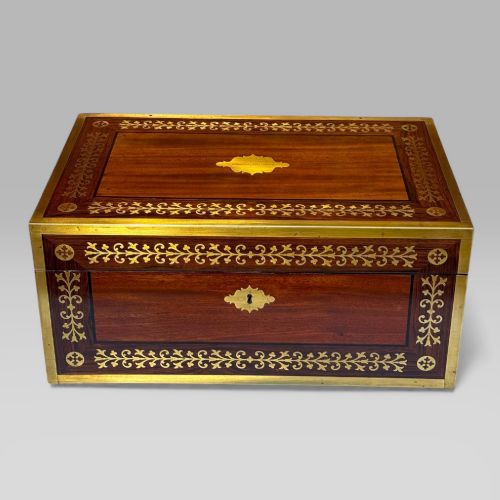
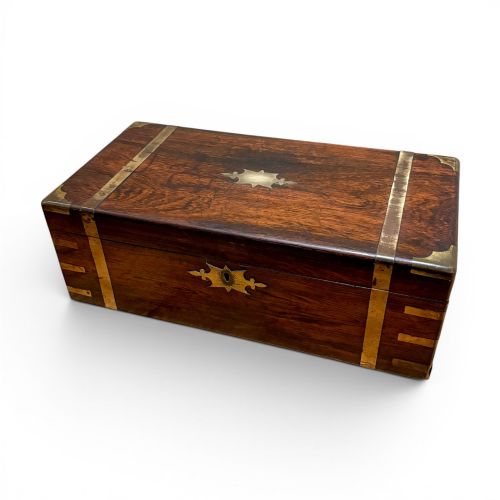
A brass bound rosewood box is a portable container strengthened with metal corners and straps, designed to protect valuables during transit or display them in a study. The form includes writing slopes, vanity cases, jewellery boxes, and document chests made across the Georgian, Regency, and Victorian periods.
Writing slopes open out to form an inclined surface for correspondence, often concealing secret drawers and compartments for inkwells. Vanity and dressing boxes contain fitted interiors with glass bottles and silvered metal, whilst simpler chests hold stationery or trinkets.
Examples on this page span the nineteenth century, including Anglo-Indian colonial pieces and French campaign styles. Buyers most frequently encounter Regency and Victorian iterations displaying brass corner plates and flush carrying handles.
How They Were Made
Cabinet makers constructed these pieces using dense rosewood timbers, frequently incorporating boxwood inlay for geometric contrast. The timber's deep reddish-brown grain provides a dark, polished ground for brass mountings.
Brass corners, straps, and escutcheons were countersunk into the wood and held with small pins to reinforce the box against travel wear. Interiors combine fitted wooden partitions with linings of blue velvet and glass containers.
What Varies in Quality
Quality rests upon the precision of the brass work and the complexity of the internal fittings. Superior examples exhibit tightly fitted brass corners flush with the timber surface and fully operational locks with working keys.
The refinement of internal compartments, such as secret drawers released by hidden latches and intact velvet linings, distinguishes standard desk boxes from master cabinet work.
Litherland Davies Of Liverpool
The Brass Bound Rosewood Box Glossary
- Writing slope
- A box that unfolds to create a sloping writing surface lined with leather or velvet. Inside are compartments for pens, ink, and paper.
- Campaign box
- Portable furniture designed for military officers on the move, fitted with flush brass handles and corner brackets to withstand travel.
- Escutcheon
- A protective metal plate surrounding a keyhole. On these pieces, it is typically made of brass.
- Boxwood inlay
- Contrasting light-coloured wood inserted into the darker rosewood surface in thin geometric lines or patterns.
Brass Bound Rosewood Box: Frequently Asked Questions
What is a brass bound rosewood box used for?
These pieces served multiple functions as portable desks, vanity cases, and secure receptacles for jewellery or documents during the nineteenth century. Officers and travellers relied on them to keep writing materials and personal valuables safe on long journeys.
Today, they function well on a desk or dressing table for storing letters, modern trinkets, and small accessories while adding period character to a room.
How do I date a rosewood box?
Dating relies on stylistic clues, construction methods, and the design of the brass hardware. Georgian and Regency pieces often feature sharper box corners and simpler escutcheons, whilst Victorian examples frequently include more elaborate brass banding and fitted glass bottles.
Reference points also include the presence of specific campaign styles, cabinet-maker signatures, and changes in interior fabric linings over the course of the nineteenth century.
Are the keys usually included?
Many boxes retain their original working keys, though some survive without them due to centuries of displacement. Working locks and functional keys add utility for those who intend to secure jewellery or correspondence inside.
Even without a key, the brass locks and escutcheons remain integral decorative elements of the campaign aesthetic.
What is the difference between a writing slope and a jewellery box?
A writing slope opens on a hinge to reveal a slanted writing surface with inkwell recesses and hidden compartments underneath. A jewellery box opens to a shallow tray or lined compartments designed specifically for rings, necklaces, and vanity accessories.
Both forms share the characteristic rosewood exterior and protective brass mounts typical of campaign design.