
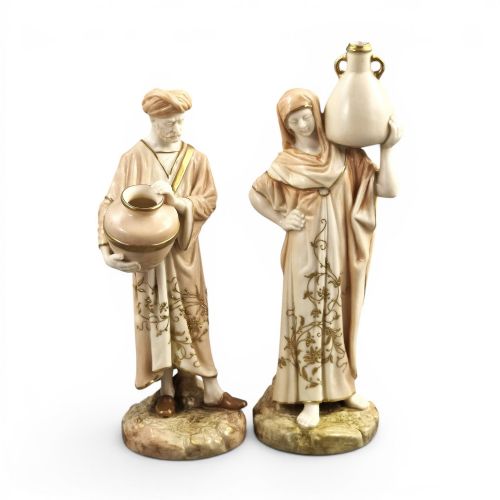


Blush Porcelain Figurine
A blush porcelain figurine brings tactile warmth and delicate modelling into a room, capturing late nineteenth and early twentieth century artistry.
Blush Porcelain Figurine
When you search for a blush porcelain figurine, you encounter sculptural works predominantly produced by Royal Worcester and Royal Dux during the Victorian, Edwardian, and later periods.
The selections on this page span decorative figures, statuettes, and functional pairings such as candelabra and jardinieres created by modellers like James Hadley.
Subjects range from classical revivals and Orientalist depictions of water carriers and musicians to rustic pastoral figures.
How they were made
Manufacturers utilised fine porcelain treated with a distinctive blush ivory glaze to create a matte, skin-like surface texture.
Artisans applied delicate enamel painting alongside gold leaf, gilding, and gilt highlights to accentuate the sculptural details and garments of each figure.
Snake charmers, water carriers, and trinket makers populate this group, bringing nineteenth-century global theatre directly to the Victorian mantelpiece.
What varies in quality
Quality rests upon the crispness of the modelling in the porcelain and the sensitivity of the hand-painted enamel and gilding.
Works bearing specific signatures or attributed to prominent modellers demonstrate superior artistic execution compared to anonymous factory output.
Royal Worcester·James Hadley·Royal Dux
The Blush Porcelain Figurine Glossary
- Blush ivory glaze
- A soft, matte cream-coloured ceramic finish developed to mimic natural skin tones and provide a subtle ground for enamel decoration. This glaze defines much of late nineteenth century British aesthetic ceramics.
- Gilding
- The application of gold leaf or gold powder to ceramic surfaces to highlight raised details and ornamentation. Skilled gilding adds a metallic lustre that complements the muted background glaze.
- Orientalism
- An artistic movement depicting themes, figures, and costumes from Middle Eastern and Asian cultures. Such subjects were popular in Victorian sculptural ceramics.
- Neoclassical revival
- A stylistic return to the classical art and architecture of ancient Greece and Rome. Figures in this style often wear classical drapery and emulate antique sculpture.
- Enamel
- A decorative vitreous composition fused to the porcelain surface through firing. Enamels provide vibrant colour accents on garments and floral motifs.
Blush Porcelain Figurine: Frequently Asked Questions
Who was James Hadley?
James Hadley was a principal modeller and designer for Royal Worcester during the late nineteenth century. His work often depicted Orientalist and figurative subjects.
Pieces bearing his signature or design show exceptional sculptural detail.
How do I date these figures?
Dating relies on factory printed backstamps, registration numbers, and stylistic markers such as Victorian or Edwardian dress. Model numbers also help establish the production era.
Most pieces on this page originate between the late nineteenth century and the 1930s.
Where were they displayed?
These figures served as decorative ornaments on mantelpieces, side tables, and cabinet shelves. Larger examples functioned as centrepieces or paired with candelabra.
Their detailed modelling was intended for close inspection in domestic drawing rooms.