


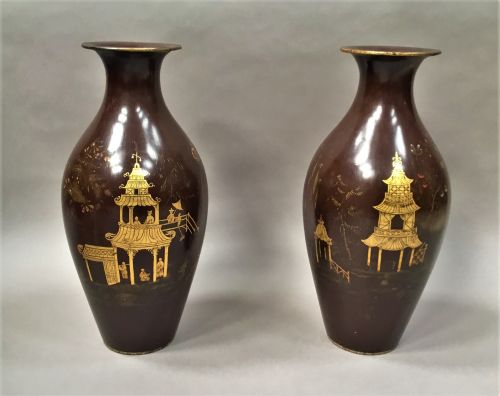


Black Lacquer Urns
Black lacquer urns bring deep hand-finished polish and gilt detail into a room, drawing the eye instantly through dark glossy surfaces.
Black Lacquer Urns
When you search for black lacquer urns, you encounter striking decorative vessels shaped by 19th century, Edwardian, and 1930s makers. These pieces span Japanese export styles, Chinese temple forms, and British toleware interpretations.
The most common examples on this page are Japanese porcelain vases finished with black lacquer over paint, often featuring koi motifs. Alongside these stand large toleware table lamps and papier-mâché vases showing distinct Chinoiserie and Aesthetic Movement influences.
Materials and construction
Makers built these pieces using varied foundational materials including porcelain, wood, papier-mâché, and toleware. Artisans applied layers of dark paint and lacquer to achieve a deep glossy finish.
Details were frequently highlighted with gold leaf and gilt work, creating sharp contrast against the dark background. Japanese export pieces integrated lacquer directly onto ceramic bodies, while British works utilised papier-mâché and metal.
Black Lacquer Urns Retail Price Guide 2026
Typical asking prices for black lacquer urns among the pieces listed under this phrase on Sellingantiques today, from the lower quarter to the upper quarter. They describe what is for sale here now, not the wider market.
Several Japanese porcelain vases from 1880 feature hand-painted koi swimming permanently across glossy black lacquer.
Evaluating quality and finish
Quality rests in the depth of the lacquer finish and the precision of the gilt detailing. Superior examples display smooth, even surfaces where the black ground retains its lustre and depth.
The complexity of the painted or applied motifs also separates standard production from finer decorative works. Pieces carrying clear maker stamps or distinct regional styles demonstrate superior craftsmanship.
Jennens & Bettridge
The Black Lacquer Urns Glossary
- Toleware
- Painted or japanned metalware, typically tin or iron, styled into decorative vessels and household objects. This technique was widely used in Regency and later periods to mimic Asian lacquer.
- Chinoiserie
- European interpretations of Chinese and East Asian artistic traditions, prominent in decorative arts and furniture. It emphasises asymmetric motifs, pagodas, and figures.
- Aesthetic Movement
- A late 19th-century design movement that prioritized visual beauty over narrative or moral message. It drew heavily on Japanese art and organic forms.
- Japanning
- A European imitation of East Asian lacquerwork involving layered varnishes and heat curing. It produced a glossy black finish often decorated with raised gilt designs.
- Papier-mâché
- A composite material made from paper pulp or reinforced sheets mixed with binding adhesive, moulded and dried. It was heavily utilised for lightweight vases and boxes before being lacquered.
Black Lacquer Urns: Frequently Asked Questions
What periods do these pieces come from?
The pieces span the 19th century, the Edwardian era, and the 1930s. They include Japanese export works and British interpretations.
Designs reflect Victorian, Aesthetic Movement, and Chinoiserie styles popular across these decades.
How were these urns and vases used?
Many served as decorative display pieces or temple vessels rather than holding water. Others have since been adapted as table lamps.
Larger floor vases and jardiniere stands functioned as architectural focal points within period rooms.
How do I care for black lacquer?
Keep these surfaces away from direct sunlight and excessive moisture to protect the finish. Dust gently with a soft, dry cloth.
Avoid chemical polishes or abrasive cleaners that can dull the glossy sheen.
How do I distinguish between materials?
Porcelain bodies feel heavy and cool, while papier-mâché offers a lighter, fibrous weight when handled. Toleware is metal and responds magnetically.
Close inspection of the base or interior typically reveals the underlying substrate beneath the lacquer.