


Black Charcoal Artwork
Black charcoal artwork brings monochromatic depth and draftsmanship into a room, capturing figures, landscapes, and studies through dark media on paper.
Materials and Technique
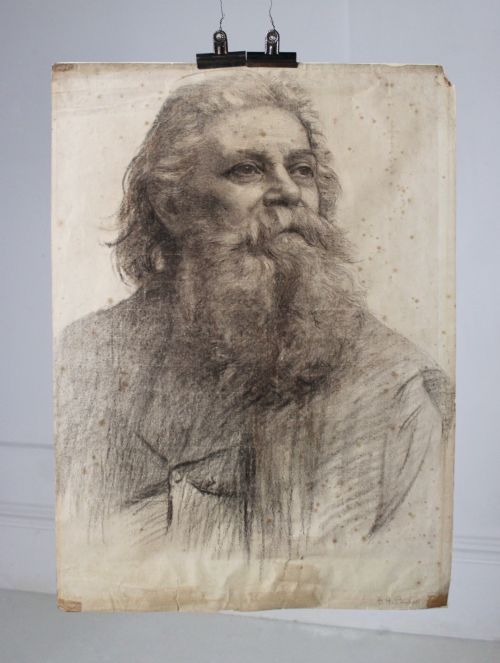
The primary medium relies on charcoal and carbon sticks applied to paper supports, sometimes combined with chalk, pastel, or graphite to build tonal contrast. Artists utilised textured or smooth paper sheets, occasionally working in deux crayon techniques or heightening compositions with white chalk for luminous highlights.
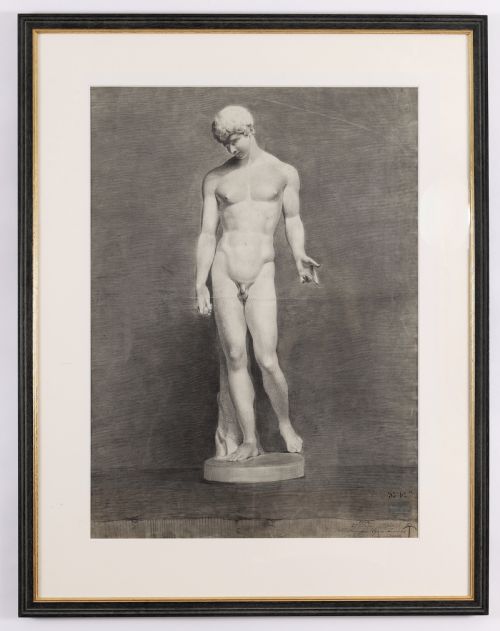
Framing typically involves protective glass set within wood or giltwood frames to safeguard the fragile charcoal particles from disturbance. The physical execution ranges from rapid plein-air sketching to painstaking academic life studies completed over extended periods in studio settings.
Assessing Quality in Drawings
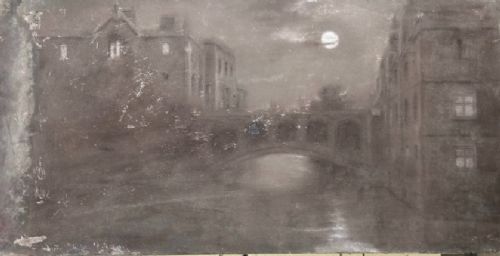
Quality rests upon the sureness of the draughtsmanship and the artist's command of light and shadow across the monochrome scale. A stronger piece demonstrates anatomical precision in life studies or atmospheric depth in landscapes, whereas lesser examples show hesitation or rigid line work.
Provenance and attribution also determine standing, with signed works by documented Royal Academicians or exhibited artists commanding greater interest than anonymous school studies. The preservation of the paper support and the absence of heavy foxing or moisture damage further separate fine examples from ordinary student exercises.
Listings span from the eighteenth century to the mid-twentieth century, featuring materials such as charcoal, red chalk, graphite, and giltwood.
Henry Arthur Roberts·Sir Edwin Landseer·Demetrios Galanis·J D Fergusson·Winifred Eugene Ballard·John Hoppner·LS Lowry·John Macallan Swan·Sonia Lawson·Francis Frank O A Haviland·Henri Joseph Harpignies·Juliet Pannett
The Black Charcoal Artwork Glossary
- Academic Realism
- A style of painting and drawing produced under the influence of European academies, emphasising traditional standards, anatomical accuracy, and meticulous life study. This approach underpins many nineteenth-century figure drawings.
- Deux crayon
- A drawing technique utilising two distinct colours of chalk or crayon, typically black and red, on toned paper to create varied tones and highlights. It allows artists to model form with greater dimension than a single medium permits.
- Giltwood
- Wood carved and coated with a thin layer of gold leaf or metallic gilt, commonly used for traditional picture frames. It adds a warm reflective border to monochrome works on paper.
- Orientalism
- Artistic style depicting scenes and people of the Middle East and North Africa, popular among nineteenth-century European painters and draughtsmen. These works often focus on exotic subjects and dramatic lighting.
- Tonalism
- An artistic style where artists paint or draw to evoke mood and shadow rather than crisp linear detail, often using a restrained palette. Edwardian tonalism employs subtle gradations of charcoal to capture atmospheric landscapes.
Black Charcoal Artwork: Frequently Asked Questions
How should I hang charcoal artwork?
Hang these drawings away from direct sunlight and high humidity to prevent the paper from yellowing and the charcoal from degrading.
Ensure the frame remains properly sealed behind glass so that ambient dust and moisture cannot reach the delicate carbon surface.
Are these pieces original drawings?
The selection consists of original hand-drawn works on paper rather than mechanical reproductions or mass-produced prints.
Artists applied charcoal and chalk directly to the sheet during sketching sessions, life studies, and studio compositions.
How do I identify academic life studies?
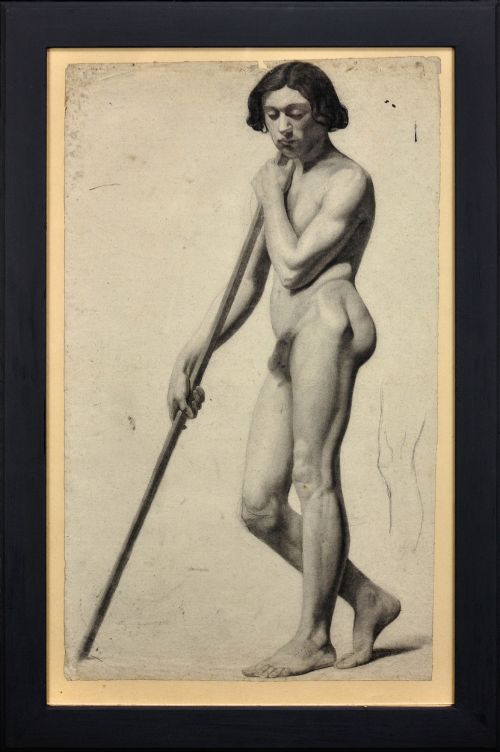
Academic life studies typically feature detailed renderings of nude human figures posed in controlled studio environments, focusing on muscle structure and shadow.
These drawings often date from the nineteenth or early twentieth centuries and reflect rigorous training methods taught in European art academies.
What is a deux crayon drawing?
A deux crayon drawing employs two contrasting drawing materials, such as black charcoal and red chalk, on a single sheet of paper.
This method allows the artist to build complex flesh tones and dynamic shading within a monochromatic or bicolour composition.
How can I tell the period of a drawing?
Dating relies on stylistic clues, framing materials, artist signatures, and paper characteristics recorded within each listing.
Victorian and Edwardian pieces exhibit distinct linear approaches compared to the later cubist or mid-century modernist sketches from the nineteen-twenties and sixties.