
charcoal
18 x 12in.
Coming to prominence in the 20s as an innovative cornet and trumpet virtuoso, Armstrong was a foundational influence on jazz, shifting the music's focus from collective improvisation to solo performers. With his distinctive gravelly voice, Armstrong was an influential singer, demonstrating great dexterity as an improviser, bending the lyrics and melody of a song for expressive purposes. He was also greatly skilled at scat singing, or wordless vocalizing.
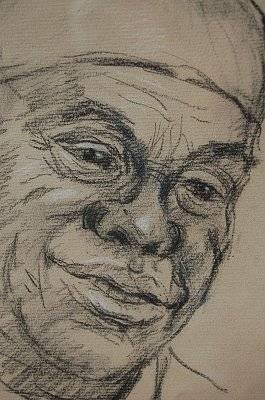
Renowned for his charismatic stage presence, Armstrong's influence extended well beyond jazz, and by the end of his career in the '60s, he was widely regarded as a profound influence on popular music in general: critic Steve Leggett describes Armstrong as "perhaps the most important American musician of the 20th century."
JULIET PANNETT began her career as an artist so long ago that she was able to draw a veteran of the Crimean War, William Brazier, who had been present at the fall of Sebastopol. And as he sat up in bed, wearing his medals, the 99-year-old smiled at the young artist and said: “You’re a beauty”. Her sympathetic portrait was just one of thousands of rather old-fashioned likenesses that she produced in a career of more than 75 years. Later Pannett had her own seat for six years in the House of Commons gallery, from which, long before the chamber was televised, she sketched the proceedings for The Illustrated London News. From there, in 1964, she drew a sadly emaciated and stooped Winston Churchill leaving the House for the last time. Over the years she produced portraits of eight other prime ministers. Her work was reproduced regularly in The Times, The Daily Telegraph and Radio Times, and for a long period her drawings appeared on the cover of The Law Guardian. Her subjects ranged from royalty through the ranks of the musical, military, academic and medical professions. Juliet Kathleen Somers was born in Hove in 1911, the fifth of seven children of a not-very-successful professional gambler. From a very early age she was determined to become an artist, and at 16 she enrolled at Brighton Art School. By the time she was 18, her drawings of local characters and sportsmen were appearing in local papers and magazines. These and her landscape paintings provided a modest living until her marriage in 1938 to Captain Maurice Pannett of The Devonshire Regiment. Juliet Pannett became a familiar figure sketching at the Albert Hall and Festival Hall, often attending orchestra rehearsals. She also attended jazz clubs, Louis Armstrong and Benny Goodman among her many musician subjects. They would often sign the completed portrait.
You can view the stock and full dealer information on the Artware Fineart Profile Page

Portrait of Louis Armstrong 1901-1971 by Juliet Pannett 1911-2005