
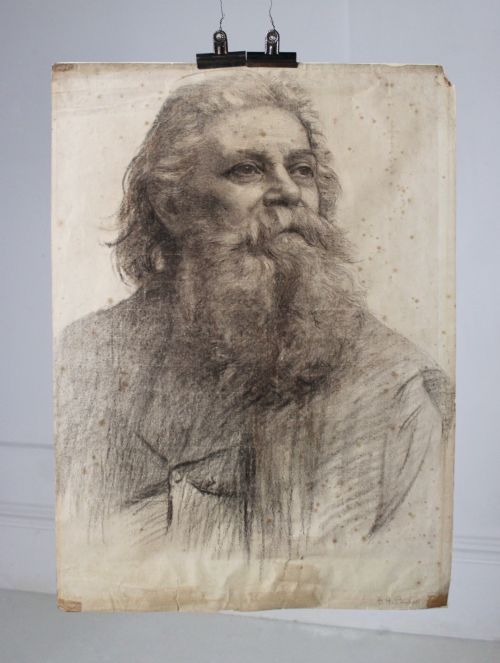


Fine Art Charcoal Drawing
Fine art charcoal drawing captures the fleeting play of shadow and light through direct mark-making on paper, offering buyers an intimate encounter with historical portraiture and landscape.
Fine Art Charcoal Drawing
A fine art charcoal drawing on this page presents monochrome or tinted studies originating from periods such as the 17th century, the Victorian era, and the mid-20th century. Buyers encounter diverse forms including detailed portrait drawings, large-scale studies, and atmospheric landscapes.
The selection ranges from early academic works to modernist and realist pieces, frequently capturing human subjects like gentlemen, explorers, and figures from specific schools of art. Many of these historical works arrive framed, preserved behind glass within wooden or gilded frames.
The aesthetic of a fine art charcoal drawing relies on the stark contrast of carbon marks against aged paper, occasionally enriched with chalk or pastel highlights. These pieces document the rigorous observational skills of artists working across the 19th and early 20th centuries.
Materials and technique
Artists utilise compressed or vine charcoal sticks applied directly to paper or canvas surfaces to build tonal depth and linear precision. The dry medium allows for rapid sketching as well as intricate blending with fingers or stumps to create soft gradients.
Support materials frequently include aged paper and canvas, sometimes complemented by pastel, chalk, or lithographic underlayers for added colour and texture. Finished pieces are secured behind glass and housed within wood, gesso, or giltwood frames for physical preservation.
Listings feature portrait drawings and landscapes executed on paper and canvas across the Victorian, Edwardian, and mid-20th-century periods.
Distinctions in quality
The distinction between standard works and superior examples rests upon the anatomical precision, expressive handling of shadow, and the documented provenance of the artist. Pieces by recognised Royal Academicians or museum-exhibited painters demonstrate a higher mastery of line and psychological depth.
Condition of the paper support, stability of the charcoal medium, and the originality of the period frame significantly influence the standing of an artwork. Superior pieces maintain their crisp tonal contrasts without excessive flaking or unmanaged foxing of the paper.
Reginald G. Eves·Sonia Lawson·Ernest Borough Johnson·George Richmond·Henri Joseph Harpignies·Cecil CP Lawson
The Fine Art Charcoal Drawing Glossary
- Charcoal
- A dry drawing medium made from slowly burned organic material, producing rich dark marks on paper. It permits both sweeping gestural lines and delicate smudged shading.
- Academic Realism
- A style of painting and drawing produced under the influence of European academies of art. It emphasises precise rendering of anatomy, perspective, and classical subjects.
- Giltwood
- Wood that has been coated with a thin layer of gold leaf or gold paint. This material is commonly found on antique picture frames housing historical drawings.
- Pastel
- A powder pigment mixed with a binder and moulded into a stick for drawing. It appears frequently alongside charcoal to introduce soft tones to a composition.
- Gesso
- A paint mixture consisting of a neutral binder mixed with chalk, gypsum, or pigment. It provides a smooth preparatory layer on wooden frames before gilding.
Fine Art Charcoal Drawing: Frequently Asked Questions
How should I display a charcoal drawing?
Keep antique drawings away from direct sunlight to prevent the paper from yellowing and the charcoal from fading over time. Maintaining stable indoor humidity protects both the delicate medium and the historical frame.
Ensure the piece remains sealed behind glass to guard against airborne dust and physical disruption of the carbon particles on the paper surface.
What is the difference between charcoal and pastel?
Charcoal consists purely of carbonized wood or organic matter, resulting in deep blacks and monochromatic tonal gradations. It relies entirely on value and line to convey form.
Pastel incorporates coloured pigments bound into sticks, introducing hues and softer opaque layers. Artists often combine both mediums to achieve dynamic contrast within a single composition.
Are these drawings original works?
The pieces listed comprise hand-drawn studies and unique works on paper rather than mass-produced mechanical reproductions. Each mark reflects the direct touch of the artist's hand during the recorded period.
Signatures, inscriptions, and distinct paper textures further confirm the individual, one-of-a-kind nature of these historical artworks.
How do I date an antique drawing?
Dating relies on stylistic evidence, artist signatures, biographical records, and the physical characteristics of the paper and framing materials. Stylistic markers often correspond to established art movements like academic realism or the Barbizon school.
Documentation associated with the artist, including exhibition history or known portrait subjects, helps narrow the creation period to specific decades.