
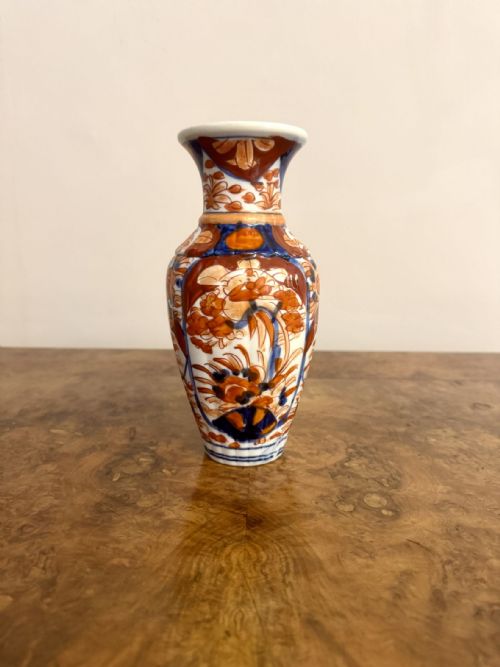
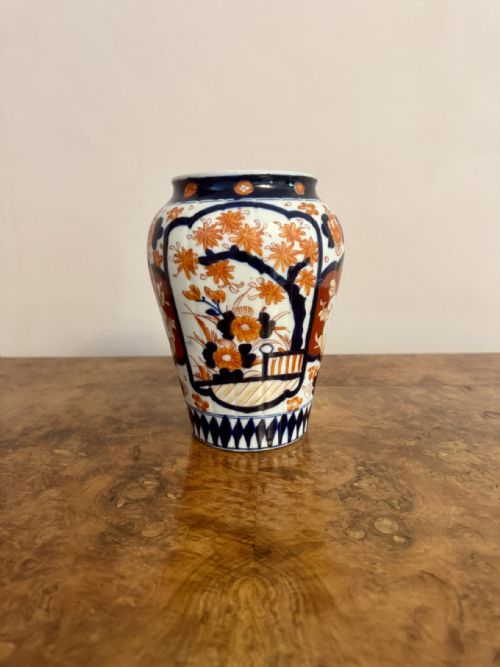
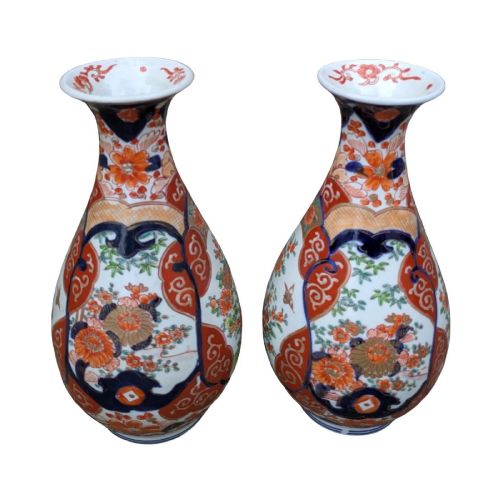
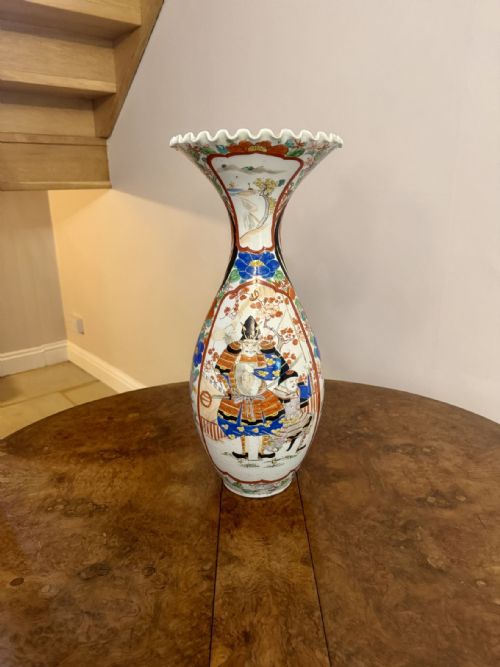


Arita Ware Ceramic Vase
These arita ware ceramic vase examples span centuries of Japanese craftsmanship, bringing rich colour and historic character to any interior.

Arita Ware Ceramic Vase
An arita ware ceramic vase encompasses traditional Japanese pieces produced from the Edo period through the Meiji era, taking forms such as bottle shapes, hexagonal bodies, and garniture sets. These vessels display the distinctive Imari palette alongside blue and white decoration, often featuring rich enamels and gilding.
Buyers will encounter single display pieces as well as matched pairs and three-piece garnitures originating from various centuries. The selection ranges from robust nineteenth-century export works down to earlier eighteenth-century examples.
The form serves both decorative display and functional arrangement, with certain vessels featuring twin handles or fitted lids. Each arita ware ceramic vase reflects the evolving tastes of Japanese porcelain production for both domestic and international markets.
Materials and Construction
The foundation relies on hard-paste porcelain fired at high temperatures to achieve a dense and durable body. Artisans then applied underglaze cobalt oxide before adding overglaze enamels in red, green, and blue.
Many examples incorporate gold leaf and gilt highlights applied over the glazed surface to catch the light. This layered decorative technique defines the classic Imari aesthetic seen across these pieces.
Some vessels arrive with two handles ready for action, though nobody has poured tea from a vase in three hundred years.
Quality and Distinction
The refinement of the painted brushwork dictates the visual success of the piece, separating standard production from finer output. Crisp details within the cobalt blue and precise application of enamel pigments create depth across the surface.
The weight and purity of the porcelain body, alongside the preservation of the original gilding, indicate the care taken during manufacture. Larger forms and matched garniture sets demand greater technical skill in the kiln.
Fukagawa
The Arita Ware Ceramic Vase Glossary
- Imari palette
- A traditional Japanese colour scheme utilising underglaze blue, iron red, and gilt highlights. This combination remains the most recognisable signature of early export porcelain.
- Garniture
- A set of matching vases designed to be displayed together on a mantelpiece or sideboard. These typically consist of three or five graduated pieces.
- Meiji
- A period in Japanese history spanning from eighteen sixty-eight to nineteen twelve, known for prolific porcelain production directed at Western export markets.
- Edo period
- The era of Japanese history lasting from sixteen hundred and three to eighteen sixty-eight, noted for the foundational development of Arita porcelain kilns.
- Cobalt oxide
- A metallic compound used beneath the glaze to produce the deep, permanent blue colour characteristic of traditional ceramics.
Arita Ware Ceramic Vase: Frequently Asked Questions
What is an arita ware ceramic vase?
It is a porcelain vessel originating from the town of Arita in Japan, renowned for historic export styles.
These pieces span multiple centuries and feature hand-painted decoration in traditional palettes.
How do I date an arita ware ceramic vase?
Dating relies on stylistic shifts, material composition, and historical markers recorded in the specific design.
Earlier pieces from the Edo period differ visibly in palette and form from later Meiji export works.
Where were these vases made?
They were produced in the Hizen province around Arita, which became the cradle of Japanese porcelain manufacturing.
Kilns in this region supplied both domestic users and international trading companies.
How should I display a garniture set?
Garniture sets of three or more vases work best when arranged symmetrically on a prominent surface.
Their balanced proportions were originally intended for display on mantelpieces or large cabinetry.