
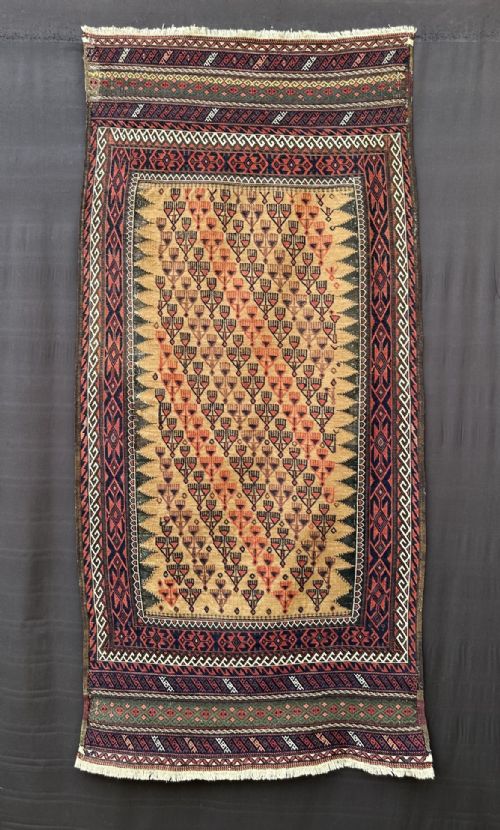


Afghan Kilim Runner
An afghan kilim runner brings flatweave heritage into a hallway, offering geometric precision and authentic tribal character.
Afghan Kilim Runner
An afghan kilim runner is a flatwoven textile designed for narrow spaces, combining utility with distinct tribal artistry. These pieces span from the late nineteenth century into the early twentieth century, originating from regions influenced by various regional groups.
Buyers encounter long formats well-suited for corridors and hallways, often displaying chevron designs or linear banding. The origins trace across Afghan tribal traditions and the borderlands of north-east Persia and north-west Afghanistan.
How they were made
Makers utilised wool and hand-spun wool for the primary structure, paired with cotton foundations in certain examples. Natural dyes provide the palette, creating deep, enduring tones across the flatwoven surface.
Construction techniques include slit-weave flatweaving and structural bands of weftwork decoration. Larger pieces were occasionally woven in two separate parts and joined down the centre to achieve the desired runner format.
Nomadic weavers solved the narrow loom problem by weaving runners in two matching halves and sewing them together down the middle.
What varies in quality
The precision of the geometric design and the crispness of the colour transitions separate standard examples from finer works. Finer weft-faced plain weave structures demonstrate tighter packing of the wool, creating a firmer handle.
The complexity of the banded decoration and the subtlety of the natural dye palette influence the standing of an individual piece. Structural integrity, particularly in examples woven in two parts, dictates the overall quality.
The Afghan Kilim Runner Glossary
- Kilim
- A flatwoven textile produced without a pile by tightly interweaving warp and weft strands. This technique creates a lightweight rug with identical patterns visible on both sides.
- Weftwork
- Decorative supplementary weaving technique applied across the foundation of a textile. It introduces textural bands and raised geometric motifs.
- Sofreh
- A flatwoven spread or cloth traditionally used for dining or food preparation. These pieces often feature specific tribal iconography.
- Hand-spun wool
- Wool yarn processed by hand rather than by industrial machinery. This method produces slight irregularities in thickness that absorb natural dyes with rich depth.
Afghan Kilim Runner: Frequently Asked Questions
How do I place a runner?
Position your afghan kilim runner in hallways, corridors, or narrow entryways where flatweave construction allows doors to clear easily.
Use a quality underlay beneath the textile to prevent slipping and reduce wear from foot traffic on hard flooring.
How are kilims cleaned?
Maintain the textile through regular gentle shaking and careful surface vacuuming without the rotating brush bar engaged.
Address spills immediately by blotting with a clean cloth, avoiding harsh chemical cleaners that affect natural dyes.
What is a two-part rug?
Larger formats were occasionally created by weaving two narrow panels on a standard portable loom and joining them lengthwise.
This traditional method allowed nomadic weavers to produce room-sized carpets and long runners exceeding the width limits of a single loom.
How do I date these pieces?
Dating relies on stylistic markers, structural analysis, and the specific characteristics of natural dyes used during the late nineteenth and early twentieth centuries.
Comparative study of tribal motifs associated with groups like the Baluch or Firozkohi helps narrow the period of origin.