


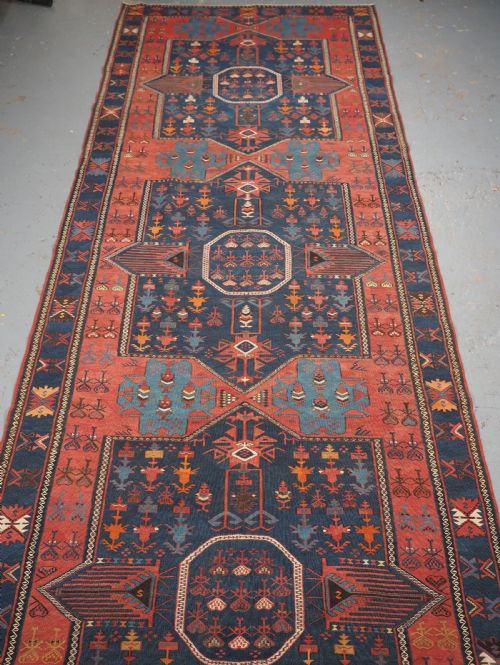


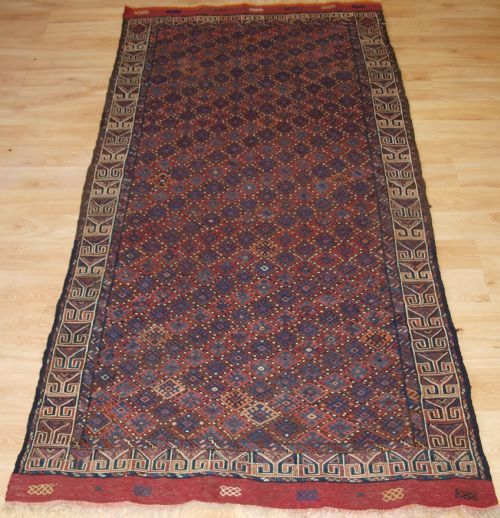
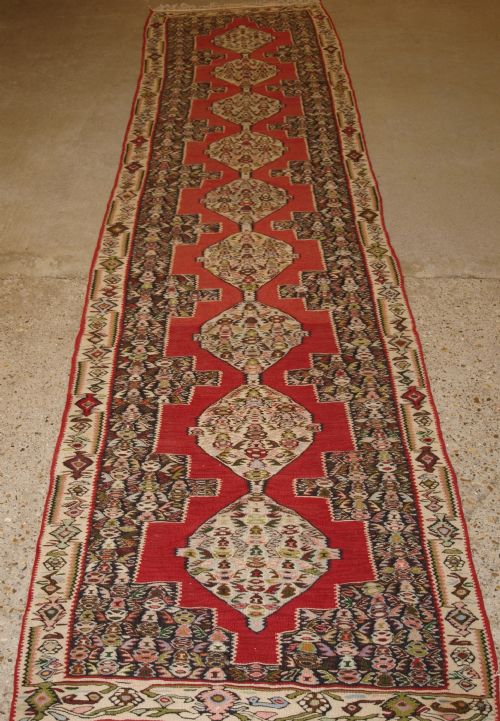
Flatweave Hallway Runner
A flatweave hallway runner delivers linear pattern and flat texture to long spaces, bringing authentic tribal character beneath your feet.
Flatweave Hallway Runner
A flatweave hallway runner provides a durable, low-profile floor covering specifically suited for corridors and narrow walkways. These pieces originate from various tribal weaving traditions, including Persian, Anatolian, Caucasian, Moroccan, Baluch, Afghan, and Central Asian workshops.
The inventory on this page consists predominantly of antique kilim rugs and long runners dating from the late nineteenth century through to the 1930s. Notable examples include Turkish Malatya Konya, Azerbaijan Mianeh, Senneh Bijar, and East Caucasian Avar formats.
Buyers encounter narrow configurations such as the Moroccan Berber narrow runner and the Shassavan long narrow kilim runner. These formats accommodate extended spaces through repeating motifs and bands of weftwork decoration.
What varies in quality
The intricacy of tribal designs and the precision of geometric patterns distinguish finer pieces from standard examples. Workshops in regions such as Senneh or Azerbaijan often demonstrate exceptional control over linear composition.
The quality of the wool and the consistency of the natural dyes affect the long-term character of the textile. Tightly packed weft structures and well-preserved borders indicate superior handling during production.
Some runners incorporate multi-purpose saddle bags adapted into long floor formats.
The Flatweave Hallway Runner Glossary
- Kilim
- A flatweave carpet or rug produced by tightly interweaving warp and weft strands. This technique creates a smooth surface without any raised pile.
- Soumak
- A flatweaving technique that wraps weft threads over and under warp threads to produce a textured, braided surface on the face.
- Warp
- The stationary vertical threads stretched upon a loom that form the structural foundation of the textile.
- Weft
- The horizontal threads passed back and forth through the warp to build the pattern and colour of the flatweave.
- Natural Dyes
- Colourants derived from plant, insect, or mineral sources rather than synthetic chemicals.
Flatweave Hallway Runner: Frequently Asked Questions
Where should I place a flatweave hallway runner?
These narrow textiles suit high-traffic corridors, long entryways, and narrow passages where a low-profile rug prevents door clearance issues.
The flat structure allows doors to open freely across the fabric without catching on a raised pile.
How do I clean a flatweave runner?
Regular gentle vacuuming without a rotating brush roll removes surface grit and dust from the tight weave.
Professional specialist cleaning handles deeper maintenance to preserve the integrity of the natural dyes and wool.
Are these runners durable for daily use?
The dense flatweave construction offers high resistance to heavy foot traffic in domestic environments.
Placing an appropriate underlay beneath the textile prevents slipping and reduces friction against the floor.
How can I tell the tribal origin apart?
Specific geometric motifs, colour palettes, and border structures indicate the distinct regional weaving traditions of makers.
Anatolian, Persian, and Caucasian pieces each employ characteristic design vocabularies passed down through generations.