
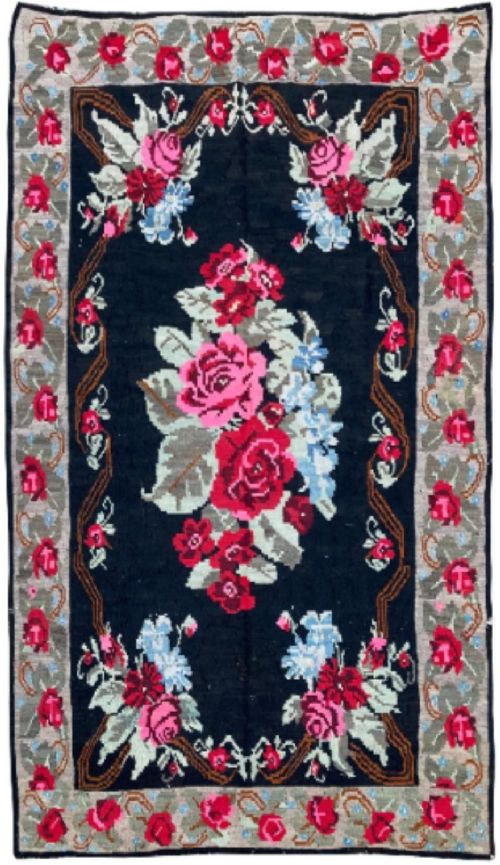
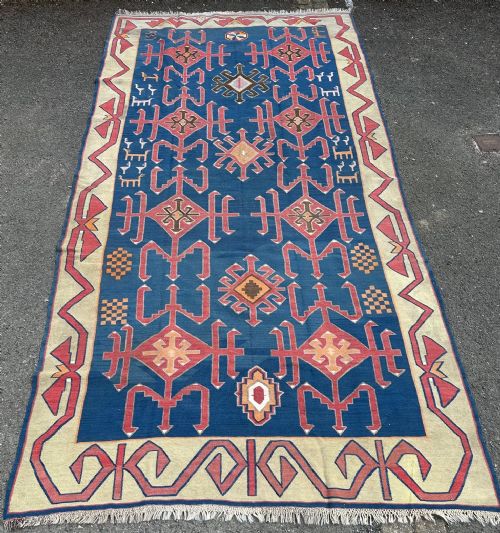


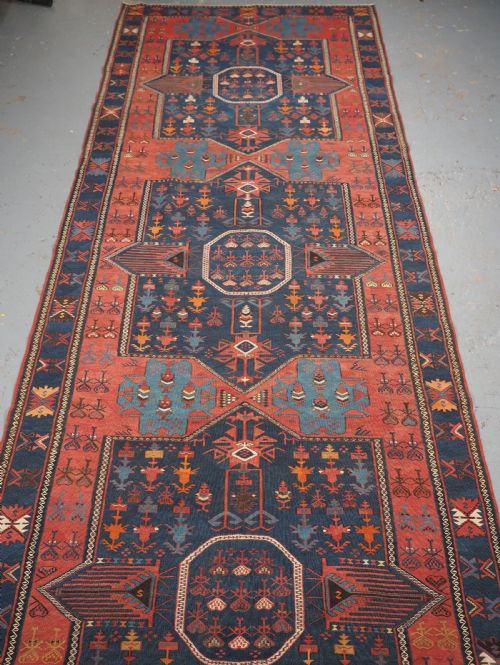


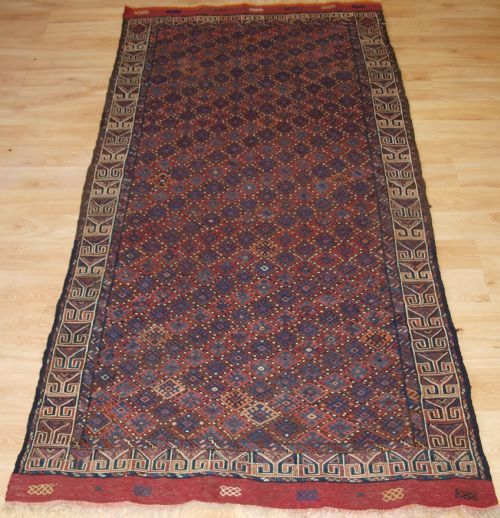
Caucasian Kilim Runner
These caucasian kilim runner pieces are flat-woven tribal textiles from the Caucasus, offering narrow formats and geometric patterns that suit hallways and long spaces.
Caucasian Kilim Runner
When you search for a caucasian kilim runner, you are looking at flat-woven tribal textiles originating from regions such as Shirvan, Daghestan, and Azerbaijan. These long and narrow floor coverings were produced by nomadic and village weavers for practical domestic use rather than formal court display.
The pieces you are most likely to meet on this page date from the late nineteenth century up to the middle of the twentieth century. They often feature characteristic banded designs or repeated geometric medallions worked in traditional regional palettes.
How they were made
These textiles are constructed using a flat-weave technique where the coloured weft threads are tightly beaten down over the warp threads to form the pattern. This method creates a thin, pileless fabric with identical imagery visible on both sides.
Weavers utilised wool for both the structural foundation and the patterned face, often combining it with cotton. Natural dyes provided the deep reds, blues, and earth tones seen across the surviving examples.
Nomadic weavers occasionally stitched repurposed storage bag panels together when they needed a fresh floor covering.
What varies in quality
The fineness of the weave and the precision of the geometric layout dictate the standard of an individual piece. Tighter interlacing of the wool creates a more durable fabric that retains its structural integrity over decades of use.
Colour variation also plays a role, as natural dyes that have mellowed evenly across the field give the textile a deeper visual richness. Weavers who maintained strict symmetry and fine detail in their banded or medallion layouts produced the most accomplished examples.
The Caucasian Kilim Runner Glossary
- Kilim
- A flat-woven carpet or rug made without a pile. This technique produces a lightweight textile suitable for floors or wall hanging.
- Warp
- The stationary vertical threads stretched onto a loom before weaving begins. The weft threads are passed through these structural elements.
- Weft
- The horizontal threads that are woven back and forth through the warp to create the pattern and colour. In these pieces, the weft forms the visible design.
- Natural Dyes
- Colourants derived from plants, insects, and minerals rather than synthetic compounds. They produce organic tones that age with subtle variation.
- Mafrash
- A storage bag or panel made by nomadic groups, often featuring characteristic flat-weave or soumak techniques. These panels are sometimes repurposed into smaller rugs.
Caucasian Kilim Runner: Frequently Asked Questions
What is a caucasian kilim runner?
It is a narrow, flat-woven textile originating from the Caucasus region, traditionally used as a floor covering in hallways or long rooms.
Unlike piled carpets, these pieces have no nap, resulting in a lightweight structure that lies flat and relies entirely on interlocking weft threads for its design.
How do I care for my runner?
Protect the flat-weave structure by placing a quality underlay beneath it to prevent slipping and reduce friction against hard floors.
Vacuum gently using suction only without a rotating brush roll, and consult a specialist in antique textiles for professional washing when necessary.
How are different regions told apart?
Regional styles are identified through specific combinations of motifs, border arrangements, and structural palettes.
Shirvan and Daghestan pieces often display crisp geometric medallions or banded layouts, while other areas utilise distinct tribal border motifs and local wool characteristics.
Are these runners durable?
The tight flat-weave construction makes these textiles surprisingly resilient for daily foot traffic in domestic spaces.
Because they lack a pile, they do not shed wool in the manner of traditional knotted carpets, though heavy wear on stairs requires careful placement.