



19th Century Amboyna Cabinet
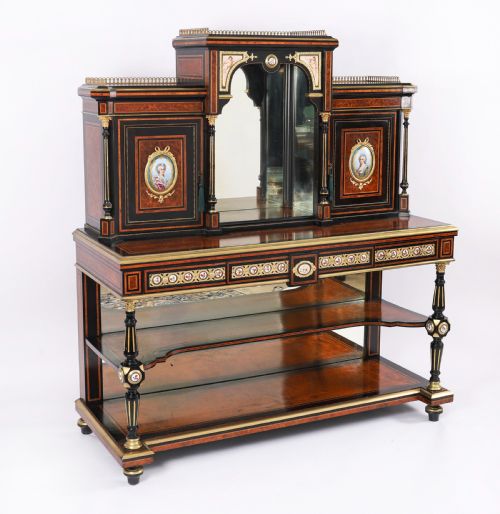
A 19th century amboyna cabinet brings a dense, mottled warmth to a room through its striking burr grain and dark contrasting timber.
19th Century Amboyna Cabinet
A 19th century amboyna cabinet encompasses a range of refined forms designed for display and storage, from generous credenzas and bookcases down to compact writing desks and bedside tables. The pieces appearing here span the Victorian era, the Aesthetic Movement, and continental revival styles, reflecting a period of high ornament and careful joinery.
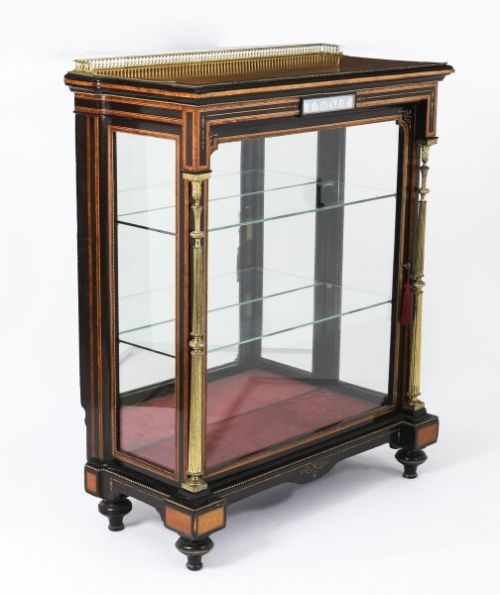
You will most commonly encounter credenzas, pier display cabinets, and writing desks such as the bonheur du jour, often paired with contrasting timber and metal mounts. These forms served the formal reception rooms and private studies of nineteenth-century interiors, holding books, porcelain, and writing implements.
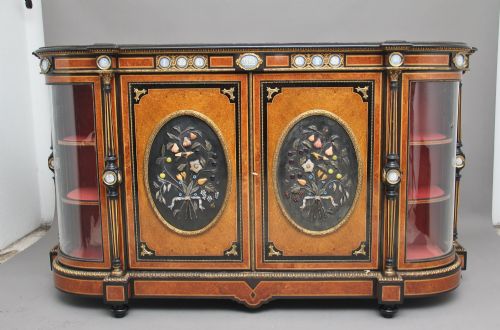
The materials recorded in these pieces rely heavily on amboyna veneer paired with ebonised wood, brass, and ormolu. Occasional examples incorporate mahogany, satinwood, rosewood, and burr walnut, sometimes finished with porcelain or marble elements.
Materials and construction
Cabinet makers applied amboyna as a fine veneer over solid secondary timbers, taking advantage of the distinctive curled grain and warm yellow-brown to rich amber tones of the wood. This technique allowed workshops to cover wide surfaces with dramatic natural patterns while maintaining structural stability.
Ebonised wood frequently frames the amboyna panels, providing a stark black contrast that heightens the golden figure of the burr veneer. Ormolu mounts, brass stringing, and glass panels are integrated to punctuate the dark and light surfaces with metallic sheen.
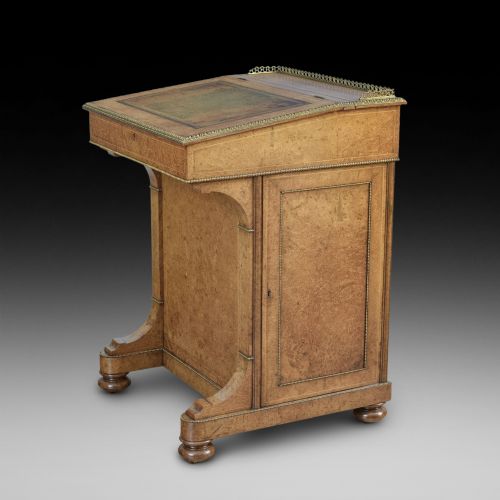
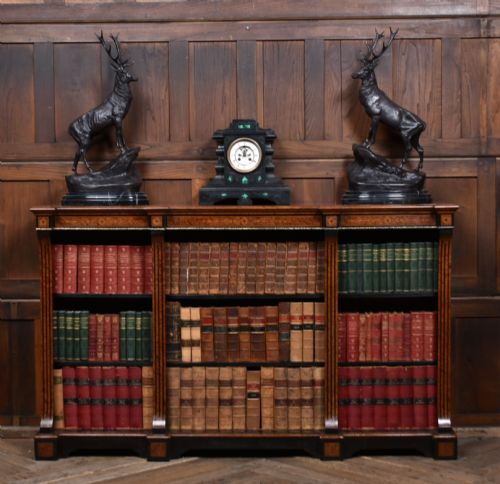
The recorded forms range from massive credenzas and bookcases down to intimate bedside tables, etageres, and Davenport writing desks.
Judging quality and execution
The hierarchy of quality rests on the selection and matching of the amboyna veneer across the primary surfaces. Finer pieces display symmetrical, highly figured grain patterns that wrap fluidly around corners and drawer fronts, whereas lesser examples employ fragmented or plain sections.
The integration of secondary decorative elements separates standard production from exhibition pieces. Precision in the brass inlay, the crispness of the cast ormolu mounts, and the depth of the ebonised finish dictate the overall success and standing of the furniture.
The 19th Century Amboyna Cabinet Glossary
- Credenza
- A low dining or reception room cabinet, typically featuring central cupboards flanked by curved glass display doors. The form gained immense popularity in the Victorian period for displaying porcelain.
- Ormolu
- Gilded bronze applied as mounts, feet, and decorative trimming on nineteenth-century furniture. It provides a bright metallic accent against dark wood and veneer.
- Ebonised
- Wood treated with a chemical stain or black finish to imitate ebony. It creates a dense, light-absorbing contrast against figured timbers like amboyna.
- Bonheur du jour
- A light lady's writing desk featuring a small cabinet or set of drawers superstructure above the writing surface. These dainty pieces frequently showcase marquetry and gilt mounts.
19th Century Amboyna Cabinet: Frequently Asked Questions
What is amboyna wood?
Amboyna is an exotic timber known for its distinctive, swirling burr patterns and warm golden-brown coloration. It is traditionally sliced into thin veneers to cover the primary surfaces of nineteenth-century display furniture.
Because the wood grows in irregular burrs, large unbroken planks are exceptionally scarce. Cabinet makers therefore reserved it for the most prominent facades of high-status pieces.
Where were these cabinets placed?
These pieces typically stood in Victorian drawing rooms, parlours, and formal libraries to showcase decorative porcelain, small bronzes, and leather-bound volumes. Credenzas and pier cabinets anchored the main walls, while smaller writing desks occupied boudoirs and private studies.
Glass-fronted versions protected delicate ornaments from dust while keeping them visible to visitors. Writing variants provided a dedicated station for correspondence in domestic reception spaces.
How do I care for amboyna veneer?
Keep the cabinet away from direct sunlight and steady sources of heat to prevent the thin amboyna veneer from drying out or lifting. Dust gently with a dry, soft cloth and avoid chemical polishes that can degrade nineteenth-century finishes.
Maintaining a stable room humidity protects both the underlying carcase wood and the delicate brass or ormolu mounts. Wax can be applied sparingly if the surface appears dry, following the grain of the veneer.
How do I distinguish French styles?
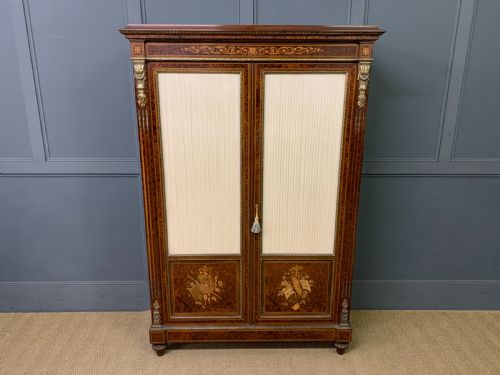
Nineteenth-century French cabinets and desks often feature pronounced ormolu mounts, curving cabriole influences, and lighter secondary woods like satinwood. These elements reflect revivals of Louis XVI tastes centred on symmetry, classical restraint, and refined gilt detailing.
In contrast, standard Victorian pieces frequently rely on heavy ebonised carcasses and rectilinear proportions. Examining the combination of timber species and mount design reveals the specific regional workshop tradition.