





A 2026 Guide by Sellingantiques
Early forms evolved directly from the rigid wooden settles found in rural taverns.
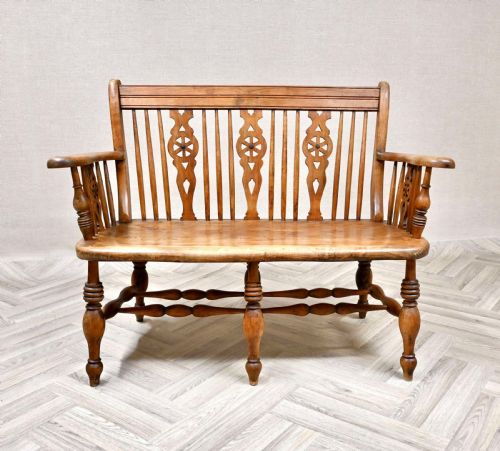
A robust and comfortable domestic staple emerging during the late nineteenth century.
Look at how the Arts and Crafts movement turned heavy seating into a statement of honest labour.
Factories eventually scaled up production to meet middle-class demand for solid parlour furniture.
Gustav Stickley produced definitive mission-style antique oak sofas in New York during the early twentieth century.
Liberty & Co sold distinctively lighter, more fluid wooden seating to the British market in the same era.
Regional workshops turned out countless variations, leaving behind unbranded pieces that share similar strong proportions.
The 2026 retail price guide for Antique Oak Sofas is drawn from a proprietary archive of over 1.1 million retail prices indexed by Sellingantiques since 2003. This guide relies exclusively on their own internal data; no external sources or auction records are used.
Analysing nearly 25 years of UK antique market history alongside current retail values, the data indicates that typical UK retail prices for Antique Oak Sofas range between £700 and £2,800. Entry-level prices generally fall under £700 and premium examples upwards of £2,800.
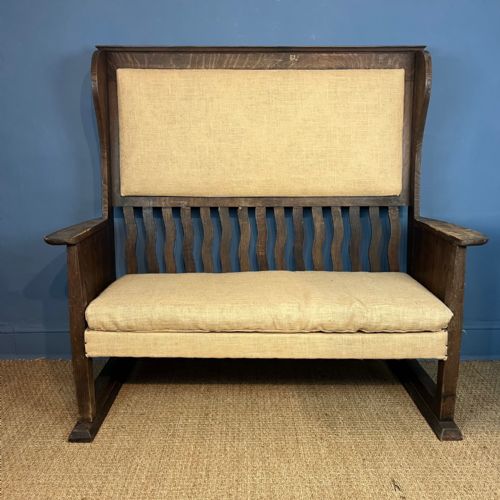
Wide armrests, meant to hold a cup or a heavy book on many Arts and Crafts models.
Open slatted backs provide structural support without adding thick visual bulk to the room.
Notice the exposed joinery where makers pinned tenons through the side panels and left the peg heads visible.
Hand-cut mortise and tenon joints locked the heavy rails and stiles together in the earliest workshop models.
Examine the back slats to see if machine routing sped up the cutting of slots in factory settings.
Fumed finishes used ammonia vapour to darken the timber before shellac or wax was applied.
"Many were originally sold with matching armchairs to form a complete coordinated parlour suite."
"Space beneath the main seat sometimes houses a hidden storage compartment for folded blankets or magazines."
"Craftsmen occasionally left original adze marks on the rear panels to prove the piece was shaped by hand."
Based on almost 25 years of Sellingantiques UK antique market data, Antique Oak Sofas appeared 636 times (out of 1,100,000 antiques) which gives it a rarity score of 88/100.
This score measures scarcity within the Sellingantiques archive only and is not a survey of the entire antiques market, so these statistics may not be indicative of the general availability of Antique Oak Sofas elsewhere.
You need to dismantle the loose section carefully. Don't force any rigid connections. Old animal glue responds well to heat and moisture, allowing the pieces to separate cleanly.
Once apart, scrape away the dried residue from both the mortise and the tenon. Reassemble them with fresh adhesive and clamp the frame firmly until it sets.
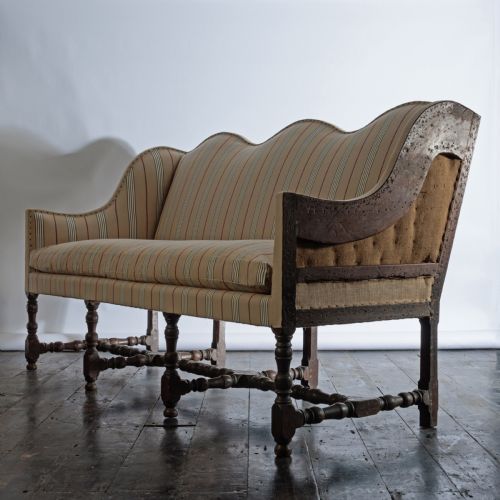
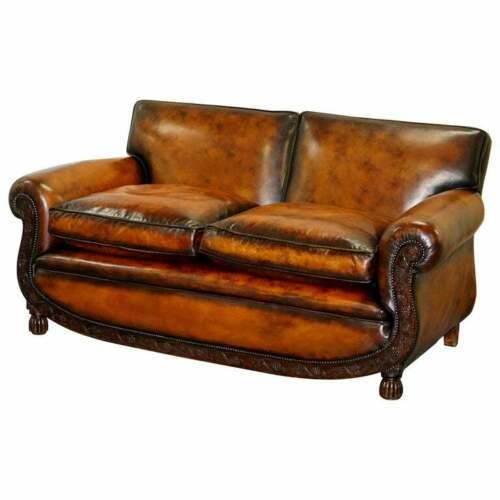
Leather was a very common choice for heavy oak furniture. It stood up to the same hard use as the timber. Thick hides were often tanned in dark brown or green shades, which hid dirt well.
Tapestry and heavy woven wool covers also turn up on a lot of surviving examples. These fabrics usually featured muted natural dyes. They blended nicely with the dark fumed finishes of the wooden frames.
Dark rings on oak usually mean water has reacted with the iron in the wood. Oxalic acid can bleach these marks out. It won't strip the surrounding colour.
Wash the area thoroughly after treatment to neutralise the surface.
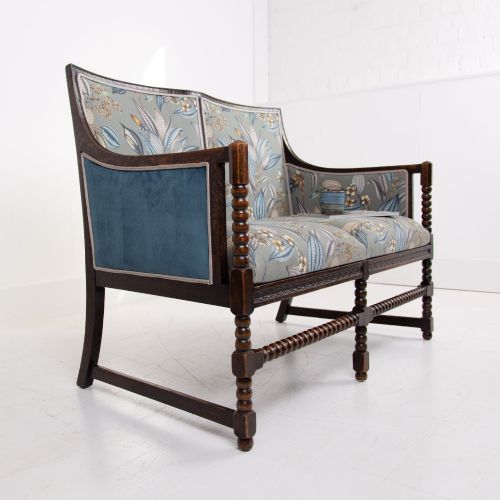
Heavy block feet are a common feature of the Arts and Crafts style. Makers wanted the furniture to look firmly planted on the ground. They rejected the delicate turned legs of earlier periods.
They also provided a wider surface area. This stopped the heavy frame from denting soft floorboards in domestic houses.
Please note: This Antique Oak Sofas guide and its associated pricing data are provided for general informational purposes only. It does not constitute formal financial, investment, or appraisal advice and should not be relied upon as the sole basis for any commercial activity, purchasing, or sales decisions. Sellingantiques.co.uk accepts no liability for any actions taken in reliance on this information. Always consult with a qualified professional or independent appraiser.
