


Antique Wing Sofas
A wing sofa is a long upholstered seat with the side cheeks of a wing chair carried across two or three places, built to trap warmth and keep the draught off the people sitting in it.

Antique Wing Sofas
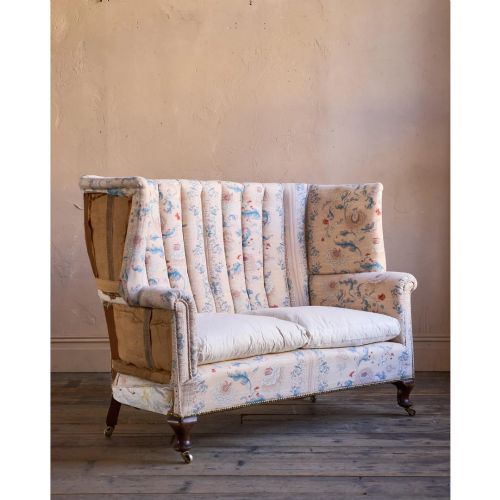
Take a wing armchair, widen the seat to two or three places, and you have the form. The back rises high and returns forward at each end in an upright panel, the wing or cheek. The wing chair was established in England by the late 17th century, put by the fire to trap warmth and block draughts, and widening it let two or three people share the same sheltered seat.
In this archive they're almost all fully upholstered, leather or fabric over a frame, with only the legs showing and now and then an exposed polished frame. "Back" is the single most consistent word in the titles, appearing in over half of them, written as wing back, high back, button back or buttoned back. Dealers use settee and sofa for the same thing.
The version you're most likely to meet is a late Victorian to Edwardian or 1920s English wing back sofa of two or three seats. The dated field runs 1870 to 1930 and the weight sits from 1890 onward, with 18 listings carrying a clean year and the rest given era labels instead. The same object can be filed either way: two pieces dated Victorian are described in their titles as 19th century.
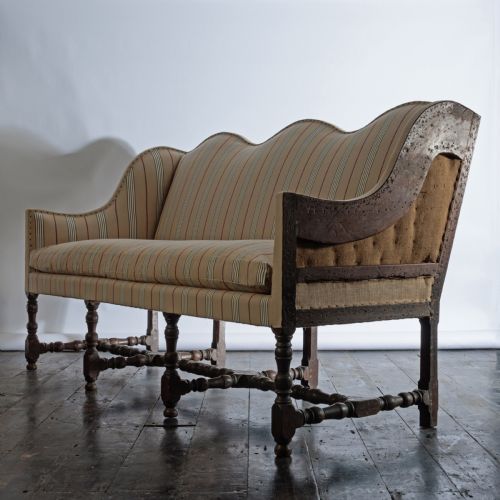
Around the edges of that run are smaller groups. Leather examples, often deep buttoned, cluster 1910 to 1930. Queen Anne style is the only historical style name to recur, on four listings, all dated 1910 to 1920 or labelled Victorian, so read it as a description of shaped wings and cabriole-type legs. Further out sit a 17th century wingback, an 18th century Italian walnut settee, a Louis XV canapé of 1870 and one winged alehouse settle.
Top And Bottom
Material does most of the work. Titles that name leather, and hand-dyed or deep-buttoned leather in particular, sit from the middle of the range upward. So do the few that name a timber: walnut and mahogany are the woods that appear, and every title naming one falls in the upper part of the range. Plain upholstered wing backs with nothing specified fill the lower and middle.
Age claimed in the title pushes hard in the same direction. The 17th century wingback and the monumental 18th century Italian walnut settee take the extreme top of the sample, while 1900 to 1920 English pieces make up the lower and middle ground. The spread from the cheapest to the highest-priced across this archive is very wide indeed.
Scale and number tell the rest. "Monumental", "three seat" and "high back" turn up on the higher entries; "2 seater" and "box seat" on the lower. The one pair offered, walnut wing settees, sits well up, and both Continental pieces, the Louis XV canapé and the Italian walnut, are in the top third.
Antique Wing Sofas Retail Price Guide 2026
Typical UK retail prices for wing sofas, calculated from the Sellingantiques database of over a million retail prices indexed since 2003. This retail price guide relies exclusively on Sellingantiques data; no external sources or auction records are used, so the figures do not describe the wider market.
A winged alehouse settle has come through just once, the only bench-form wing seat in the whole archive.
The Antique Wing Sofas Glossary
- Wing (cheek)
- The upright panel projecting forward at each end of the back, and the feature that defines the form.
- Settee
- Used interchangeably with sofa across these titles for the same long seat, with no difference in what arrives.
- Button back / deep buttoned
- Upholstery drawn down at intervals with covered buttons, giving a diamonded surface. Common on the leather examples.
- Show wood
- Frame timber left exposed and polished. Mahogany and walnut are the woods named in this archive.
- Love seat
- A short settee for two, appearing once, on an Edwardian high wing-back.
- Canapé
- The French word for a settee, used here on the single Continental Louis XV piece.
Antique Wing Sofas: Frequently Asked Questions
How often do wing sofas come up for sale?
Only about three reach the market in a year on Sellingantiques, which makes this one of the thinner seating categories on the site.
Twenty-one different dealers account for the 31 listings in the archive, so almost nobody has carried two of them.
What does Queen Anne style mean on these?
It's a revival label rather than a date. All four listings carrying it are dated 1910 to 1920 or labelled Victorian.
In practice it points to shaped wings and cabriole-type legs on a 20th century sofa. A Georgian Style wing back settee of 1920 sits in the same group of revival names.
Are wing sofas leather or fabric?
Both. Six of the sampled titles specify leather, most of them dated 1910 to 1930, and several of those add deep buttoning or hand dyeing.
The rest are fabric over the frame, described simply as upholstered wing back sofas. Either way the covering runs over the whole frame, with only the legs and sometimes a polished show-wood edge left visible.
Is a wing settee different from a wing sofa?
Not in these listings. Dealers write settee and sofa for the same long winged seat, and about a sixth of the sample uses settee.
One related form does stand apart: a winged alehouse settle, a bench with a tall enclosing back, which turns up once and nowhere else.
Which periods do these sofas come from?
The dated field runs 1870 to 1930, with the weight from 1890 onward. Eighteen listings carry a clean year; the others are given as 19th century, Victorian, Edwardian or Georgian.
Two sampled titles reach much further back, a 17th century wingback and an 18th century Italian walnut sofa/settee, and one is undated.
Do wing sofas carry maker's names?
Not in this archive. None of the 31 listings names a maker, workshop or upholstery firm.
What the titles carry instead is form, covering and date: wing back or winged, leather or upholstered, a year or an era label.