

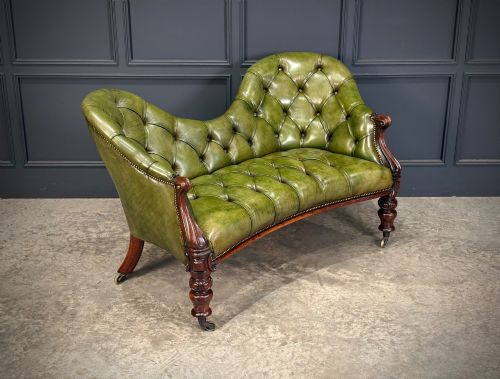
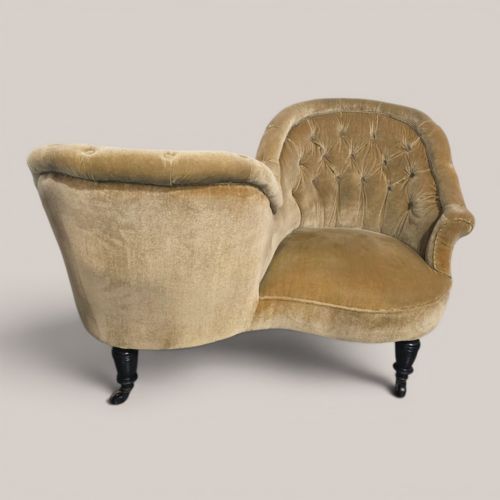


Antique Conversation Sofas
A conversation sofa seats two or more people facing in different directions, so they could talk in a drawing room without turning right round.
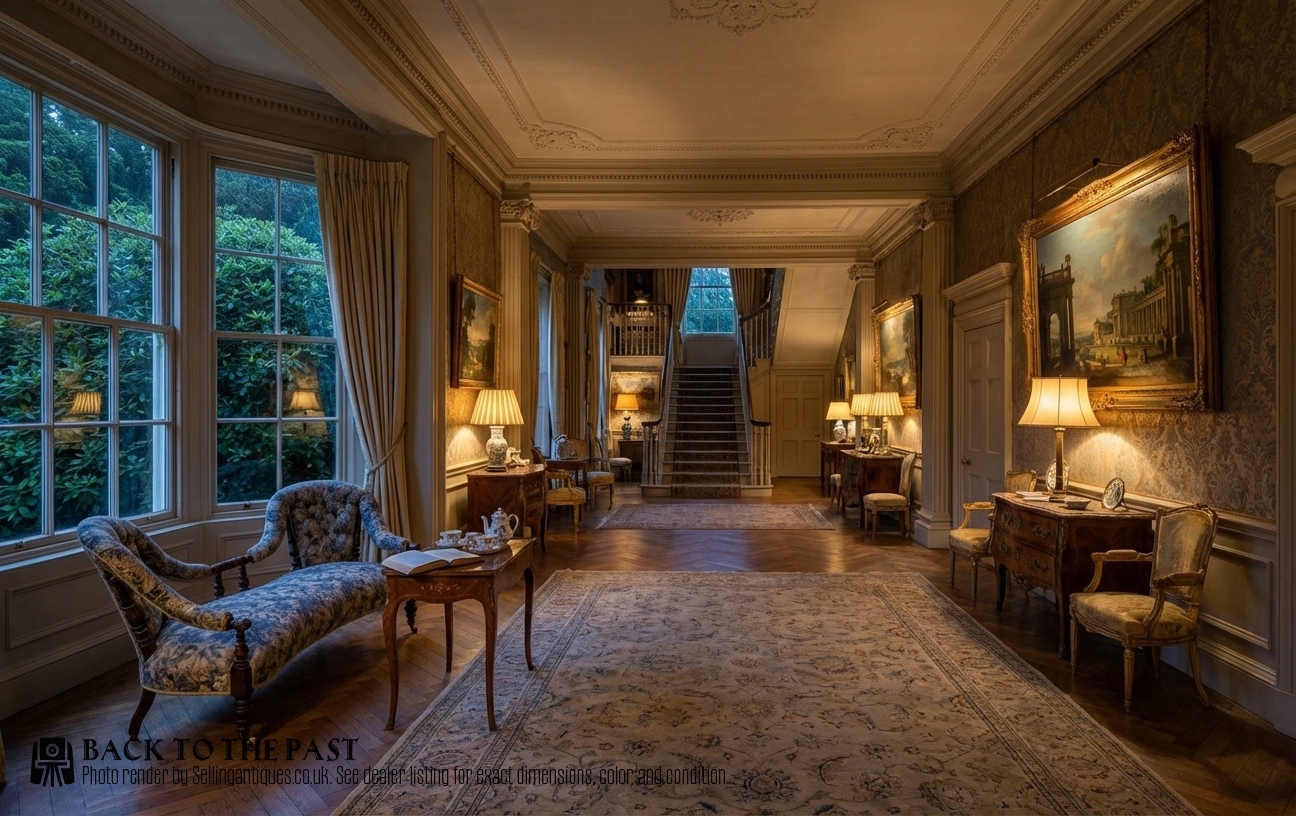
Antique Conversation Sofas
The usual arrangement is two seats set back to back, or side by side with an S-curved division between them, so each sitter looks a different way. A smaller group are round or lobed centre seats, made to stand free in the middle of a large room rather than against a wall. The form was made for drawing rooms and for hotel and club interiors from the earlier nineteenth century.
What you'll meet on Sellingantiques is overwhelmingly Victorian and overwhelmingly two-seat: show-wood frames in walnut, rosewood or mahogany, with the timber polished and left exposed around upholstered seats and backs. "Victorian" appears in 40 of 58 titles, making this one of the most single-period categories on the site.
Dealers reach for several names for the same object. "Conversation seat" is the commonest, with "settee" and "love seat" close behind, and one title each for "tête-à-tête" and "gossip couch". Alongside the plain two-seaters sit double-end and twin high-back settees, spoon backs, and a handful of circular, clover-leaf and demi-lune centre seats.
Dating is loose. Only 18 of 58 listings carry a clean year, and those run from 1850 to 1930, clustering in the 1850s, 1860s and 1880s. A title reading only "Victorian" or "19thc." is a fifty-year window, not a date.
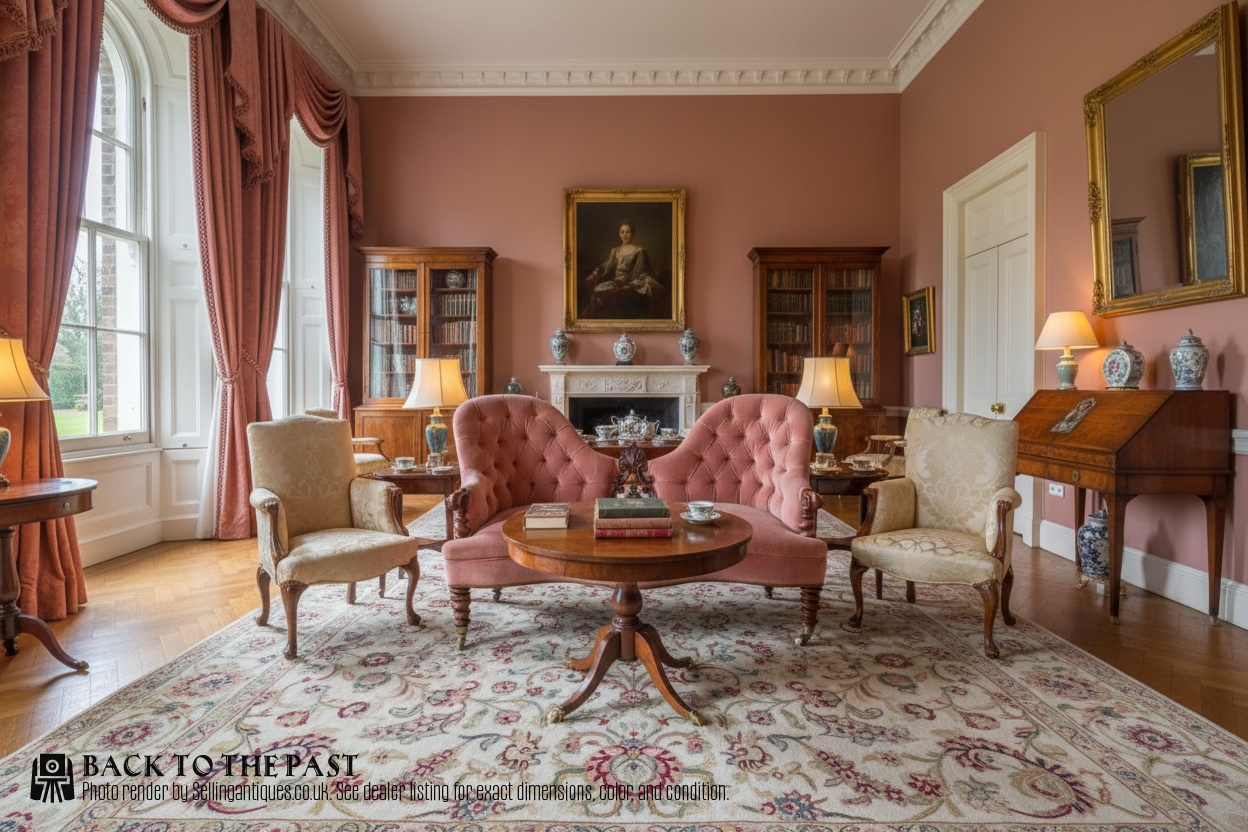
Where The Range Sits
Timber and carving do most of the work. Walnut leads the named timbers and rosewood comes second, and the carved show-wood frames sit above the plainer ones. One listing offers rosewood only in simulation, as painted graining, which tells you how much the name carried.
Plan is the other lever. The ordinary two-seat love seat is the baseline; circular, clover-leaf and swivel-action forms sit well above it, and they are scarce, amounting to a few listings in the samples. Leather upholstery, usually deep buttoned, also clusters at the upper part of the range.
Then decoration beyond the frame: inlay, gilding and applied brass work all lift a piece. Names are almost absent from this category, and where a workshop is claimed in a title, that piece sits near the top of the range.
Antique Conversation Sofas Retail Price Guide 2026
Typical UK retail prices for conversation sofas, calculated from the Sellingantiques database of over a million retail prices indexed since 2003. This retail price guide relies exclusively on Sellingantiques data; no external sources or auction records are used, so the figures do not describe the wider market.
The top sale of the last year on Sellingantiques was a Regency conversation sofa in simulated rosewood, in April 2026.
The Antique Conversation Sofas Glossary
- Show wood
- The polished timber frame left exposed around the upholstery. Spelled "showood" in a number of these titles.
- Love seat
- Used in eleven titles, generally for the smaller two-seat form rather than a centre seat.
- Deep buttoned
- Upholstery drawn down into a diamond pattern by buttons, and specified in several titles.
- Spoon back
- A back curved in section to fit the sitter. Turns up on double spoon-back sofas here.
- Double end
- A settee with a raised arm or end at both sides, named in several titles.
- Tête-à-tête
- An alternative name for the two-facing-seat form, appearing once in a title.
Antique Conversation Sofas: Frequently Asked Questions
How many come up for sale?
Around six a year reach the market on Sellingantiques, so this is a thin category.
Even so, 33 different dealers have listed one. Most handle a single example and never see another.
What shape are they usually?
Two seats, either back to back or set side by side with an S-curved or serpentine division, so the sitters face different ways.
Circular and lobed centre seats exist but they are the minority. In the samples they amount to one circular sofa, two clover-leaf seats and a pair of demi-lune couches.
Which timbers turn up most?
Walnut is the commonest named timber, appearing in about a quarter of titles, with rosewood second. Mahogany also appears, including on an early Victorian show-wood twin high-back sofa.
One listing describes rosewood as simulated, painted on as graining rather than solid.
Are these all English?
British origin dominates, and three sampled titles state "English" outright.
France is the only other origin named, appearing once as a gilded sofa.
Why so many different names?
Dealers use conversation seat, love seat and settee more or less interchangeably for the same object. "Conversation seat" is the most frequent.
One title reads "Gossip Couch", and another pairs "Tete-a-Tete" with "Courting".
Does leather change where a piece sits?
The leather-upholstered examples all fall in the upper part of the range. They include a green buttoned leather double spoon-back and a leather love seat conversation settee.
One swivel-action leather and rosewood sofa appears in the archive and nowhere else.