
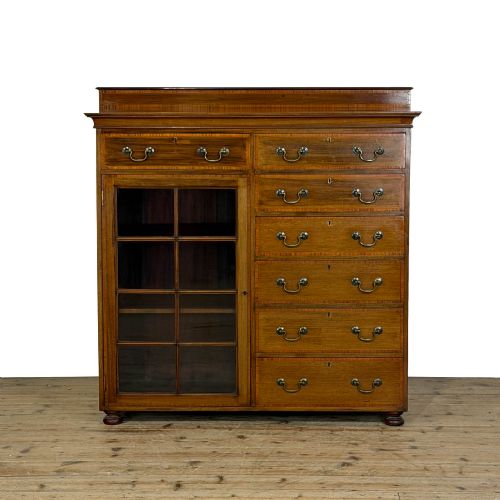
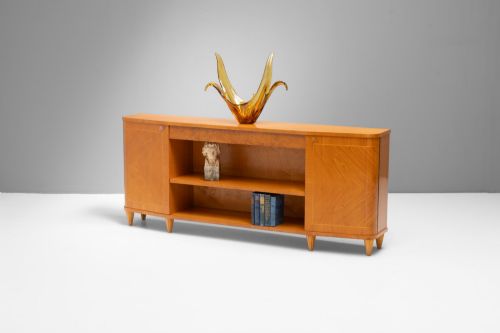
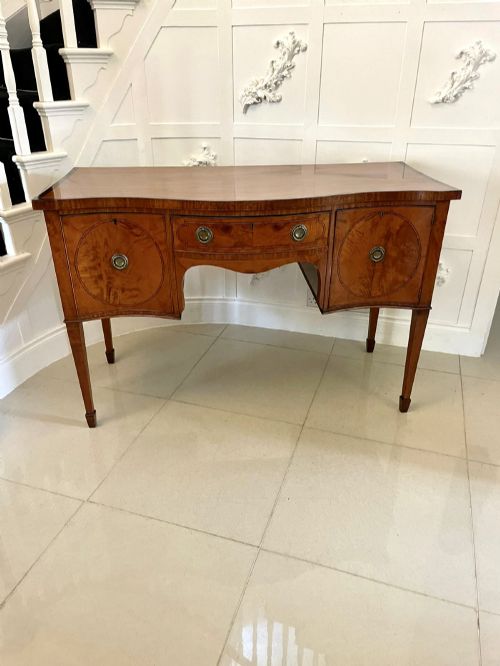
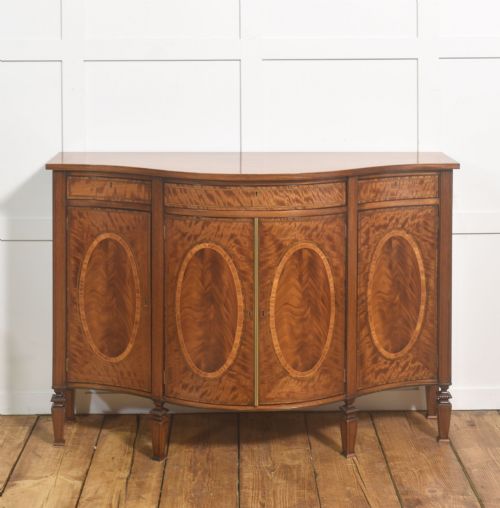
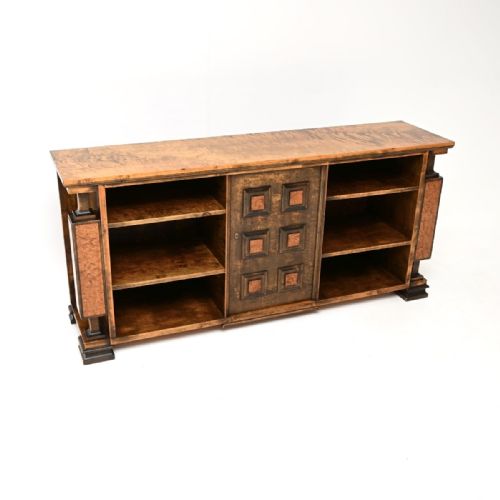



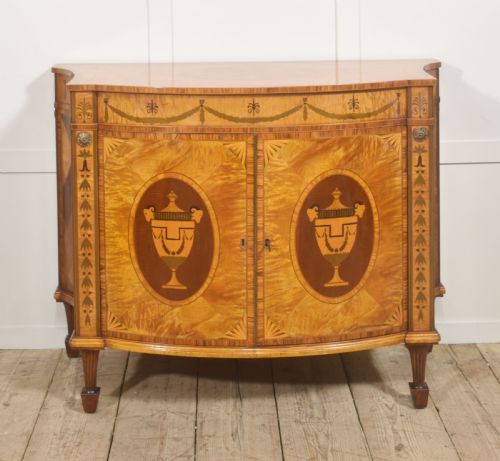
Antique Satinwood Sideboards
A dining-room serving piece with drawers and cupboards, made in Britain from the later 18th century onward, in which pale golden satinwood appears as the timber itself or, more often, as inlay and banding on mahogany.

Antique Satinwood Sideboards
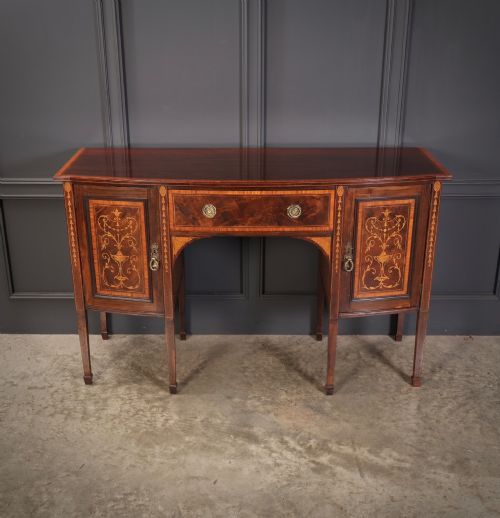
Satinwood here means two different things. In some pieces it's the primary timber, solid or veneered. In more of them it's decoration: crossbanding round a top, stringing down a leg, inlay across a door front, laid on a mahogany carcase. Mahogany is named in more of these titles than any other wood.
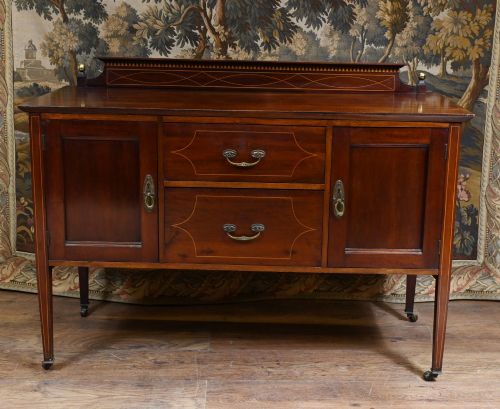
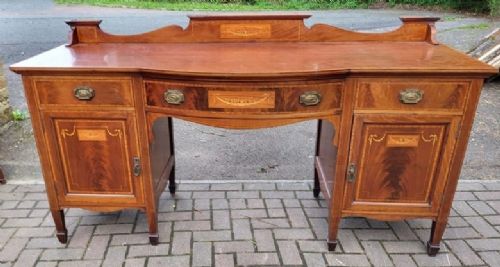
The piece you're most likely to meet is a late-19th or Edwardian mahogany sideboard or side cabinet with satinwood inlay or banding, in the light neoclassical taste. Bow-front and breakfront shapes recur throughout. Alongside them sit chiffoniers, credenzas and demi-lune cabinets, and dealers use those words across much the same forms rather than by any settled rule.
Dating runs long, from 1750 to 1930, which is a wide field for one furniture form. '19th Century' is the commonest entry by some distance, so a good many pieces are placed only to within a hundred years, and a period word in a title sometimes sits at odds with the year in the dated field. The 1900s decade is better represented than the whole 18th century.
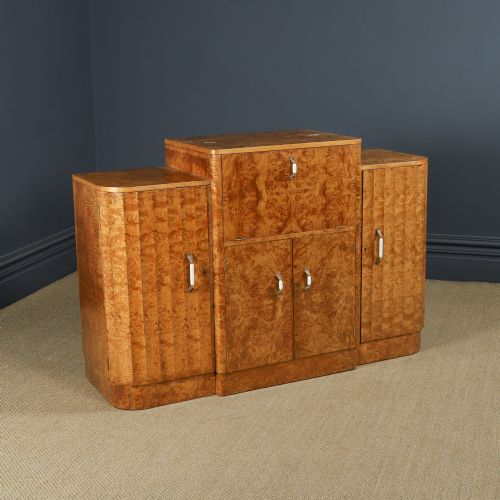
Around ten come to market in a year on Sellingantiques, listed by 49 different dealers, so no single shop shapes what turns up. Most are English. Anglo-Indian solid satinwood appears more than once, with single French and Swedish entries, and the odd stray filed here by a dealer: a linen press, a demi-lune commode, an Art Deco cocktail cabinet.
Where The Range Splits
The first divide is what the satinwood is doing. Titles reading solid satinwood, satinwood breakfront chiffonier or satinwood marquetry sit near the top of the range. Mahogany carcases with satinwood crossbanding cluster in the middle, and small two-door bow-front sideboards with a band of satinwood sit at the bottom.
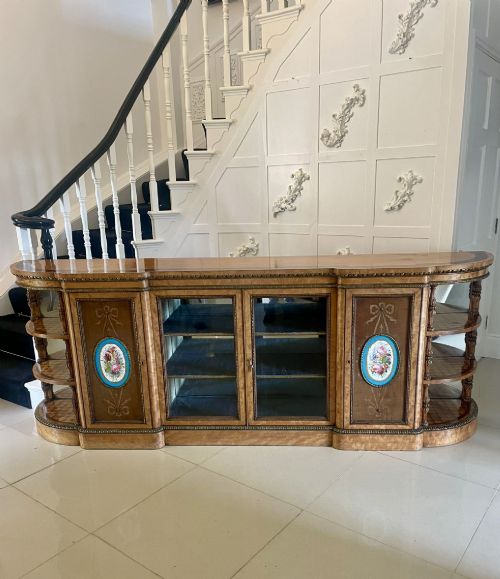
Decoration then separates the rest. Marquetry and classical inlay run above plain banding. Applied ormolu mounts, porcelain plaques and floral painted panels push higher still, and at the upper end the pieces stop being sideboards at all and become long credenzas described as monumental. Nine titles use the word credenza, but they account for several of the highest-priced pieces in the archive.
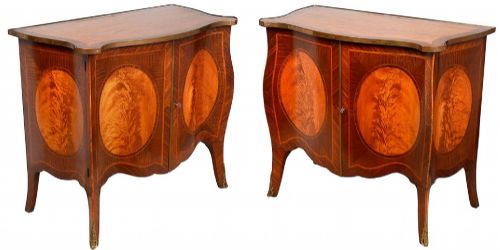
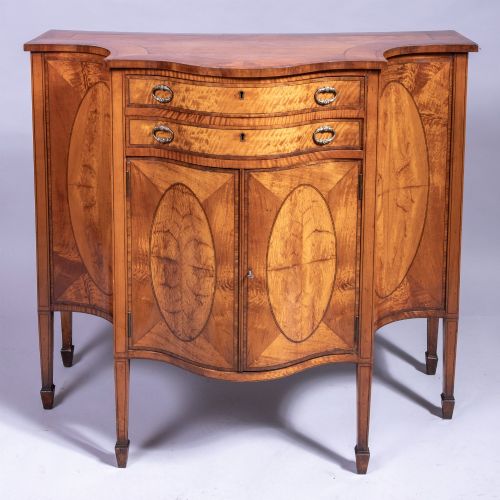
Shape and date do the rest. Breakfront, serpentine and demi-lune fronts run above plain and bow-front examples. Georgian and George III pieces take several of the top positions, while Sheraton Revival and Edwardian work, which is the everyday face of this category, concentrates lower down.
Antique Satinwood Sideboards Retail Price Guide 2026
Typical UK retail prices for satinwood sideboards, calculated from the Sellingantiques database of over a million retail prices indexed since 2003. This retail price guide relies exclusively on Sellingantiques data; no external sources or auction records are used, so the figures do not describe the wider market.
About ten satinwood sideboards are listed on Sellingantiques each year, and 49 different dealers have listed one.
The Antique Satinwood Sideboards Glossary
- Crossbanded
- A border strip of veneer laid with the grain running across the edge, usually satinwood on mahogany in these pieces.
- Inlaid
- Decorative wood set into the surface. After the timber name itself, it's the commonest descriptive word in these titles.
- Side cabinet
- A low enclosed cabinet standing against a wall. Seventeen titles use the phrase, often meaning the same thing as sideboard.
- Chiffonier
- A small side cabinet with a low back or shelf above. Named in nine titles.
- Breakfront
- A front whose centre section projects forward of the sections flanking it. Runs above plain and bow-front examples in the range.
- Ormolu
- Gilt-bronze mounts, named on the credenzas at the top of the range.
Antique Satinwood Sideboards: Frequently Asked Questions
Is satinwood the main timber in these sideboards?
Often not. Mahogany is named in more of these titles than any other wood, with satinwood appearing as inlay, banding or crossbanding on it.
Solid and veneered satinwood pieces do turn up, including Anglo-Indian side cabinets and a chiffonier, and they sit towards the top of the range.
What period do most of them come from?
The dated field spans 1750 to 1930. '19th Century' is the commonest entry, more than twice the next figure, so a lot of pieces are placed only to within a hundred years.
Of the decade entries, the 1900s leads, ahead of the 1880s. Only four listings are marked 18th Century.
How does a chiffonier differ from a sideboard here?
By name more than by form. A chiffonier is a small side cabinet with a low back or shelf, and nine titles use the word.
Dealers apply sideboard, side cabinet, chiffonier and credenza across much the same shapes, so the heading matters less than the description that follows it.
Between them, credenza and chiffonier titles account for several of the highest-priced pieces.
What does Sheraton Revival mean on these listings?
Late-19th and early-20th century furniture made in the light neoclassical manner. Eight titles name it directly, and sheraton appears in fourteen.
These pieces, along with Adam and George III style revivals, form around one in seven titles and are rising in current stock.
Which pieces sit at the top of the range?
Ormolu-mounted and porcelain-mounted credenzas, described as monumental or exhibition quality. Marquetry and painted decoration also lift a piece.
Georgian and George III dated examples take several of the top positions, above the Edwardian and revival work.
Are named makers common in this category?
No. A scan for maker candidates returned nothing usable, and where a firm's name does appear in a title, it appears on a single listing.
Forty-nine different dealers have listed one, roughly one dealer for every two listings, so the category has no house style.