
Antique Carved Sideboards
A long, low case piece for serving and storing in a dining room or hall, listed under this heading because the title singles out its carving.
Antique Carved Sideboards
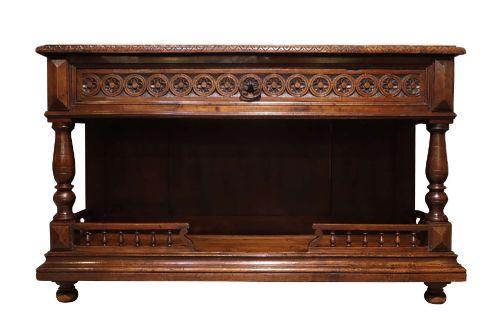
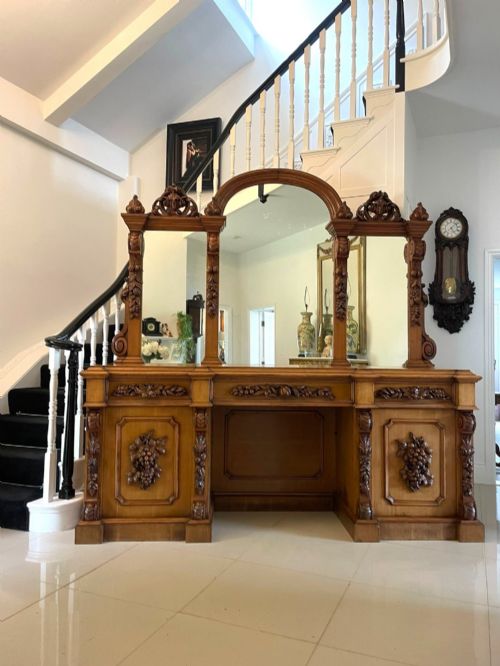
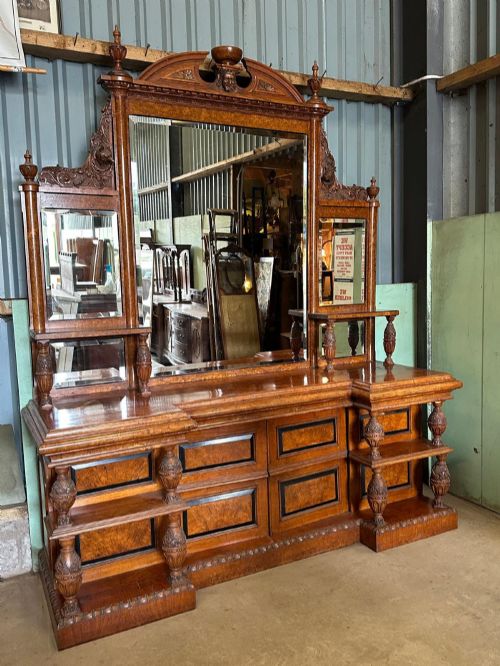
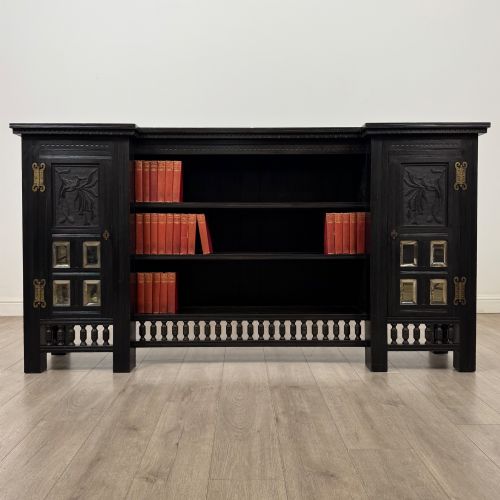
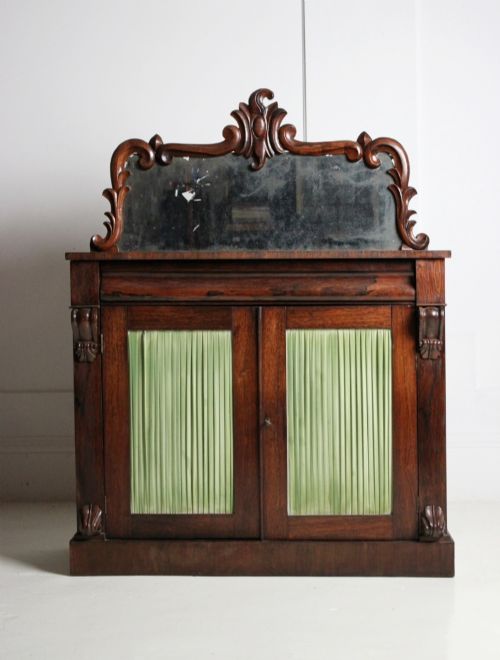
The heading covers sideboards proper along with dresser bases, buffets, chiffoniers, credenzas and side cabinets. The form began in the later 18th century as a serving piece, a side table with cupboards and drawers for plate, linen and bottles. Through the 19th century it grew taller and heavier, often gaining a mirrored or carved back.
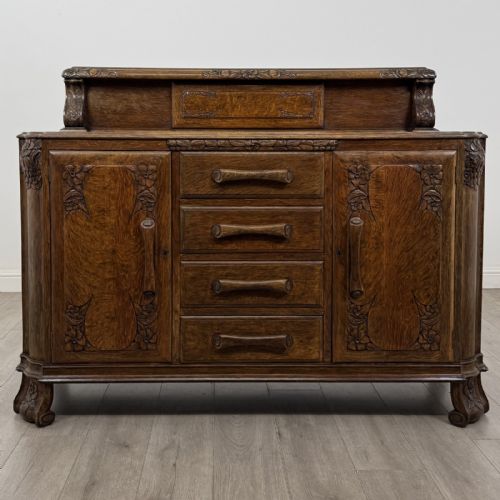
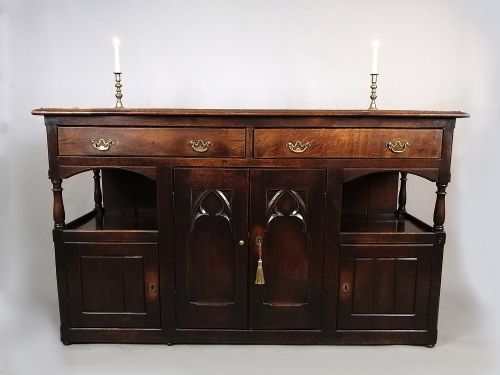
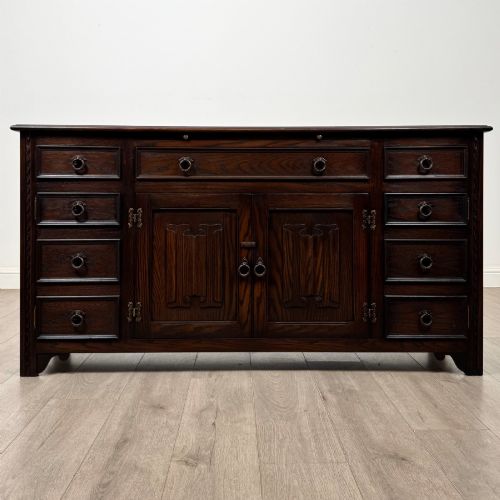
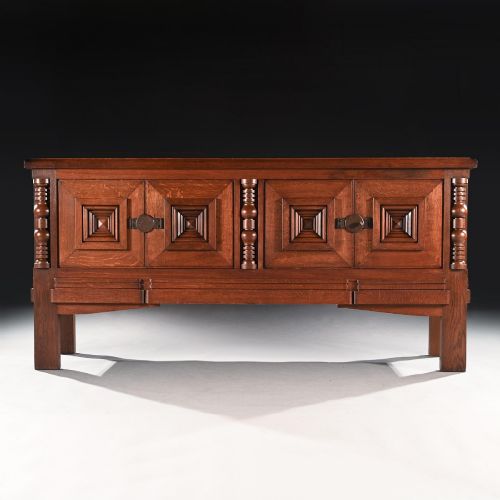
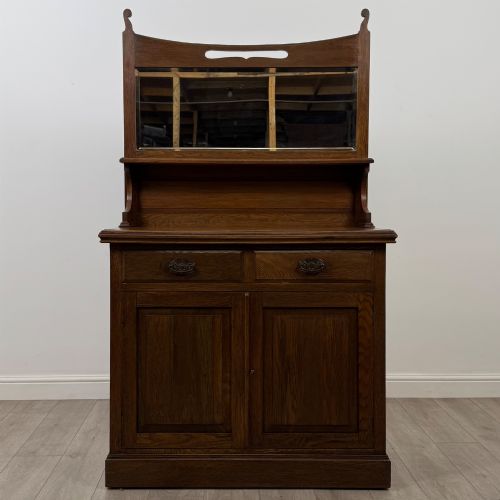
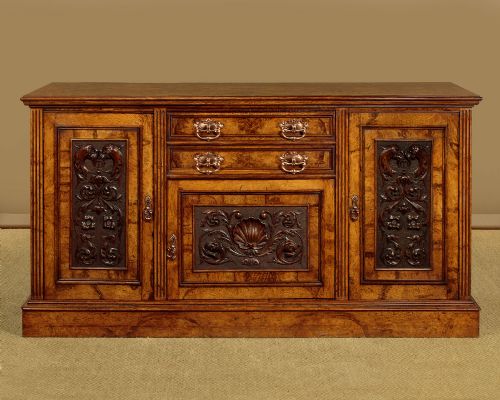
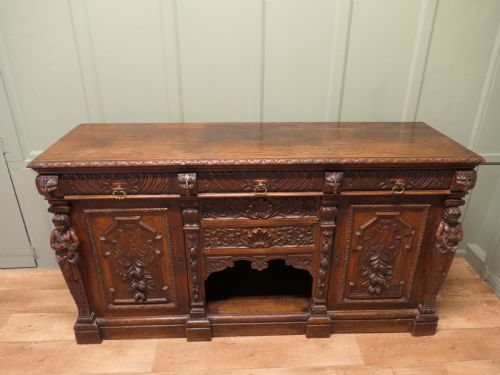
Descriptions here are led by timber. Oak comes first in the titles, then mahogany, with walnut behind them, and the carving itself is usually named only as "carved", "heavily carved" or "ornately carved" rather than by motif. One motif does recur enough to be a sub-type: the Green Man foliate mask, named in around a dozen oak buffet, sideboard and dresser titles.
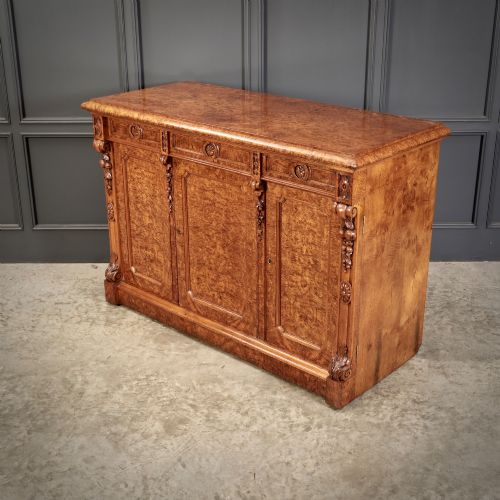
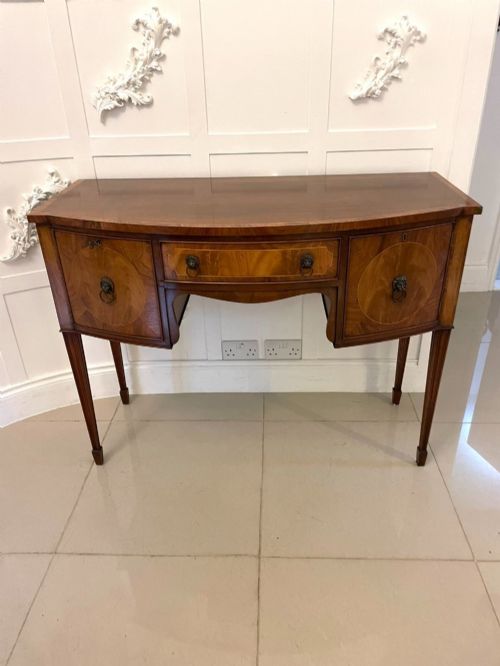
The piece you are most likely to meet is a Victorian carved oak sideboard. "Sideboard" is in the majority of titles, and Victorian plus the 1850s, 1860s and 1880s dated groups account for well over 200 listings. Mahogany follows in pedestal, breakfront and bow-front forms, then walnut chiffoniers and credenzas, often burr and mirror-backed.
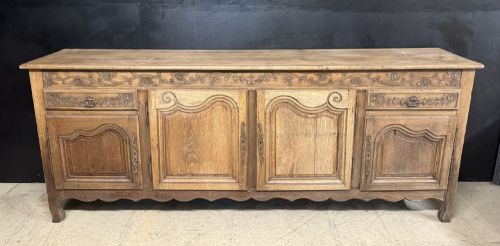
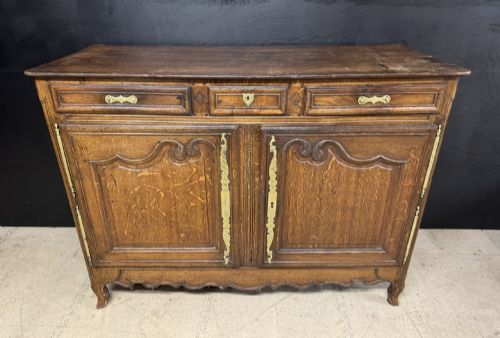
Dating is loose more often than precise: "19th Century" and "Victorian" between them outnumber every decade bucket, and there is a distinct 1920s group as well. A handful of late 17th-century oak dressers and servers exist at the early end, but only a handful. French buffets and enfilades and Anglo-Indian padouk pieces make up a smaller strand, with Chinese, Italian, Flemish, Dutch and Scandinavian examples turning up once or twice.
Top And Bottom
Timber and figure do most of the sorting. Burr walnut, pollard oak, flame mahogany, amboyna, kingwood and satinwood sit high in the range; plain oak and pine sit at the bottom. Scale pushes the same way, with mirror-backed and pedestal forms concentrated above the middle and words like monumental or "of grand proportions" appearing only at the very top.
Titles also grade the carving itself. Plain "carved" is one thing; "heavily", "ornately" and "profusely carved" is another, and the last of those keeps company with exhibition-quality descriptions. Fifteen titles claim exhibition quality, and they sit at the top alongside the marble, marquetry, ormolu and porcelain-mounted credenzas.
Decoration beyond the carving lifts a piece again: marble tops, marquetry and specimen-wood inlay, mother-of-pearl and gilt gesso. So does a named idiom. Gothic, revival, and Arts and Crafts labels recur, along with the vernacular-revival corner of the category, where "Ipswich oak" turns up three times, all 1920s, and "Cotswold School" once.
Antique Carved Sideboards Retail Price Guide 2026
Typical UK retail prices for carved sideboards, calculated from the Sellingantiques database of over a million retail prices indexed since 2003. This retail price guide relies exclusively on Sellingantiques data; no external sources or auction records are used, so the figures do not describe the wider market.
Carved sideboards have been listed on Sellingantiques since 2009, and over two hundred have passed through since then.
The Antique Carved Sideboards Glossary
- Sideboard
- Long, low case piece with drawers and cupboards for a dining room. It appears in the majority of titles under this heading.
- Dresser base
- The lower half of a dresser, used on its own as a sideboard. Fifty-one titles, some with a potboard beneath.
- Chiffonier
- Low cupboard-fronted side cabinet, often with a shelved or mirrored back. Fifty titles, in walnut and mahogany.
- Buffet
- Serving piece, in this archive commonly a tiered oak cupboard or a French one. Sixty-nine titles.
- Credenza
- Long side cabinet, usually walnut, with rounded or serpentine ends. Thirty-five titles.
- Green Man
- Foliate mask carving, named in around a dozen oak buffet, sideboard and dresser titles, once paired with a Tree of Life.
Antique Carved Sideboards: Frequently Asked Questions
What wood are these usually made from?
Oak leads the titles, followed by mahogany and then walnut. The oak block is the largest single group, much of it Victorian sideboards and buffets, a good number mirror-backed.
Above those sit the figured timbers: burr walnut in 39 titles, plus pollard oak, flame mahogany, amboyna, kingwood and satinwood. Padouk and satinwood appear in the Anglo-Indian pieces.
How old are carved sideboards on Sellingantiques?
The dealer-entered dates run from 1700 to 1940, and 291 of the 636 listings carry a clean year. The rest use era labels, and "19th Century" and "Victorian" together outnumber any decade.
Where decades are given they cluster in the 1850s, 1860s and 1880s, with a separate 1920s group and smaller 1900s and 1910s tails.
The pre-1800 end is thin: a few late 17th-century oak dressers and servers, and one entry dated before 1700.
Which forms count as sideboards here?
Sideboards proper dominate, but the heading also takes in dresser bases and low dressers, buffets, chiffoniers, credenzas and side cabinets. They all served the same storing-and-serving role in different rooms.
Within the sideboards, pedestal, breakfront and bow-front forms are named in mahogany titles, and mirror backs appear in 40 titles across oak and walnut.
Are French or Continental examples listed?
Yes, though as a minority. French buffets and enfilades account for 48 titles, and the latest thing in the archive is a 1940-dated French oak sideboard.
Beyond Britain and France the spread is wide but thin: Anglo-Indian and Burmese padouk, Chinese elm and lacquer, Italian walnut, and Flemish, Dutch, Hungarian, Belgian, Irish and Scandinavian pieces appearing once or twice.
Do these carry maker's names?
No maker or workshop stands out in this category. The evidence returned no maker candidates at all, so a name in a listing is the exception rather than the pattern.
What does appear instead is design language: Gothic, revival, and Arts and Crafts labels, plus "Ipswich oak" three times and "Cotswold School" once.
How many come up for sale each year?
Around 70 a year come to market on Sellingantiques, and 146 different dealers have listed one. No single dealer defines the category.
Sizes range widely too, from titles reading "of small proportions" and "petite" up to six-foot buffets and sideboards billed as monumental.