


A 2026 Guide by Sellingantiques
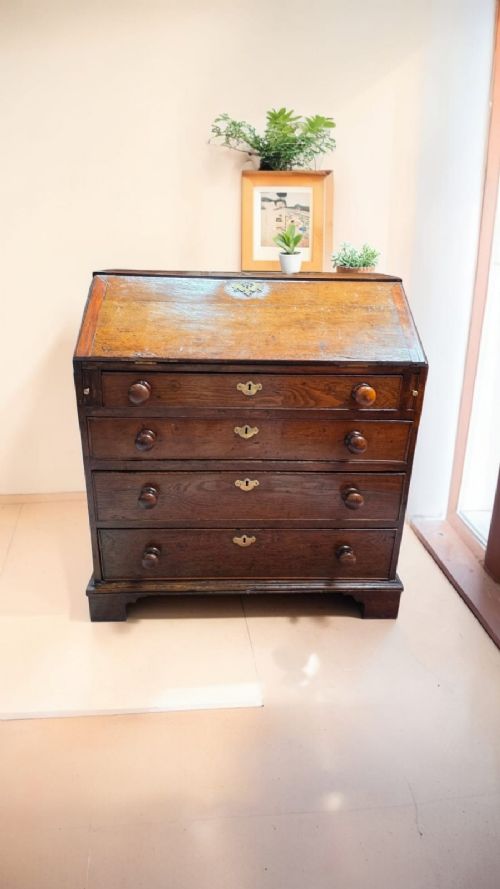
Bureau Bookcase, Georgian
Priced at £995 from Midwinter Antiques
Evolved from the portable writing box on a stand. Craftsmen eventually merged the desk section with a chest of drawers to create the standard antique oak bureau.
Look for early eighteenth-century examples featuring a prominent waist moulding. This covered the join between the top section and the base.
Provincial workshops produced these in huge numbers throughout the Georgian period. They suited yeoman farmers and local merchants who needed practical, sturdy furniture.
Victorian tastes shifted towards mahogany and walnut. Production of heavy oak versions slowed right down until the late nineteenth-century revival movements.
Documented names are rare for standard oak furniture. London makers preferred fashionable veneers, leaving solid oak production to undocumented provincial joiners.
Regional construction details sometimes hint at origins. Welsh and northern workshops frequently incorporated local variations in inlay or carving.
A paper trade label occasionally survives inside a drawer. These were pasted in by regional cabinet-makers selling both their own goods and imported pieces.
Bureau, Desk, Dutch, Oak, 19th Century
Priced at £795 from Antiques Online Ltd
The 2026 retail price guide for Antique Oak Bureau is drawn from a proprietary archive of over 1.1 million retail prices indexed by Sellingantiques since 2003. This guide relies exclusively on their own internal data; no external sources or auction records are used.
Analysing nearly 25 years of UK antique market history alongside current retail values, the data indicates that typical UK retail prices for Antique Oak Bureau range between £400 and £1,900. Entry-level prices generally fall under £400 and premium examples upwards of £1,900.
The fitted interior defines the form. Expect a central cupboard flanked by pigeonholes and small stacked drawers for organising papers.
Pull-out lopers support the hinged writing surface. These square wooden slides pull forward from the carcase just above the top drawer.
Most sit on bracket feet. Earlier ones might rest on bun feet, though many of those have been replaced over the centuries.
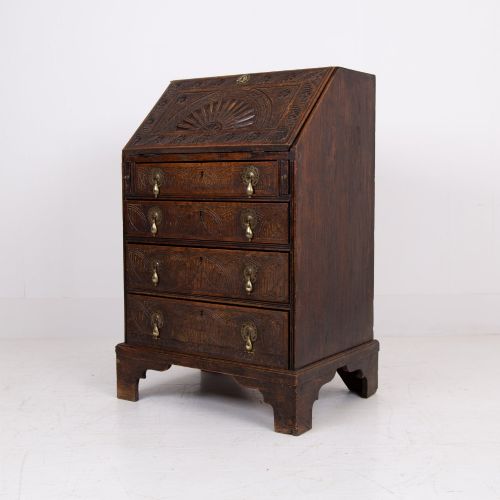
18th Century Oak Bureau, 18th Century
Priced at £450 from Abersoch Antiques
Hand-cut dovetail joints secure the drawers. Early examples show wide, coarse pins, while later eighteenth-century work becomes finer and more precise.
The carcase is constructed using heavy plank sides. Joiners housed the horizontal dust boards directly into grooves cut across these vertical flanks.
Inspect the backboards. They are typically rough-sawn and held in place with hand-forged iron nails, showing the tool marks from the original pit saw.
"Hidden compartments were a standard offering. Cabinet-makers cleverly concealed shallow drawers behind removable architectural pillars in the central interior section."
"The angle of the slope was carefully calculated. It allowed the piece to function as a comfortable reading stand when closed."
"Some examples feature internal leather writing surfaces. This provided a smooth base for quill pens, preventing the wood grain from distorting ink lines."
Based on almost 25 years of Sellingantiques UK antique market data, Antique Oak Bureau appeared 2240 times (out of 1,100,000 antiques) which gives it a rarity score of 64/100.
This score measures scarcity within the Sellingantiques archive only and is not a survey of the entire antiques market, so these statistics may not be indicative of the general availability of Antique Oak Bureau elsewhere.
They are substantial pieces of furniture. A standard oak bureau requires two strong people to move it safely. The dense timber and thick carcase sides add up quickly.
Take the drawers out before you try to lift one. It reduces the weight and stops them sliding open on the stairs.
The fall is designed to support the weight of a person writing. When the lopers are pulled out fully, they provide a firm base for the hinged section.
The hinges take the strain if the lopers are not engaged properly. Always pull the wooden supports out all the way before lowering the writing surface. This protects the joints from unnecessary leverage.
Many retain their original brass locks, though the keys are frequently lost. The mechanisms are simple iron levers inside a brass casing.
If you find one with a working key, turn it gently. The internal springs can become brittle with age. A locksmith can usually cut a new key if the lock itself is sound.
That gap is shrinkage. Oak contracts across the grain as it dries. Because the sides are secured at the top and bottom, the wood splits as it shrinks.
It is standard for country oak furniture.
Please note: This Antique Oak Bureau guide and its associated pricing data are provided for general informational purposes only. It does not constitute formal financial, investment, or appraisal advice and should not be relied upon as the sole basis for any commercial activity, purchasing, or sales decisions. Sellingantiques.co.uk accepts no liability for any actions taken in reliance on this information. Always consult with a qualified professional or independent appraiser.
