38,371  PAGES BROWSED TODAY PAGES TODAY 182 ANTIQUES UPLOADED TODAYNEW ARRIVALS
182 ITEMS ADDED TODAY
Sort Order
Items Per Page
Browse Categories
Sort order
Relevant Links
Items per page
ID #SA1233127
FOR SALE
£2,250
Email
Save
Eugène-louis Gillot, a Hospital Ship in Wartime - Antique Oil Painting
Brave Fine Art
for sale €2,633     $2,858
£2,250
Brave Fine Art

Brave Fine Art

Sellingantiques Verified Since Nov 2018
View Dealers Stock Page
  • About Us
    Exquisite antique paintings that capture the imagination.
Id #SA1233127
PDF SHARE
SAVE

Eugène-louis Gillot, a Hospital Ship in Wartime - Antique Oil Painting

1900 - 1920
For Sale by Brave Fine Art
Description

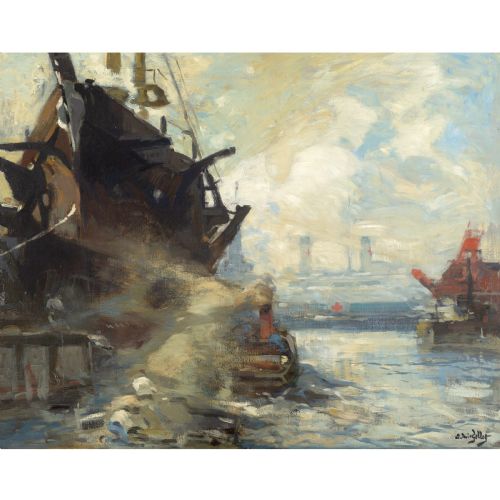
This early 20th-century oil painting by French artist Eugène-Louis Gillot (1868-1925) depicts a harbour scene during World War I. A large vessel looms on the left while, through a haze of steam and smoke, a hospital ship marked prominently with red crosses passes beyond.

Gillot was an exceptional painter of atmosphere. During the First World War, he served with the French Navy and produced works recording the conflict, including a piece titled 'An Attack by Flame-throwers', now held by the Imperial War Museum. His experiences during these years brought him into direct contact with naval subjects and ultimately led to his appointment as an official painter of the French Navy in 1921.

This work appears particularly interesting in that context. The distant vessel is unmistakably associated with medical service. Three red crosses are visible: one prominently displayed along the side and two painted upon the forward-facing sides of its funnels. Its pale colouring and conspicuous markings are also consistent with the internationally recognised appearance of hospital ships from the period.

An exact identification, however, remains tantalisingly unresolved. Several French hospital ships possessed broadly comparable characteristics, including the 'André Lebon', which served from 1916. Period photographs show her with two funnels bearing cross insignia, although other elements of her configuration do not correspond precisely with Gillot's vessel. Given the painter's loose, atmospheric technique, and his willingness to subordinate detail to the overall effect of a scene, comparisons based upon individual structural features should be treated cautiously.

The reverse provides another useful clue. The canvas bears the stencil of the highly regarded Parisian artists' colourman Paul Foinet Fils, 21 rue Bréa, an address associated with the firm from the early 20th century. It establishes an appropriate material context for Gillot's mature career.

Stylistically and historically, a date during or around the First World War seems particularly plausible. Perhaps most compelling is the mood Gillot has created. The enormous dark hull at left bears down upon the composition, almost swallowing the figures beneath it, while smoke, steam and industrial haze dissolve the harbour beyond. Against this heaviness, the little flashes of brilliant red identifying the hospital ship become strangely poignant. Seen in the context of wartime France, such a vessel may have carried wounded servicemen returning from the machinery of war, but also medical care, sanctuary and hope.

There's also an intriguing documentary trail still to follow. Gillot exhibited works relating to his wartime and naval experiences, including at an exhibition held at Galerie Lambert in Marseille in July 1918, while surviving exhibition catalogues and archival material concerning the artist are preserved at the Bibliothèque nationale de France. Further investigation of these records may eventually establish whether this particular harbour scene was exhibited, titled or connected with an identifiable vessel.

For now, therefore, we would resist attaching a specific ship's name to it. Instead, we consider it most probably a French naval harbour scene featuring a hospital ship, painted during or in the aftermath of the First World War.

For a collector with an interest in maritime or First World War history, this is a very interesting project.

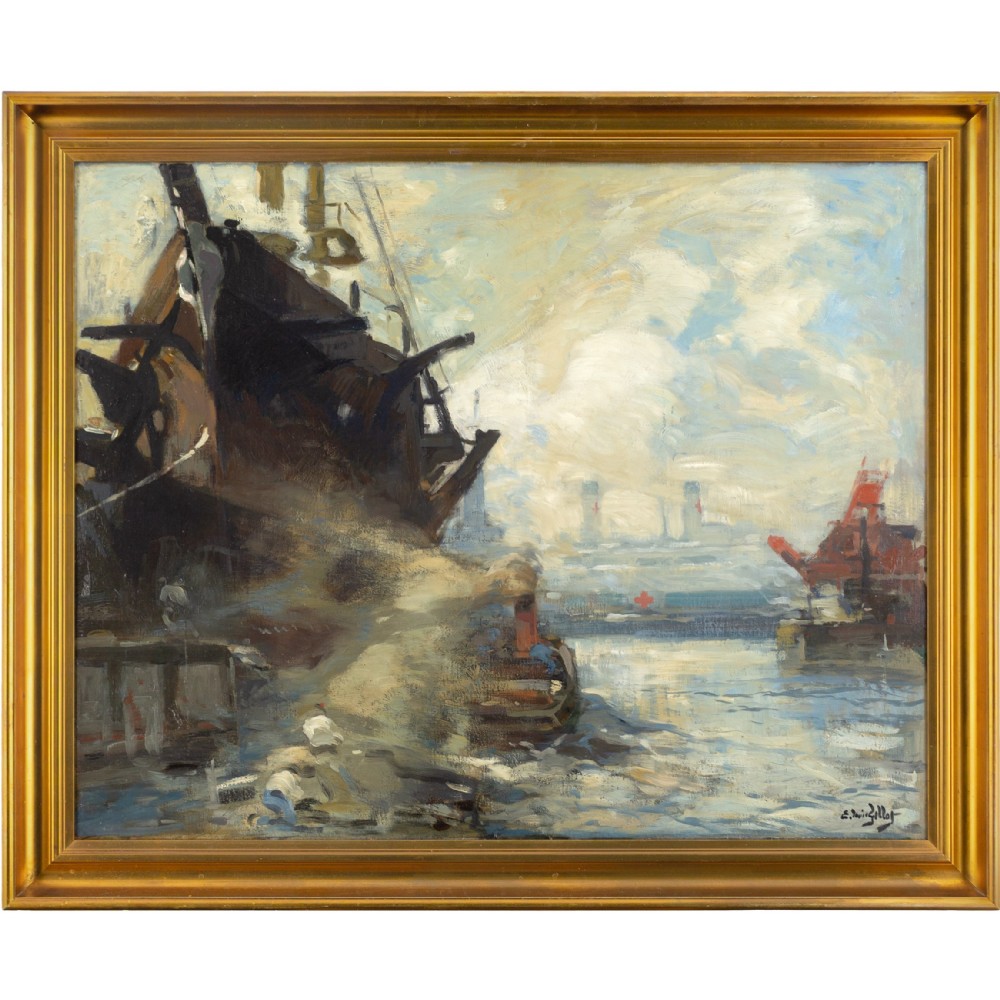
Signed in the lower right and held within a wooden frame with stepped mouldings.

Learn more about Eugène-Louis Gillot in our directory.

Medium: Oil on canvas

Overall size: 40½” x 33” / 103cm x 84cm

Year of creation: c. 1917

Labels & Inscriptions: Stencil on the reverse relating to the Parisian artists' colourman Paul Foinet Fils, 21 rue Bréa,

Provenance: Private collection, Denmark.

Condition: Cleaned. Revarnis

Physical Dimensions
Height
84cm (33.07")
Width
103cm (40.55")
Depth
6cm (2.36")
Declaration

Brave Fine Art has dated this Antique Maritime Oil Painting to the 1910s.
Reference Numbers
Sellingantiques Reference
SA1233127
Dealers Internal Reference
BRV2322
Description
This early 20th-century oil painting by French artist Eugène-Louis Gillot (1868-1925) depicts a harbour scene during World War I.
A large vessel looms on the left while, through a haze of steam and smoke, a hospital ship marked prominently with red crosses passes beyond.
Brave Fine Art
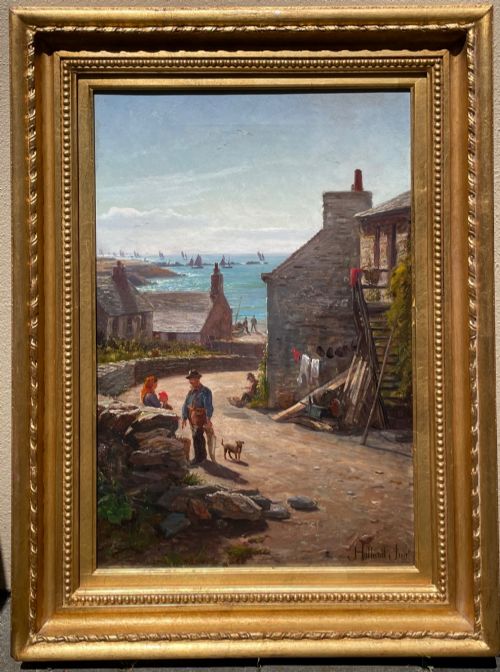
fig 1. An impressionist oil painting depicting a wartime hospital ship and harbour scene enclosed in a gold gilded frame.
fig 1. Eugène-louis Gillot, a Hospital Ship in Wartime - Antique Oil Painting

Gillot was an exceptional painter of atmosphere. During the First World War, he served with the French Navy and produced works recording the conflict, including a piece titled 'An Attack by Flame-throwers', now held by the Imperial War Museum. His experiences during these years brought him into direct contact with naval subjects and ultimately led to his appointment as an official painter of the French Navy in 1921.

This work appears particularly interesting in that context. The distant vessel is unmistakably associated with medical service. Three red crosses are visible: one prominently displayed along the side and two painted upon the forward-facing sides of its funnels. Its pale colouring and conspicuous markings are also consistent with the internationally recognised appearance of hospital ships from the period.

An exact identification, however, remains tantalisingly unresolved. Several French hospital ships possessed broadly comparable characteristics, including the 'André Lebon', which served from 1916. Period photographs show her with two funnels bearing cross insignia, although other elements of her configuration do not correspond precisely with Gillot's vessel. Given the painter's loose, atmospheric technique, and his willingness to subordinate detail to the overall effect of a scene, comparisons based upon individual structural features should be treated cautiously.

The reverse provides another useful clue. The canvas bears the stencil of the highly regarded Parisian artists' colourman Paul Foinet Fils, 21 rue Bréa, an address associated with the firm from the early 20th century. It establishes an appropriate material context for Gillot's mature career.

Stylistically and historically, a date during or around the First World War seems particularly plausible. Perhaps most compelling is the mood Gillot has created. The enormous dark hull at left bears down upon the composition, almost swallowing the figures beneath it, while smoke, steam and industrial haze dissolve the harbour beyond. Against this heaviness, the little flashes of brilliant red identifying the hospital ship become strangely poignant. Seen in the context of wartime France, such a vessel may have carried wounded servicemen returning from the machinery of war, but also medical care, sanctuary and hope.

There's also an intriguing documentary trail still to follow. Gillot exhibited works relating to his wartime and naval experiences, including at an exhibition held at Galerie Lambert in Marseille in July 1918, while surviving exhibition catalogues and archival material concerning the artist are preserved at the Bibliothèque nationale de France. Further investigation of these records may eventually establish whether this particular harbour scene was exhibited, titled or connected with an identifiable vessel.

For now, therefore, we would resist attaching a specific ship's name to it. Instead, we consider it most probably a French naval harbour scene featuring a hospital ship, painted during or in the aftermath of the First World War.

For a collector with an interest in maritime or First World War history, this is a very interesting project.

Signed in the lower right and held within a wooden frame with stepped mouldings.

Learn more about Eugène-Louis Gillot in our directory.

Medium: Oil on canvas

Overall size: 40½” x 33” / 103cm x 84cm

Year of creation: c. 1917

Labels & Inscriptions: Stencil on the reverse relating to the Parisian artists' colourman Paul Foinet Fils, 21 rue Bréa,

Provenance: Private collection, Denmark.

Condition: Cleaned. Revarnis

Height
84cm (33.07")
Width
103cm (40.55")
Depth
6cm (2.36")
Date of Manufacture

Brave Fine Art has dated this Antique Maritime Oil Painting to the 1910s.

Reference Numbers
Sellingantiques Ref
SA1233127
Dealers Internal Ref
BRV2322
Brave Fine Art
Brave Fine Art
Sellingantiques verified Since Nov 2018

Exquisite antique paintings that capture the imagination.

Dealer Profile

You can view the stock and full dealer information on the Brave Fine Art Profile Page
PDF SHARE
SAVE
An impressionist oil painting depicting a wartime hospital ship and harbour scene enclosed in a gold gilded frame.
1 / 2
Archive I An impressionist oil painting depicting a wartime hospital ship and harbour scene enclosed in a gold gilded frame.

Eugène-louis Gillot, a Hospital Ship in Wartime - Antique Oil Painting
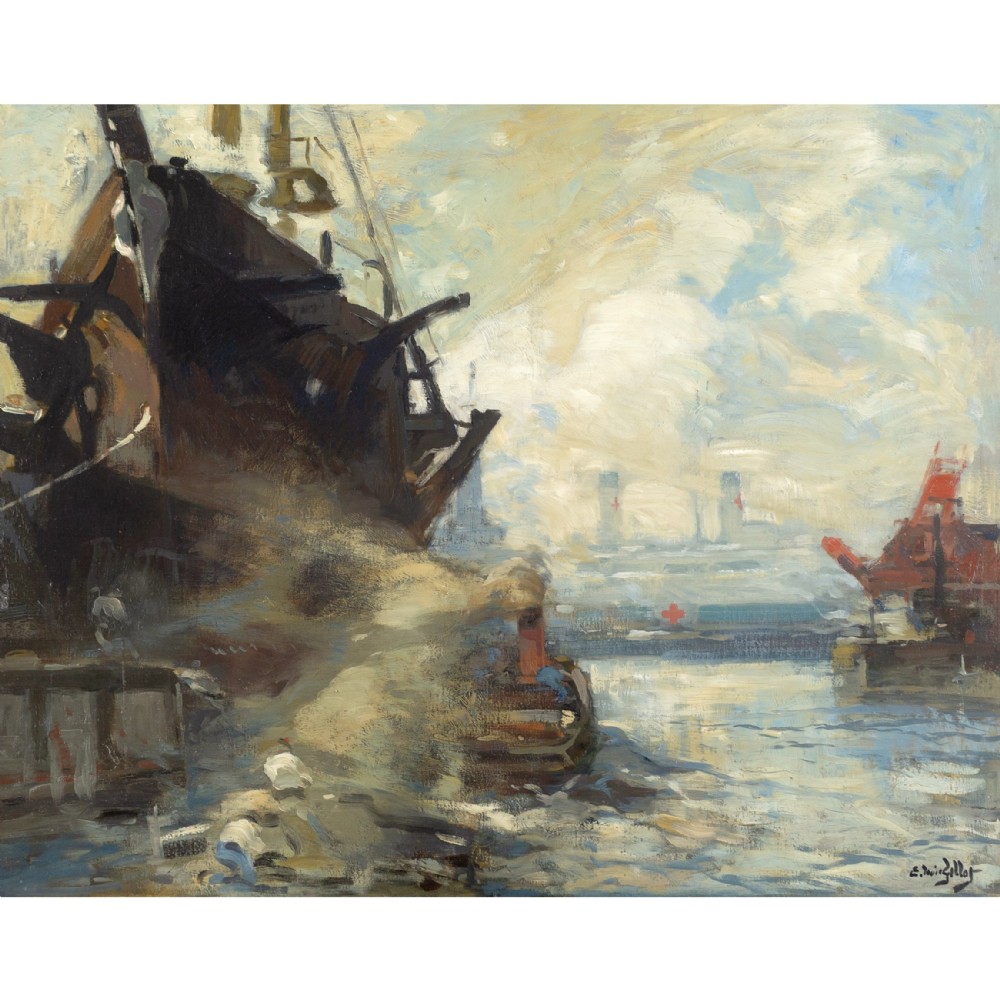
Archive II An impressionist oil painting depicting a wartime hospital ship and harbour scene enclosed in a gold gilded frame. View II
FURTHER BROWSING

Visitors also looked at these ⇣

Enlarged Archival View
Telephone 01684 215986
Location
21 Enterprise Way
Arle Road
Cheltenham
Cotswolds
GL51 8LZ
United Kingdom

Under appointment only.
Verified Since Nov 2018
Items For Sale 70
Items Sold 1,841
Brave Fine Art
Brave Fine Art
Verified Since Nov 2018
View Dealer Info
Location: 21 Enterprise Way, Arle Road, Cheltenham, Cotswolds, GL51 8LZ, United Kingdom, , Under appointment only.
Verified
Nov 2018
For Sale
70
Sold
1,841
An impressionist oil painting depicting a wartime hospital ship and harbour scene enclosed in a gold gilded frame.
Eugène-Louis Gillot, A Hospital Ship In Wartime - Antique Oil Painting
Ref: SA1233127
An impressionist oil painting depicting a wartime hospital ship and harbour scene enclosed in a gold gilded frame.
Detail View 1
Archival Detail
Every single antique dealer on our platform is individually approved by our internal team. We verify their professional trade history, ethical standards, and photographic quality to ensure a secure, high-standard buying environment. Upon joining, every dealer agrees to a strict 9-point code of conduct. While issues can occasionally arise, our dealers typically resolve them swiftly and directly with the buyer. In fact, since our founding in 2002, Sellingantiques has only had to step in to help resolve an issue on roughly five occasions—a true testament to the quality of our dealers and their dedication to your happiness.
Our dealers are highly experienced in packing and shipping fragile, high-value antiques. Because you are in direct contact with the dealer, you will be able to easily go through all available shipping and insurance options together to ensure your item arrives safely.
Antiques are the ultimate green purchase. By choosing historical pieces over newly manufactured goods, you completely eliminate the carbon footprint of modern mass production while preserving exceptional, timeless craftsmanship.

Early 20th-century French maritime oil paintings often combine Impressionist light techniques with Post-Impressionist brushwork, capturing commercial ports, naval shipping, and coastal industrial themes with textured impasto.

Paintings from this period were typically executed using oil pigments on stretched linen canvas or wooden panels, housed within timber frames finished with gold leaf or metallic gilding.

Authentic period works display natural age craquelure across the paint surface, historic oxidation on the back of the canvas or wooden stretcher, and period-correct artist signatures.

A maritime oil painting can be placed above a wooden console or fireplace mantel to anchor a room, pairing well with dark wood finishes, brass accents, and neutral wall tones.

Keep the painting away from direct sunlight, moisture, and radiator heat. Clean dust gently from the frame using a soft dry brush, and consult a professional restorer for varnish cleaning.
items
Add keywords to the filter
Price
£100
£250000
Era
Movements
Material
Origin
Stock Location
Freshness
Online Payments
Categories