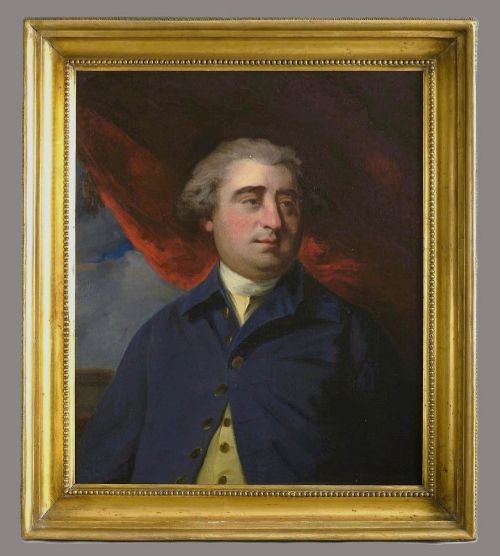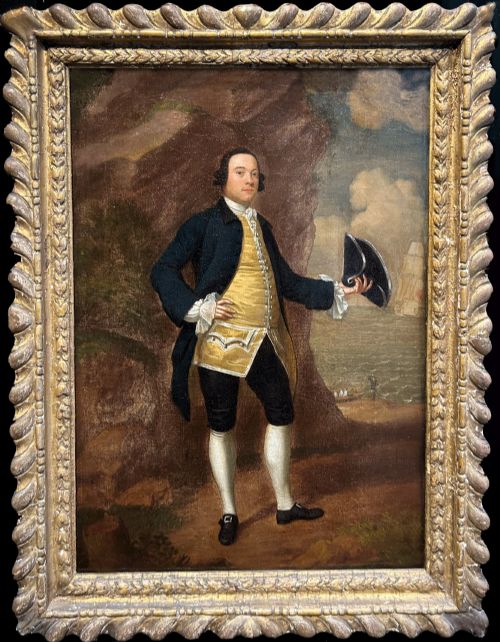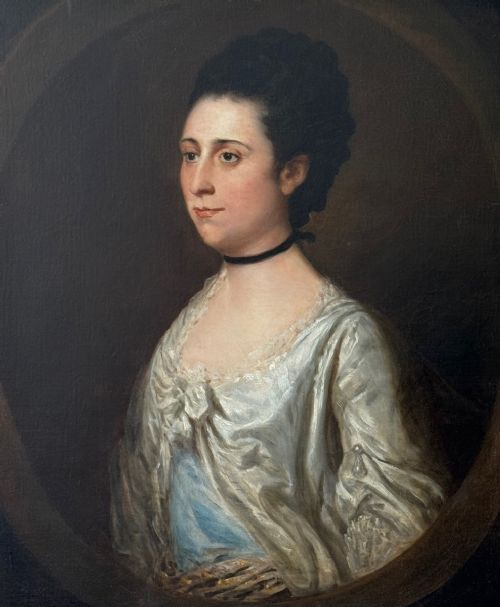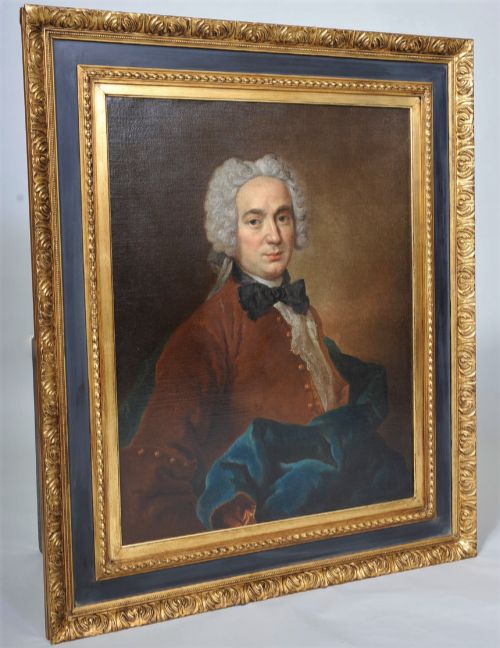
Cheshire Antiques Consultant Ltd has dated this 18th Century Portrait Painting to the 18th Century.
After Sir Joshua Reynolds
Subject & Medium
This remarkable late 18th-century watercolour on paper presents a compelling dual portrait: Charles Stanhope, 3rd Earl of Harrington, depicted in ceremonial armor, and Marcus Richard Fitzroy Thomas, a young Jamaican boy.

Composition & Technique
Styled after in the dramatic, allegorical approach pioneered by Sir Joshua Reynolds, the portrait evokes grandeur and gravitas — yet the choice of watercolour introduces a soft immediacy and rare delicacy. Stanhope stands at center in polished armor, rendered with cool washes of silver, slate blue, and soft grey, contrasted by a vivid crimson sash. Behind him, turbulent skies unfold in expressive layers of indigo, ochre, and stormy blue — suggesting both personal valor and the political unrest of the age.

At his side stands Marcus Richard Fitzroy Thomas, solemnly holding the Earl’s helmet. He is portrayed with a rare dignity and realism, dressed in dark livery and rendered with sensitive attention to expression and form. Unlike many similar works, Marcus is not ornamental but grounded and present — providing emotional balance and deeper narrative resonance.

The triangular composition guides the eye upward: from Marcus to Stanhope to the roiling heavens — a structure that symbolically reflects 18th-century hierarchies of empire, race, and power. Stanhope is idealized, while Marcus is strikingly authentic — anchoring the painting with human truth.

More than a portrait, this is a visual tableau of authority, visibility, and historical complexity — a striking and nuanced double portrait of unequal measure.
Historical Context & Biography
Charles Stanhope (1753–1829) served in Jamaica — Britain’s most fortified and profitable slave colony — during the final phase of the American Revolutionary War. Promoted to Colonel and appointed Aide-de-Camp to King George III upon his return in 1782, he soon after inherited his father’s title and married Jane Fleming, heiress to Caribbean plantation wealth.

Marcus Richard Fitzroy Thomas, estimated to be around 14 years old in this portrait, was likely brought from Jamaica as part of Stanhope’s retinue. Parish and military records later reveal his extraordinary life: he was baptized in London (coincidentally on the same day as one of Stanhope’s own children), joined the Westminster militia as a drummer, married, had children, and died in poverty in 1816. He was buried in St. Martin’s Gardens, Camden.

Artistic Attribution
Though unsigned, the painting is clearly influenced by the mature style of after Sir Joshua Reynolds (1723–1792) — the founding President of the Royal Academy. Reynolds elevated his subjects through classical posturing, allegorical overtones, and dramatic skies — all present here. However, the unflinching portrayal of Marcus diverges from convention, adding a contemporary and humanizing counterpoint to the genre’s typical idealism.

Frame & Presentation
This artwork is presented in a beautifully crafted reverse-profile moulded gold leaf frame, adding refined period character. The piece has been professionally conserved and reglazed with museum-quality AR70 glass — a premium, low-reflective UV-filtering surface that protects while enhancing visibility and detail.

Framed Dimensions: 55 cm (H) × 47 cm (W)
Depth: 1.5 cm
Provenance
Formerly in a private Scottish collection
Acquired through a respected Scottish auction house
Curated by Cheshire Antiques Consultant LTD
Exhibited at a regional museum in the Midlands
Cheshire Antiques Consultant Ltd has dated this 18th Century Portrait Painting to the 18th Century.
Source the historic in 17th, 18th, 19th & 20th century fine arts, painting, sculptures & collectibles
You can view the stock and full dealer information on the Cheshire Antiques Consultant Ltd Profile Page

18th Century Oil Painting Charles Stanhope Third Earl of Harrington