
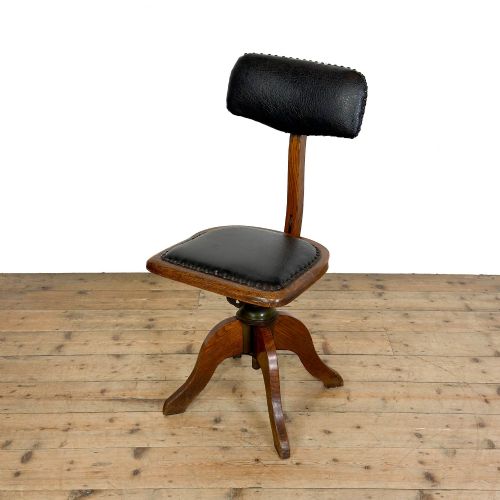
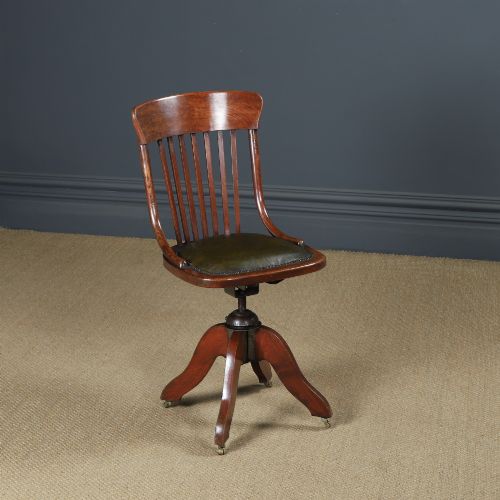
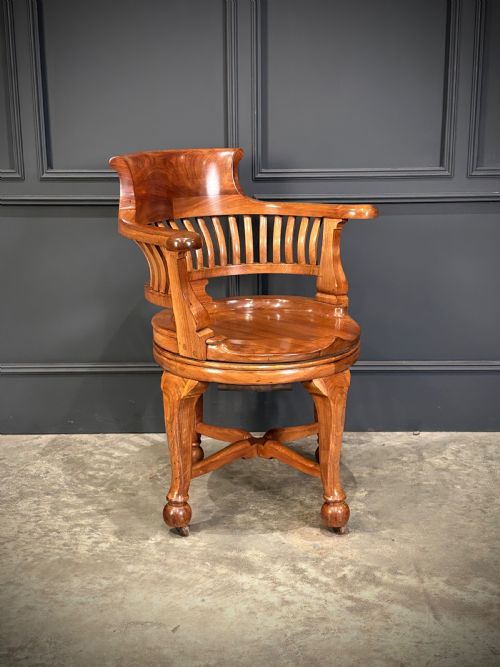
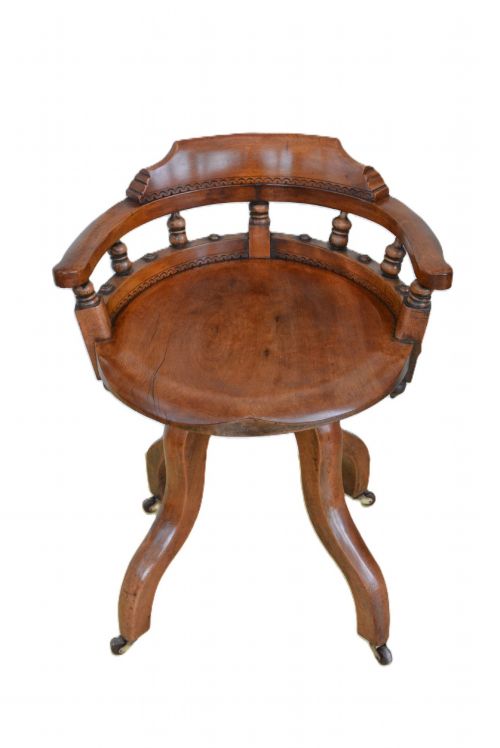
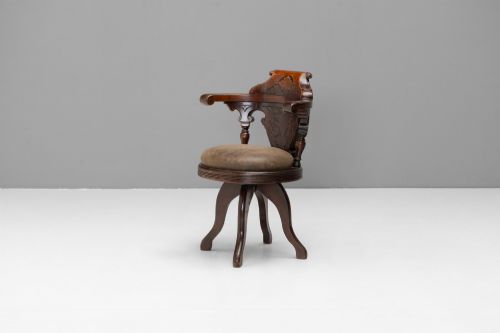


Wooden Revolving Office Chair
A wooden revolving office chair brings practical Victorian and Edwardian mechanics together with solid timber for daily workspace use.

Wooden Revolving Office Chair
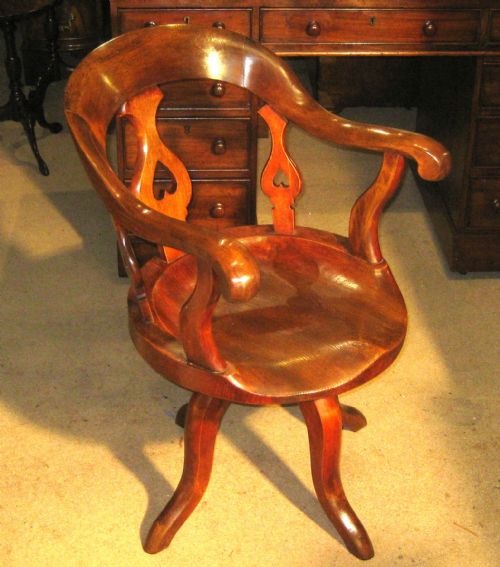
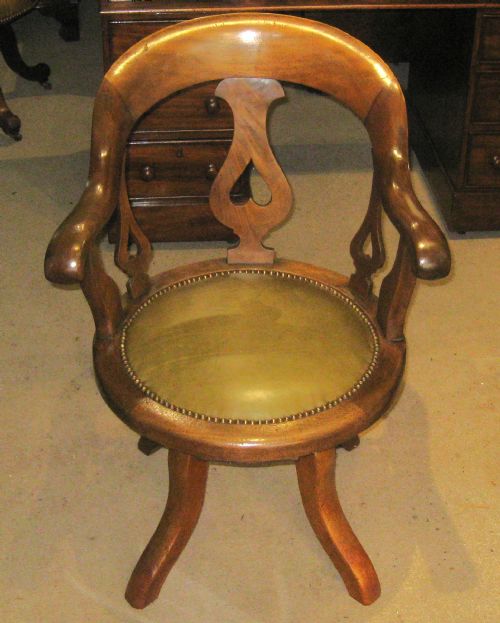
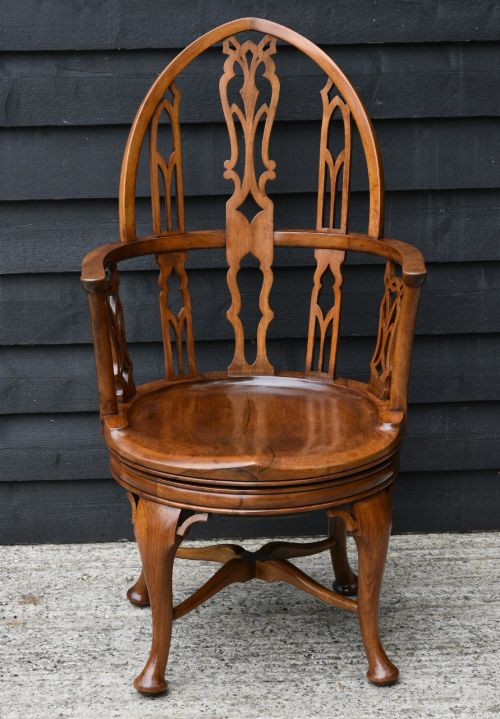
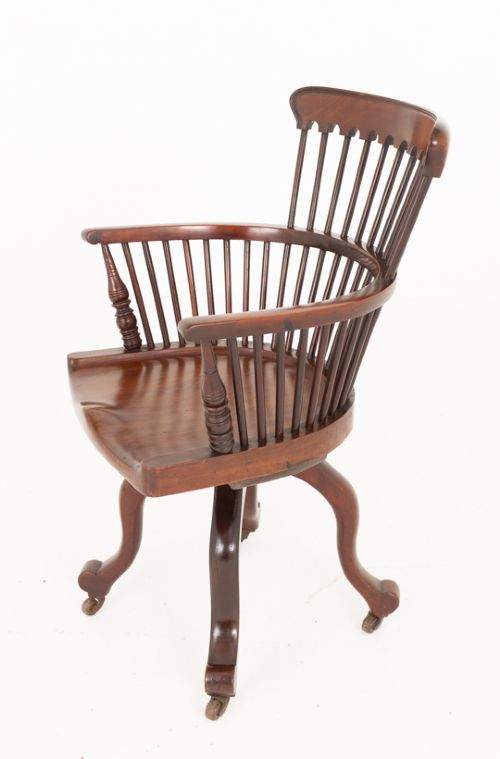
A wooden revolving office chair is a task-oriented seating form designed for nineteenth and early twentieth-century workspaces, combining swivelling mechanisms with traditional cabinet timbers.
The versions most commonly met on this page date from the Victorian and Edwardian eras through to the early twentieth century, appearing in forms such as desk chairs, office chairs, and ships chairs.
Makers utilised sturdy hardwoods like mahogany, oak, and walnut to construct frames capable of enduring regular movement and weight adjustment in a working environment.
How they were made
Makers constructed the primary frames of solid mahogany, oak, walnut, beech, and ash, often incorporating bentwood techniques for curved backrests and arm supports.
Mechanically, these chairs relied upon iron, cast iron, and brass swivel and tilt assemblies, which allowed the wooden upper portion to rotate and adjust.
Upholstery, where present, typically employed leather supported by horsehair or stuffing, complemented by metal or wooden castors on the base.
Several chairs retain their original iron screw threads, which occasionally squeak just enough to announce your arrival in the study.
What varies in quality
The sophistication of the timber carving and the choice of primary wood distinguish standard utility models from finer examples, with figured mahogany and carved oak representing higher tiers of production.
The complexity and robustness of the under-seat swivel and tilt mechanism also separate everyday workshop output from pieces bearing maker details or patent designs.
Kendrick & Jefferson·Edward William Godwin·Shoolbred
The Wooden Revolving Office Chair Glossary
- Swivel
- A mechanism allowing the upper seat portion to rotate fully around the central vertical axis. This permits movement between different areas of a desk.
- Tilt
- A functional adjustment allowing the backrest and seat to angle backward against a tension spring. It provides ergonomic support during long periods of seated work.
- Bergere
- A traditional upholstered armchair style featuring cane web panels inserted into a wooden frame. In office seating, this appears on the backrest for lighter visual weight.
- Castor
- A small wheel attached to the base of the legs to allow easy rolling across floor surfaces. These are frequently made of brass and iron.
- Aesthetic Movement
- A late nineteenth-century design style emphasising visual beauty over narrative meaning, often drawing inspiration from Anglo-Japanese or simpler geometric forms.
Wooden Revolving Office Chair: Frequently Asked Questions
How do I adjust the height?
Most period examples rely on a central threaded iron spindle beneath the seat, requiring the user to manually spin the wooden chair top clockwise or anti-clockwise to raise or lower it.
Later Edwardian and early twentieth-century models sometimes introduced rise-and-fall lever mechanisms, though the threaded screw remains the most common adjustment method.
Are these chairs comfortable for daily use?
Their suitability for daily work depends on the specific design, as many feature contoured wooden seats or supportive curved backrests that naturally encourage an upright posture.
Upholstered leather and swivel-tilt variants offer additional cushioning and flexibility, though they lack the pneumatic height adjustment found in modern task seating.
How do I date an office chair?
Dating relies on identifying the combination of timber choices, turning styles, and ironwork mechanisms, with Victorian pieces often showing heavier mahogany or walnut construction.
Edwardian and later examples frequently incorporate lighter oak, simpler bentwood components, or stamped metal patent marks on the underside of the swivel mechanism.
Can I replace the castors?
Original metal and wooden castors can occasionally be serviced or replaced if they are damaged, provided suitable period-appropriate brass or iron counterparts are sourced.
Preserving the original base hardware maintains the structural integrity and historical accuracy of the revolving mechanism.