


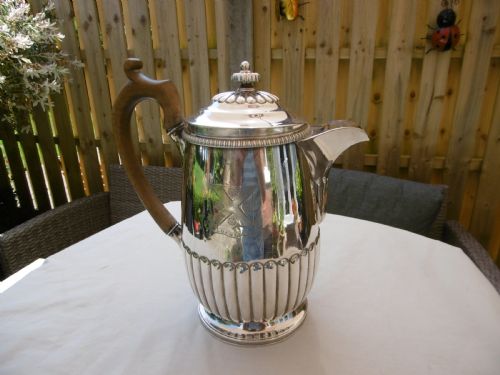


Wooden Handle Silver Pot
These wooden handle silver pot examples bring together sterling silver, Old Sheffield plate and copper with turned wood insulators for daily service or display.
Wooden Handle Silver Pot
When you search for a wooden handle silver pot, you encounter hollowware vessels designed for tea, coffee, chocolate and hot water across several centuries. The selection spans Georgian, Victorian and mid-century periods, alongside earlier eighteenth-century forms.
You are most likely to meet coffee pots, teapots and hot water pots alongside larger tea and coffee sets. These items bridge British, Irish and continental European origins, incorporating side-handled chocolate pots and tea pots on stands.
The styles range from the restraint of early periods through Regency and Neoclassical lines to Victorian Rococo revivals and mid-century modern design. Each piece combines metal bodies with contrasting wooden handles intended to protect the hand from heat.
How they were made
Silversmiths formed the bodies of these pots from sterling silver or applied silver sheets over copper bases in the Old Sheffield plate tradition. Handles were turned from hardwood, often secured with insulated sockets to prevent heat transfer during use.
Makers shaped the metal through raising and spinning, then applied chased fluting, engraved crests and hinged lids with cast finials. Early pieces display hand-beaten marks, while later examples utilise refined rolling and soldering techniques.
Listings feature periods spanning from seventeen hundred through the Victorian era to nineteen sixty-eight.
What varies in quality
The standard of a wooden handle silver pot rests in the crispness of its chased or engraved decoration, such as crests and fluted bodies. Heavier gauge metal and balanced proportions distinguish the finer examples from standard production work.
The integrity of the wooden handle and its insulated joints dictates the structural preservation of the vessel. Original craftsmanship in the hinge mechanism and the alignment of the lid further separate standard domestic items from exceptional workshop output.
Matthew Boulton·John Hoyland·Georg Jensen
The Wooden Handle Silver Pot Glossary
- Old Sheffield Plate
- A fused composite material made by melting a sheet of silver onto a thicker copper base before rolling them together into sheets for smithing. This technique preceded modern electroplating and leaves characteristic copper edges.
- Hollowware
- A category of metal tableware that includes pots, jugs, kettles and vessels designed with internal volume rather than flat items like trays. These pieces require specialist raising or spinning techniques.
- Sterling Silver
- An alloy comprising ninety-two point five percent silver and seven point five percent other metals, usually copper, to increase durability. British pieces carry hallmark stamps verifying this standard.
- Chasing
- A metalworking technique where the artisan hammers the front surface of the metal with punches to sink the design without removing material. This creates raised relief patterns such as fluting on pot bodies.
- Finial
- A decorative knob or ornament attached to the top of a pot lid. They are often cast in distinct shapes to match the prevailing style of the vessel.
Wooden Handle Silver Pot: Frequently Asked Questions
What are wooden handle silver pots used for?
These vessels were created for brewing and serving hot beverages including tea, coffee and chocolate. The wooden handle provided a thermal barrier to protect the user's hand from boiling liquids.
Today, they serve both as functional tableware for formal gatherings and as decorative objects in traditional or modern interiors.
How do I identify a Georgian pot?
Georgian pieces generally display classical proportions, urn shapes or straight tapering sides, often complemented by restrained engraving. Examining the hallmarks or stamped marks on the base helps confirm the manufacturing era.
Stylistic cues like Neoclassical swags or simple wooden grip handles also point directly to this period.
What is Old Sheffield plate?
Old Sheffield plate is an early fusing method where a thin layer of silver is bonded to a copper core under heat and pressure. This composite material was then worked into hollowware forms before electroplating was invented.
Collectors prize these items for their rich surface texture and historical manufacturing process.
How should I clean silver pots?
Clean these items using a gentle silver polish and a soft cloth, avoiding abrasive pads that can wear down thin plating. Care must be taken around wooden handles to keep moisture away from the grain and joints.
Regular light dusting preserves the surface without stripping the natural patina accumulated over centuries.