
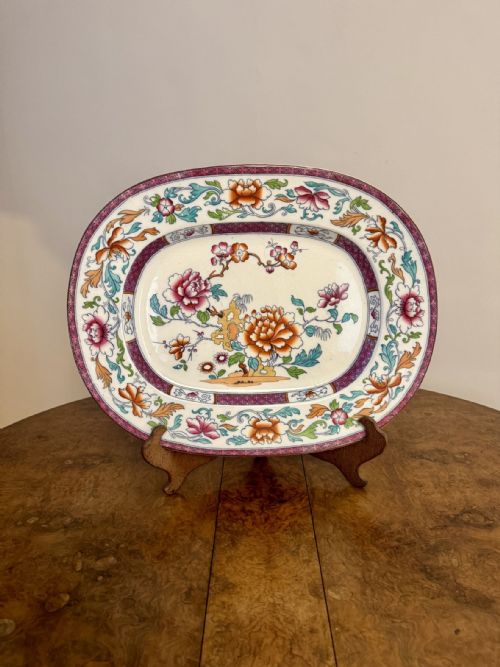


White Ironstone Serving Dish
A white ironstone serving dish is a sturdy utilitarian vessel designed for the dining table, combining heavy earthenware bodies with durable glaze.
White Ironstone Serving Dish
A white ironstone serving dish encompasses heavy earthenware platters, tureens, and cheese dishes found across the nineteenth century. These forms range from large meat platters and well and tree serving platters to lidded tureens with ladles.
The version most commonly met on this page is the large Victorian meat platter or serving dish, frequently decorated with transfer print patterns such as Chinoiserie, Italianate landscape, or Pagoda designs. Makers like Mason's feature prominently among these utilitarian yet decorative pieces.
Pieces span from the Georgian period through the Victorian era, capturing the shift towards robust domestic dining wares. Collectors encounter both plain white ironstone and intricately patterned examples featuring transfer printing or enamel work.
Materials and technique
Potters constructed these dishes using dense ironstone and earthenware bodies covered in a smooth glaze. This heavy ceramic composition provided the resilience needed for daily service in large country houses.
Decoration relied heavily on blue and white transfer printing, alongside enamel colours and occasional gilding. Transfer printing allowed potteries to apply complex scenes like Chinese Villa, Indian Grasshopper, and Mandarin patterns onto the ceramic surface before glazing and firing.
An eighteenth-century elk pattern dish brings unexpected wildlife to the dining table.
Variations in quality
Quality in a white ironstone serving dish rests upon the crispness of the transfer print and the complexity of the form, such as integrated strainers or well and tree channels. Plain ironstone relies entirely on the purity of the glaze and the heaviness of the potting.
Desirable pieces often bear identifiable maker marks from notable potteries like Mason's or Minton, alongside specialised patterns such as Chinoiserie Mandarin or Italianate landscapes. The presence of matching elements like lids and ladles elevates the standing of a tureen.
Mason·Minton·Elkington
The White Ironstone Serving Dish Glossary
- Ironstone
- A heavy, durable type of earthenware patented in the nineteenth century to imitate Chinese porcelain. It resists chipping far better than standard earthenware.
- Transfer print
- A decorative technique where an engraved copper plate transfers a design onto tissue paper, which is then stamped onto the unglazed ceramic. This allowed potteries to produce intricate scenes consistently.
- Well and tree
- A serving platter featuring a carved channel around the edge and a recessed well at one end to collect meat juices during carving. It is a practical design standard in nineteenth-century dining.
- Tureen
- A deep covered bowl designed for serving soups, sauces, or vegetables at the table. Many examples include matching ceramic ladles and fitted lids.
- Chinoiserie
- A decorative style reflecting European interpretations of Chinese and East Asian artistic traditions. It appears frequently on nineteenth-century transfer-printed ceramics.
White Ironstone Serving Dish: Frequently Asked Questions
What is ironstone?
Ironstone is a dense, heavy earthenware developed in the nineteenth century to provide a durable alternative to porcelain. It forms the robust body of most nineteenth-century serving platters and tureens.
Potters valued the material for its resistance to heavy use in busy dining rooms, making it a staple of country house hospitality.
How do I date a white ironstone dish?
Dating relies on maker marks, style periods such as Victorian or Georgian, and the specific transfer print patterns used. Many pieces date from the nineteenth century around eighteen-hundred to eighteen-eighty.
Examination of the ceramic body, glaze texture, and registry marks on the underside also helps narrow down the production era.
Were these dishes used for everyday dining?
These large platters, tureens, and cheese dishes were essential for serving meats, poultry, and courses in nineteenth-century homes. Their sturdy ironstone construction meant they could handle the demands of heavy daily use.
Households used them to present joints of meat, stews, and cheeses directly at the dining table.