
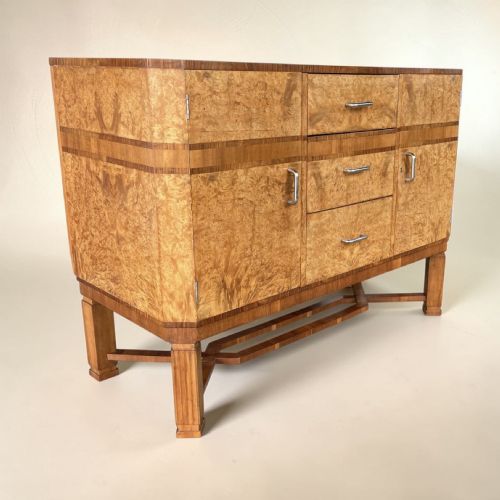
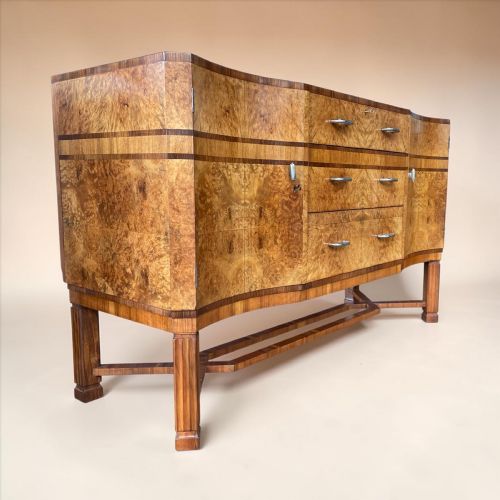
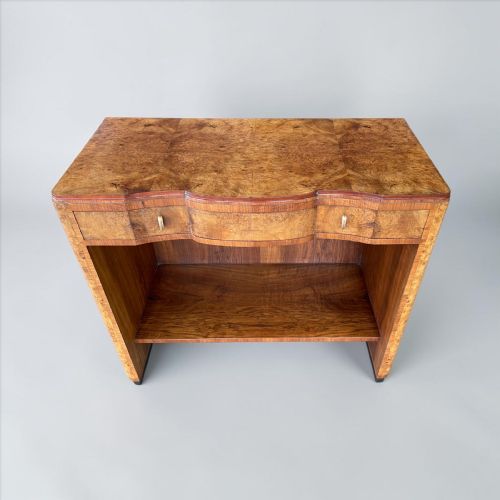
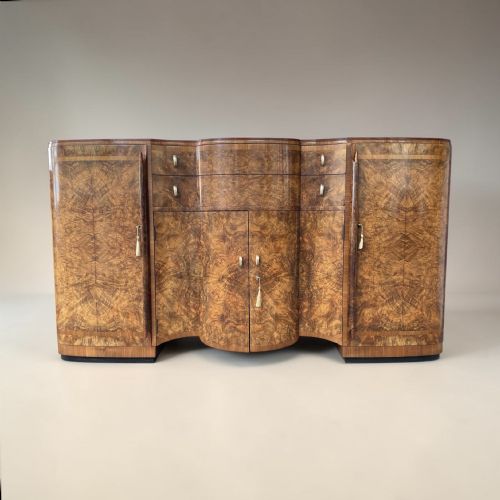

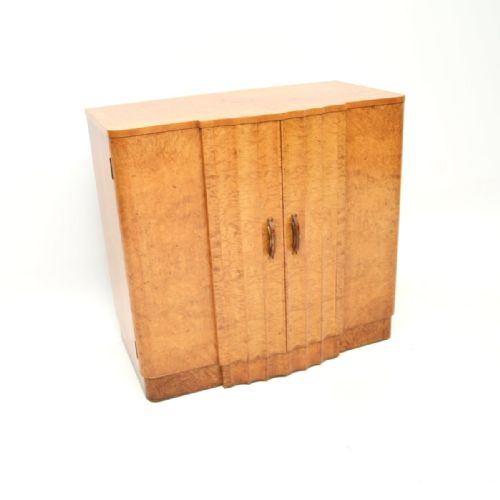
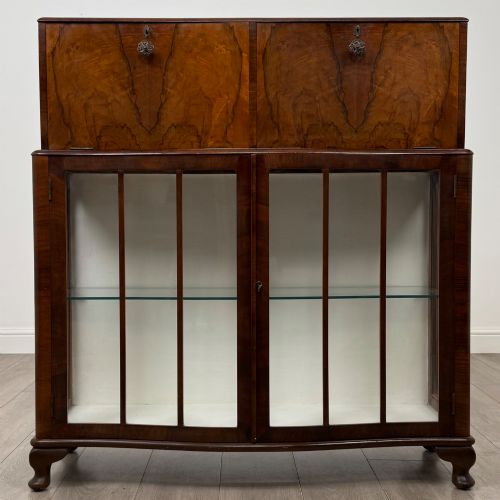
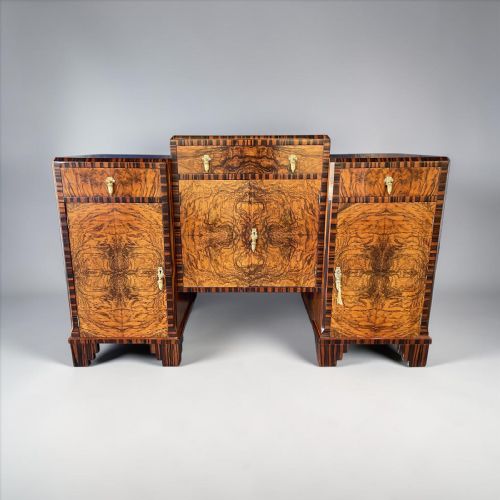
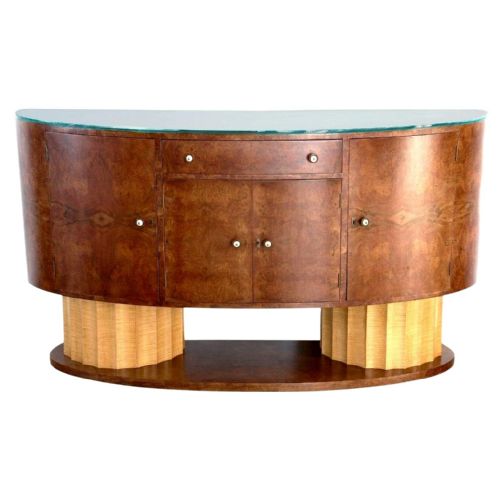
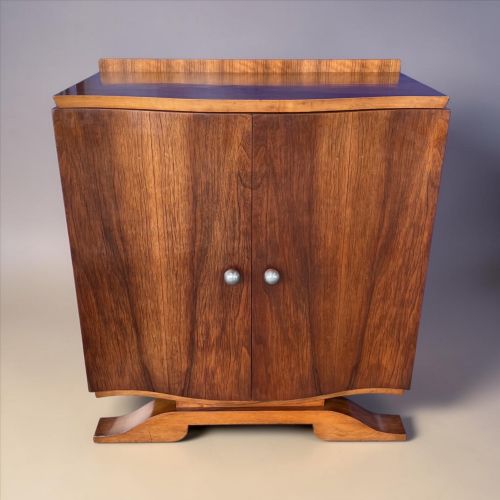


Walnut Art Deco Sideboard
When you search for a walnut art deco sideboard, you step into an era of bold geometric forms and rich cabinet-making.
Walnut Art Deco Sideboard
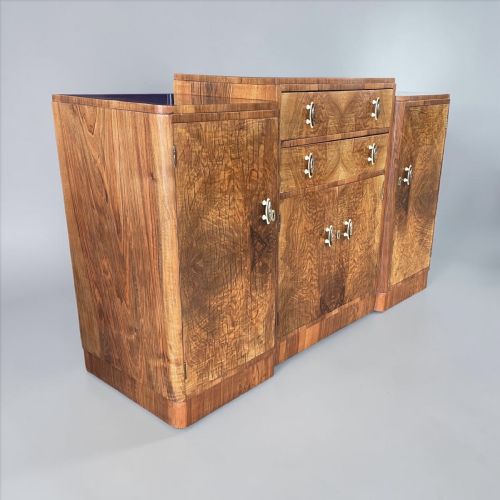
A walnut art deco sideboard represents a major statement in twentieth-century interior design, combining robust storage with the theatrical curves and sharp angles characteristic of the nineteen-thirties. You will frequently encounter low, heavy chassis forms, double bow fronts, and cloud-shaped profiles designed to anchor a dining room or living space.
While the vast majority of these pieces originate from the nineteen-thirties, earlier examples stretch back through the nineteen-twenties with occasional Edwardian or nineteen-ten antecedents appearing in related cabinet forms. Alongside traditional sideboards, the search phrase encompasses specialised serving tables, cocktail cabinets, and credenzas built to serve the domestic rituals of the period.
Originating from British workshops as well as French and Italian ateliers, these cabinets reflect both domestic utility and continental flair. Makers ranged from prominent London workshops to individual designers, ensuring a rich variety of regional interpretations within the same overarching aesthetic.
Materials and Construction Techniques
Makers relied heavily on figured walnut and burr walnut veneers to achieve mesmerising grain patterns across large, flat cabinet doors and curved drawer fronts. These veneers were carefully matched and laid over secondary woods, often accented with contrasting timbers such as sycamore, satin birch, or maple.
Hardware played an integral structural and decorative role, featuring polished brass fixtures, glass shelving, and occasional bakelite details. Carcase construction favoured solid joinery combined with clever internal fittings, such as pull-out serving trays, revolving bottle holders, and integrated electric lighting for drinks compartments.
Listings feature periods spanning from nineteen-ten through the nineteen-thirties, showcasing materials from burr walnut and glass to brass and bakelite.
What Separates Examples Across the Range
The distinction between standard commercial output and exceptional studio work lies in the ambition of the silhouette and the handling of the timber. Top-tier pieces feature book-matched burr walnut veneers that flow seamlessly across multiple drawers and doors, creating symmetrical patterns that demand immense skill from the artisan.
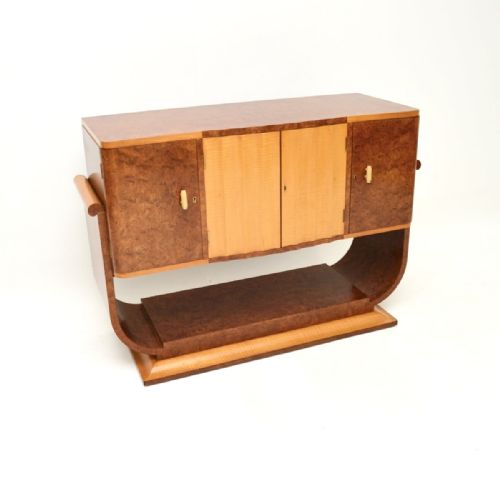
Structural complexity also dictates standing, with cloud shapes, U-shaped console bases, and multi-tiered cocktail sections requiring far greater carpentry prowess than a simple rectangular carcase. Furthermore, attribution to recognised makers or documented workshops elevates a piece from a functional antique to a collectible design object.
Maurice Adams·Harry and Lou Epstein·Hille·Hamptons of Pall Mall London·The Bowman Brothers·Waring and Gillow·Leemings of Halifax·Salaman Hille·Jules Leleu·Étienne Kohlmann
The Walnut Art Deco Sideboard Glossary
- Burr walnut
- A prized timber harvested from the irregular growth knots of the walnut tree, yielding dense, swirling grain patterns. Cabinet-makers slice this wood into thin leaves to veneer prominent exterior surfaces.
- Book-matching
- A technique where adjacent slices of veneer are opened like a page and glued side by side to mirror each other's grain. This creates symmetrical, abstract patterns highly favoured in art deco furniture.
- Cocktail cabinet
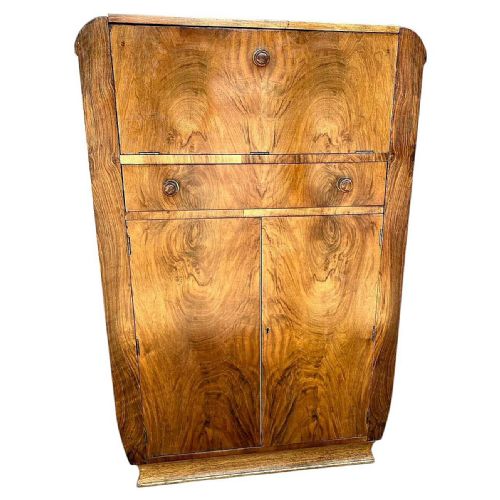
- A specialised storage piece fitted internally for glassware, mixing trays, and bottle storage, often featuring mirrored backs and drop-down serving flaps. These units became central to entertaining during the interwar years.
- Credenza
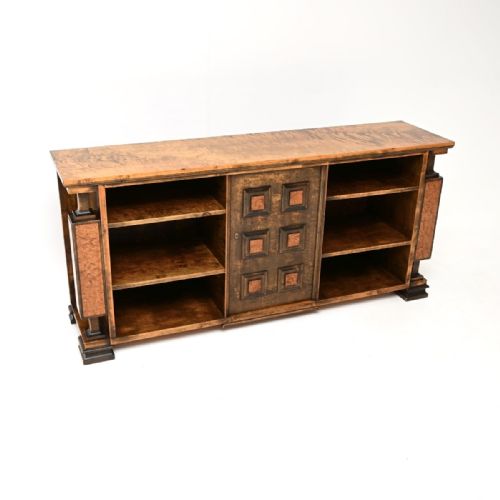
- A low-profile storage cabinet historically used for serving food or displaying items, adapted in the twentieth century to feature clean geometric lines and sliding or hinged doors.
- Veneer
- A thin layer of choice wood applied over a stable base timber to provide a decorative exterior without the structural instability of solid figured wood.
Walnut Art Deco Sideboard: Frequently Asked Questions
What is an art deco sideboard used for?
These large cabinets were originally designed to hold dining silver, linens, and serving dishes in formal dining rooms.
Today, their generous proportions and striking grain make them equally useful as media consoles or statement storage pieces in contemporary living spaces.
How do I identify a cocktail cabinet?
Cocktail cabinets typically feature a drop-down central flap that serves as a preparation shelf, accompanied by mirrored interiors and specialised bottle racks.
Many also include internal lighting and glass shelving designed specifically for glassware and spirits.
Are these sideboards made of solid walnut?
Most pieces utilise a stable secondary wood for the main carcase, which is then covered in high-quality walnut or burr walnut veneers.
This technique allowed makers to display dramatic, symmetrical grain patterns across large curved surfaces without the wood warping over time.
Where were these cabinets manufactured?
The pieces originate primarily from British workshops, particularly in London, alongside notable French and Italian design houses.
Continental examples often lean towards lighter satinwood accents or more adventurous serpentine and U-shaped carcases.