


Vintage Wooden Nesting Tables
These vintage wooden nesting tables offer compact multi-tiered surfaces in mahogany, walnut, and rosewood, perfect for flexible living spaces.
Vintage Wooden Nesting Tables
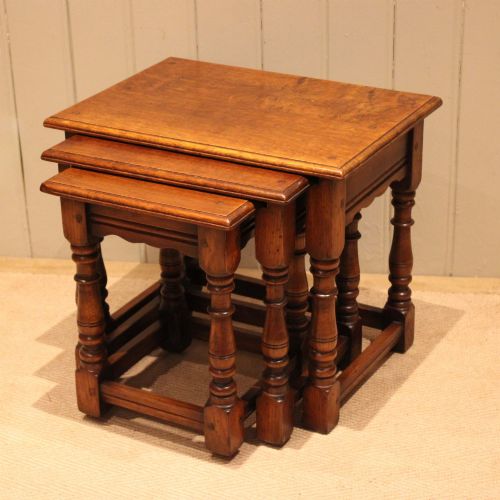
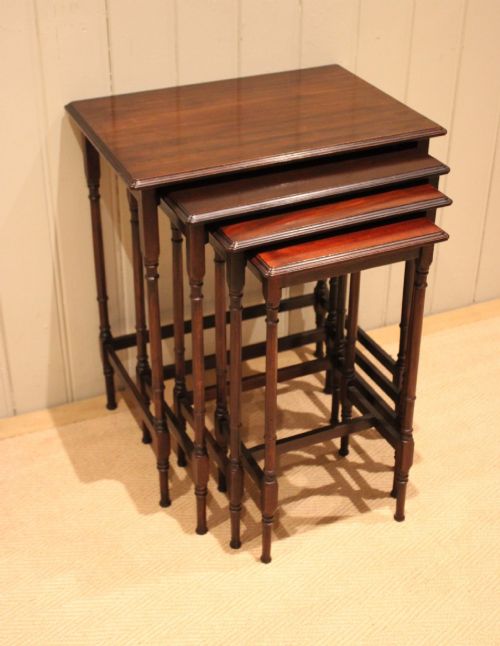
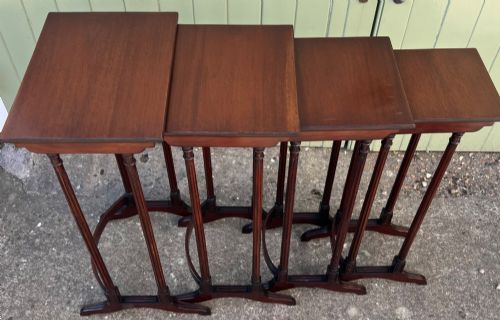
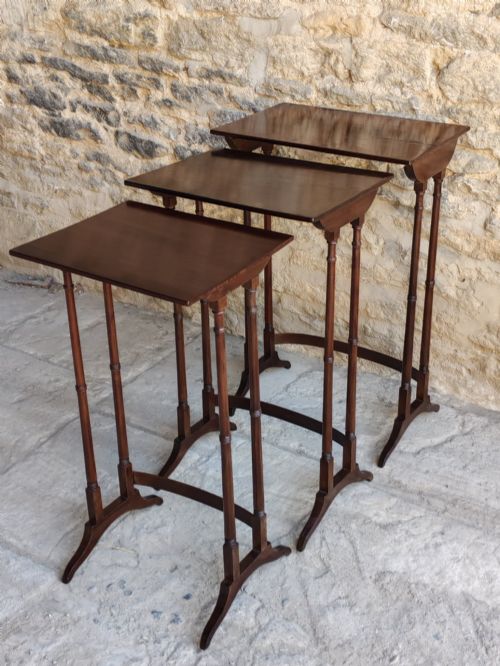
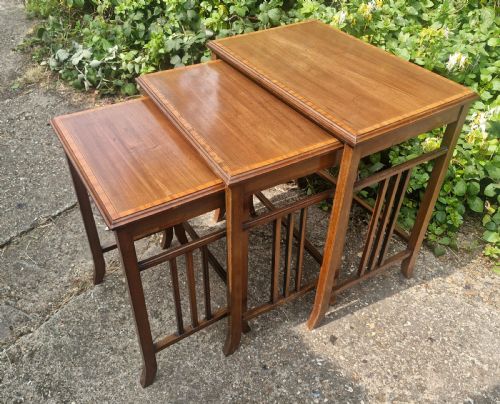
Vintage wooden nesting tables comprise sets of graduating surfaces that slide neatly beneath one another when floor space is at a premium. Edwardian and 1920s examples appear most frequently, spanning three to five tables designed for drawing rooms and occasional use. Early pieces include quartetto sets of four tables alongside compact oak, walnut, and mahogany iterations.
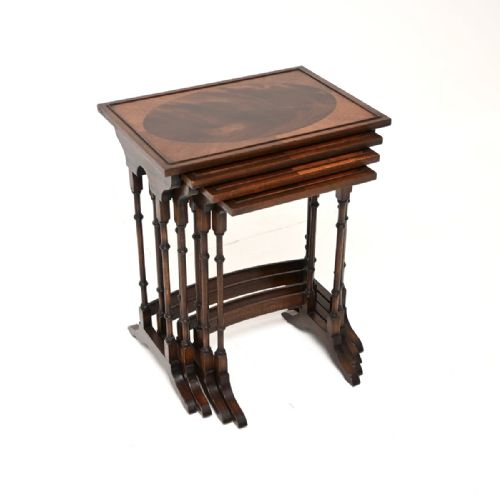
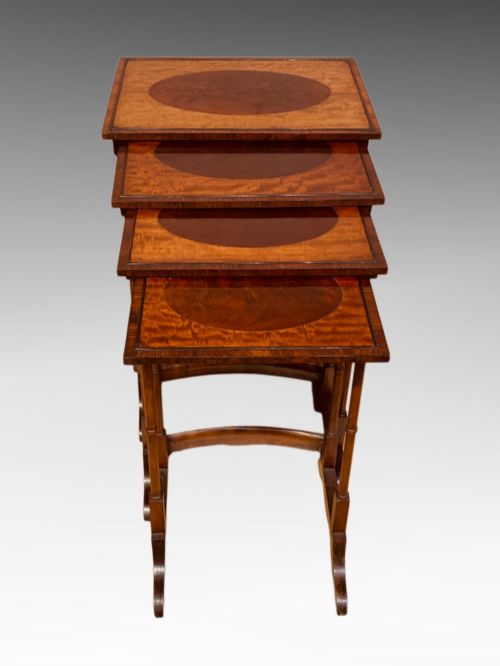
The form spans straightforward Edwardian utility items to elaborate Victorian and Georgian style interpretations with inlaid satinwood and leather tops. Makers such as Heal's produced distinct Art Deco versions, while other workshops focused on carved teak or Chinoiserie decoration. Buyers encounter everything from simple three-table sets to larger graduated assemblies designed to slide together effortlessly.
Materials and construction methods
Makers relied heavily on solid mahogany, walnut, and oak, often enhancing surfaces with contrasting boxwood and satinwood inlay. Rosewood and burr walnut appear on finer examples, adding rich grain patterns to the stacked tops. Timber selection directly dictated how well the sliding frames withstood daily extraction and storage.
Joinery techniques focused on stability within restricted dimensions, ensuring the smaller under-tables cleared the legs of the larger frames above. Tables featured shaped tops, carved details, and occasionally embossed leather insets secured to the primary wooden structure. Polished finishes protected the timber while highlighting the natural figuring of the wood.
Periods represented range from nineteenth-century Victorian and Georgian styles through to 1930s Art Deco designs.
Differentiating quality across sets
Quality reveals itself in the precision of the graduated fit and the integrity of the timber used for the frames and legs. Superior sets maintain structural rigidity even when all tables are separated across a room, whereas lesser examples suffer from loose joints and misaligned sliding paths. Selected veneers and fine string inlay indicate workshops that prioritised decorative refinement.
The choice of secondary woods and the crispness of carved elements or inlaid motifs separate standard production items from finer workshop pieces. Better examples display balanced proportions in the smallest bottom table without sacrificing legibility in the overall stacked silhouette.
The Vintage Wooden Nesting Tables Glossary
- Quartetto
- A set of four tables designed to nest together. The term appears frequently in Edwardian cataloguing for graduating side tables.
- Inlay
- A decorative technique inserting contrasting woods such as satinwood or boxwood into the primary timber surface. This creates delicate borders and geometric patterns.
- Graduated
- Describing tables built in diminishing sizes so each smaller piece slides completely beneath the preceding one. This scaling allows multiple surfaces to occupy the floor space of a single table.
- Burr walnut
- Timber taken from a tree growth featuring intricate, swirling grain patterns. It provides a highly decorative surface on table tops.
Vintage Wooden Nesting Tables: Frequently Asked Questions
How were nesting tables used?
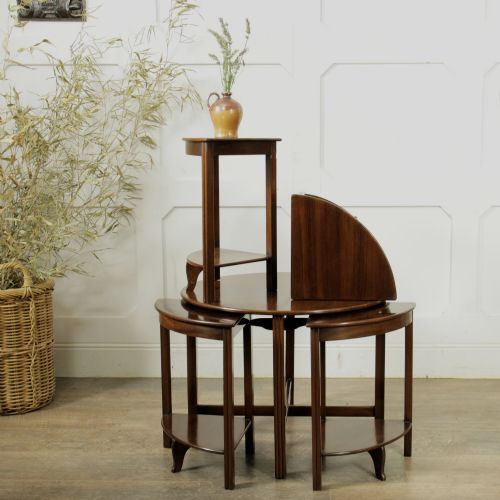
These tables served as portable tea and coffee surfaces in Edwardian and Victorian drawing rooms. Servants or hosts deployed them individually around guests before stacking them away.
They provided temporary table space without cluttering the room permanently. When tea service finished, the graduating frames slid back together into a single compact footprint.
What periods do these tables span?
The selection includes late Victorian and Edwardian pieces alongside 1920s and 1930s Art Deco designs. Earlier Georgian styles also inspire revival pieces from the early twentieth century.
Construction details and timber choices help distinguish between turn-of-the-century craftsmanship and later modernist interpretations. Edwardian inlaid mahogany sets represent the most common historical grouping.
How do I maintain the wooden surface?
Keep wooden nesting tables away from direct heat sources and strong sunlight to prevent the timber and veneer from drying out. Regular dusting with a soft cloth preserves the polished finish.
Apply quality beeswax sparingly when the wood appears dry. Avoid placing wet glasses directly on antique polished tops without protective coasters.
What does quartetto mean?
Quartetto denotes a specific grouping of four tables engineered to slide inside one another. The format gained popularity during the Edwardian era for occasional entertaining.
These sets require careful handling to ensure all four tiers slide smoothly along their respective channels without binding.