
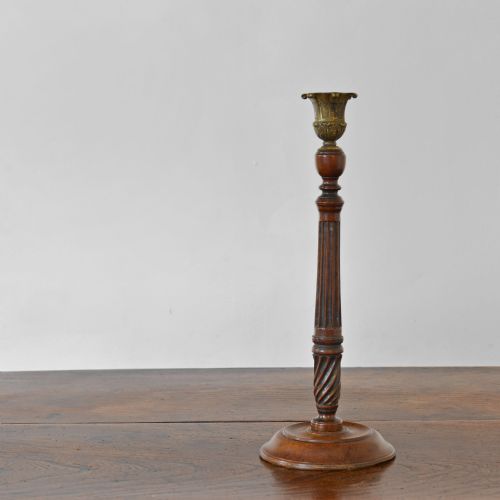
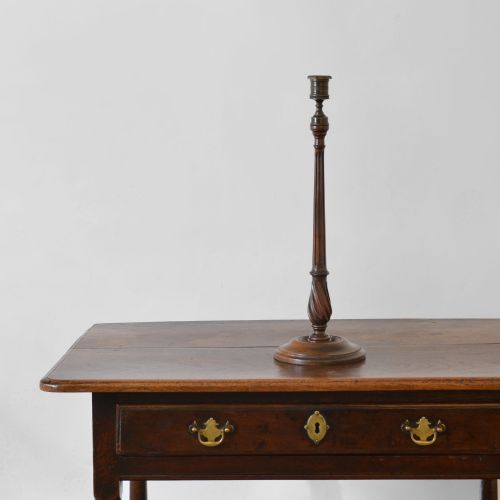


Vintage Timber Candle Holders
These vintage timber candle holders bring centuries of craftsmanship and warmth into a room.
Vintage Timber Candle Holders
Vintage timber candle holders span centuries of domestic lighting, ranging from Georgian mahogany to 17th century wall sconces and folk art pieces. These items serve both functional and decorative roles, often taking the form of candlesticks, wall sconces, or figurative carvings.
The versions most commonly encountered on this page include turned wood candlesticks from the nineteenth and early twentieth centuries alongside walnut, mahogany, and carved hardwood examples. Makers utilised various timbers to create upright supports for tallow and wax illumination.
Geographic origins and stylistic influences stretch from English period designs to Anglo-Indian mirrored sconces and French Chateau aesthetics. Buyers frequently encounter matched pairs designed for mantelpieces or side tables.
How they were made
Craftsmen shaped these objects using hand-carved techniques and wood-turning lathes, employing hardwoods such as mahogany and walnut. Many examples incorporate subsidiary materials like brass sockets, iron components, and silver leaf accents.
Folk art pieces demonstrate sculptural hand-carving, sometimes depicting figures such as poachers or angels rather than adhering to formal architectural orders. Structural joints rely on traditional carpentry methods appropriate to each period.
What varies in quality
The distinction between standard items and superior examples lies in the crispness of the turning and the depth of the hand-carving. Finer pieces display balanced proportions and thoughtful integration of secondary materials like brass prickets.
Age and regional provenance also influence standing, with seventeenth-century pieces and detailed folk art carrying distinct historical weight compared to later twentieth-century production.
The Vintage Timber Candle Holders Glossary
- Treen
- Small handmade wooden domestic objects. This term encompasses the smaller taper candlesticks found in domestic settings.
- Pricket
- A sharp metal spike on a candlestick designed to secure a candle. Earlier church and domestic lighting often utilised this method.
- Sconce
- A candle holder fixed to a wall rather than resting on a surface. These often feature mirrored backs or wooden backplates.
- Turned
- Shaped on a lathe while rotating. This technique accounts for the symmetrical cylindrical columns seen on many candlesticks.
- Folk art
- Utilitarian objects created by self-taught or local makers. These items often feature unconventional figurative carvings.
Vintage Timber Candle Holders: Frequently Asked Questions
How do I date wooden candle holders?
Dating relies on identifying the timber species, tool marks, and stylistic indicators such as Georgian proportions or Victorian turning patterns.
Comparison with documented examples from the seventeenth century through to the 1920s helps confirm the period of manufacture.
Were these used for candles or oil?
These pieces were primarily designed for wax or tallow candles rather than oil lamps. Many retain original brass sockets or metal prickets intended to hold the candle steady.
Later adaptations sometimes alter these fittings for modern electrical use.
Can I still burn candles in them?
Using traditional candles remains possible provided the socket size matches standard dimensions. Care must be taken to protect the surrounding timber from dripping wax.
Many collectors prefer to display them as decorative sculptures without active burning.
What is the difference between treen and standard candlesticks?
Treen specifically refers to small wooden domestic items shaped by hand or turned on a lathe. Candlesticks classified as treen are typically smaller scale taper holders.
Larger architectural or formal pieces fall outside this category.