


Mahogany Candlesticks
Mahogany candlesticks bring rich timber grain and polished brass into a room, offering warm illumination and timeless presence on any surface.
Mahogany Candlesticks
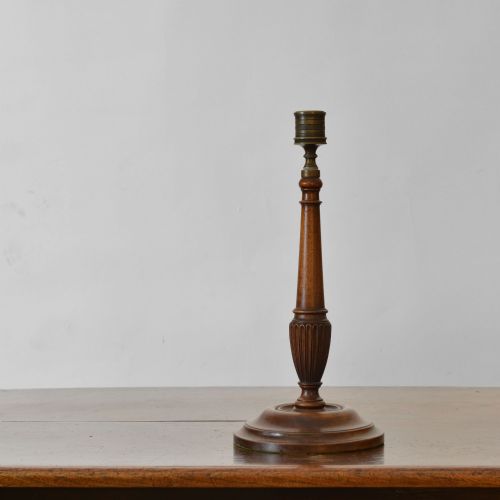
Mahogany candlesticks are turned or carved wooden supports designed to hold taper candles, frequently encountered on this page as matched pairs from the Georgian, Victorian, and Edwardian periods.
The selection ranges from restrained 18th-century columnar forms to later Edwardian interpretations and revival styles such as Adam and Louis XVI.
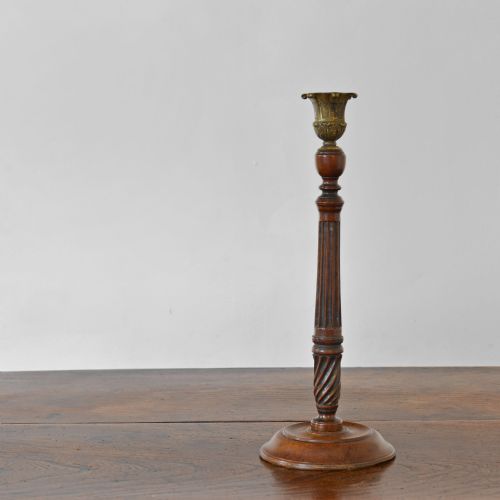
Many examples incorporate contrasting metal elements, uniting deep brown timber with functional brass sconces and sockets.
How they were made
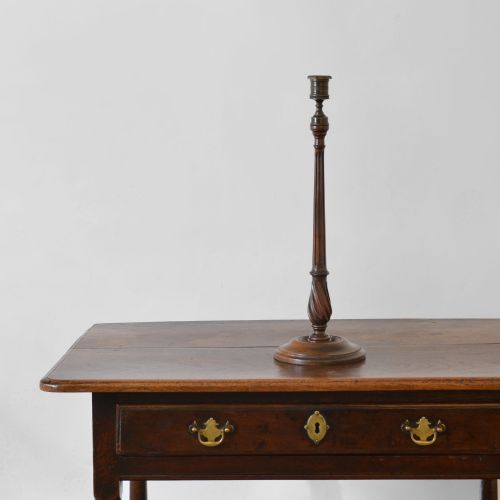
Turners shaped the dense timber on a lathe, producing slender columns, barley twists, and reeded shafts that display the natural figure of the wood.
Makers integrated brass sconces, nozzles, and weighted bases to secure the candles and provide necessary stability to the upright shafts.
Unusual travelling versions known as Brighton Bun candlesticks collapse safely into compact wooden spheres for packing away.
What varies in quality
The quality of mahogany candlesticks depends largely on the crispness of the turning and the depth of the timber's grain and polish.
Examples that maintain correct proportional balance between the turned shaft and the supportive base show superior craftsmanship.
The Mahogany Candlesticks Glossary
- Sconce
- The metal nozzle or socket fitted to the top of a candlestick to hold the candle securely.
- Reeded
- A decorative surface carved with parallel convex mouldings resembling bundled reeds.
- Barley twist
- A spiral turning resembling a twisted rope, popular on nineteenth-century wooden stems.
- Column
- A vertical architectural support forming the main upright shaft of the candlestick.
Mahogany Candlesticks: Frequently Asked Questions
Are most mahogany candlesticks found as pairs?
The evidence shows that the majority of these pieces survive and are offered as matched pairs, which were originally intended to balance each other on a mantelpiece or dining table.
Single candlesticks do occasionally appear, but pairs remain the standard form sought after by collectors.
What metals are typically combined with the wood?
Brass is the predominant metal used alongside the timber, appearing as protective sockets, drip pans, and weighted base plates.
Gilt brass also occurs on certain decorative nineteenth-century examples to provide a contrasting metallic highlight.
How do Georgian examples differ from later ones?
Georgian candlesticks tend to display cleaner architectural lines, often following classical column designs or straightforward turned profiles without excessive ornament.
Later Victorian and Edwardian versions frequently embrace more exuberant carving, such as open barley twists.
Can these hold standard modern candles?
Most antique brass sconces are sized for standard taper candles, though minor variations in historical socket diameters are normal.
A simple adjustment or fitted beeswax taper usually ensures a secure fit without altering the metal.