

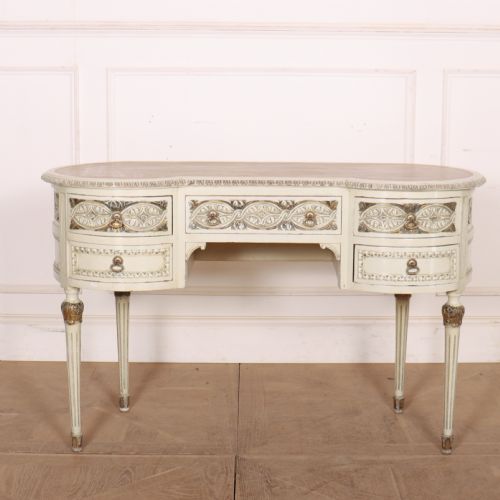

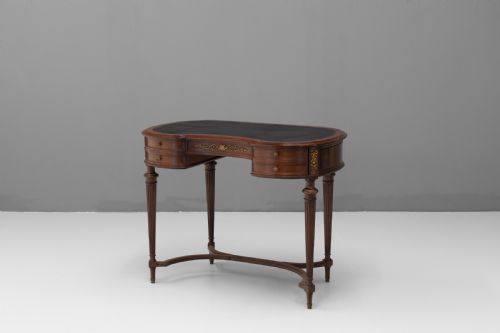


Vintage Kidney Shaped Table
A vintage kidney shaped table brings a sweeping, serpentine curve to a room, offering practical surface space without sharp corners.
Vintage Kidney Shaped Table
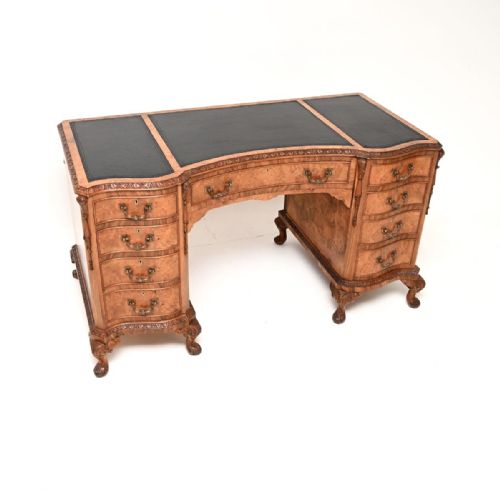
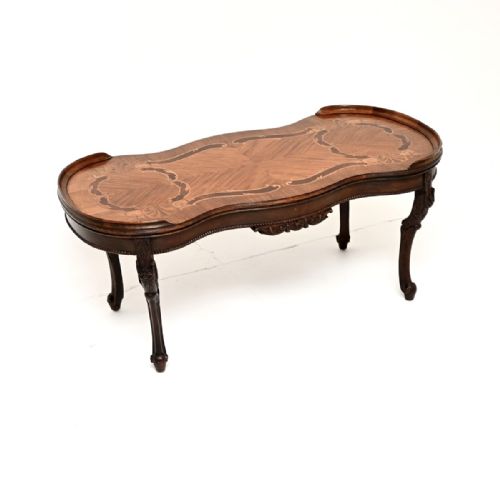
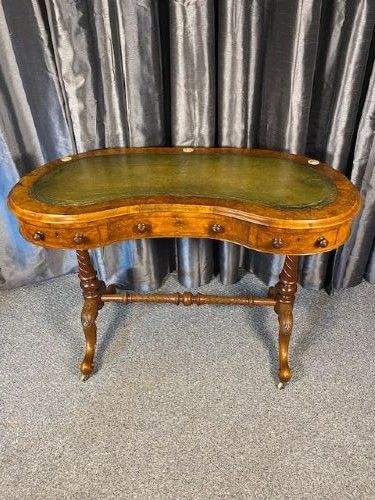
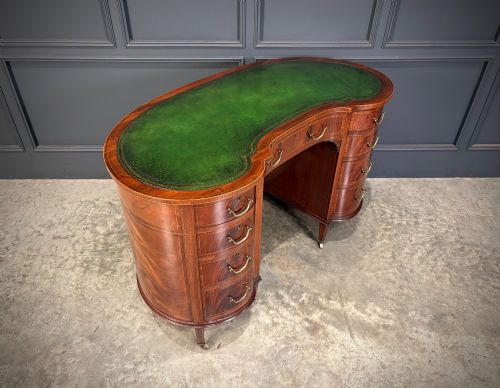
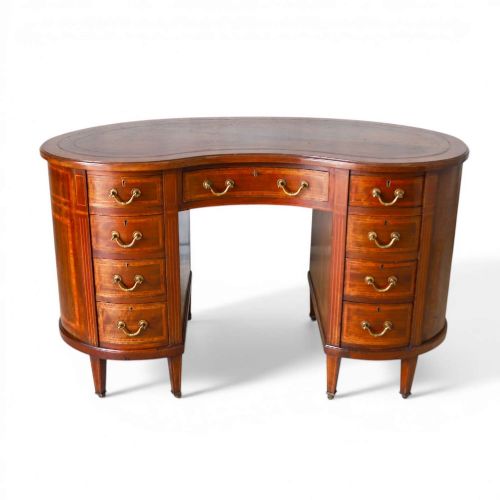
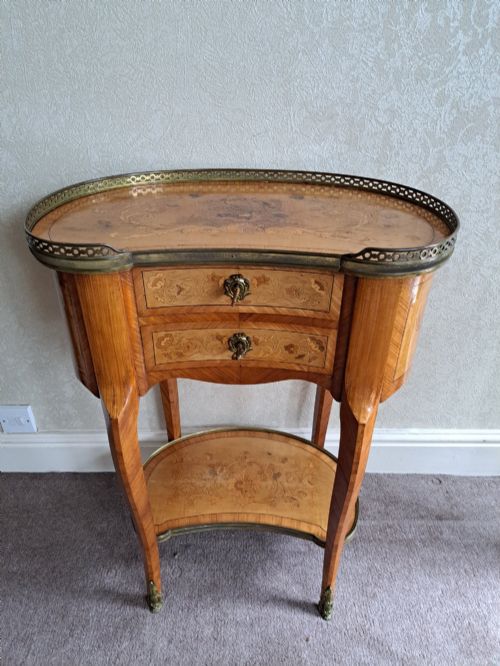
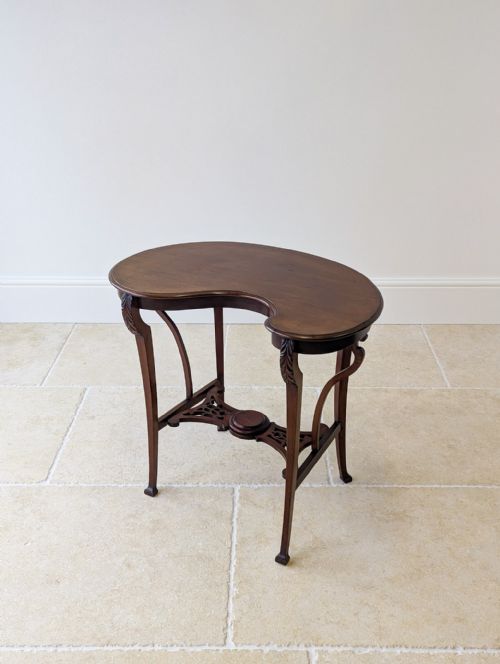
When searching for a vintage kidney shaped table, buyers encounter a distinct curved silhouette designed to hug the body, historically favored for writing, occasional use, and bedside storage. These pieces emerge most frequently from Edwardian workshops and the late nineteenth century, appearing as writing desks, occasional stands, and compact bedside tables.
The layout of these tables varies from simple side pieces with slender legs to elaborate pedestals and library tables fitted with leather inserts. Makers utilised the concave curve to create intimate workspaces that fit comfortably within a corner or float within a room without dominating the floor space.
Materials and Construction Techniques
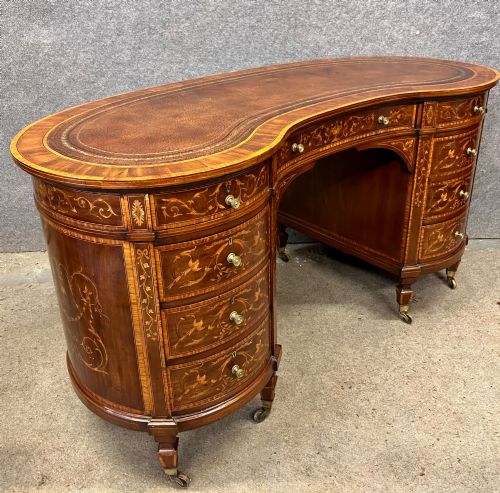
Cabinetmakers built these curved frames using dense timbers like mahogany, walnut, and burr walnut, often applying intricate marquetry or satinwood and boxwood stringing to accentuate the serpentine outline. Surfaces frequently incorporate tooled leather writing inserts, whilst finer examples feature cast brass mounts, ormolu details, and raised galleries.
Achieving the distinctive bean-shaped curve required precise bending of wood and careful veneer work, particularly on drawer fronts that followed the convex and concave radiuses. Structural integrity relied on tapered legs, sometimes braced with cross stretchers or organised into twin pedestals supporting the main writing surface.
Listings feature kidney shaped tables spanning the Victorian and Edwardian eras, alongside 1930s interpretations.
Judging Quality and Execution
Quality in these curved pieces rests on the precision of the veneer matching along difficult radiuses and the crispness of any inlaid marquetry or stringing. Superior examples maintain tight joints along the sweeping curves where lesser pieces might show separation or movement in the timber over time.
The selection of secondary woods, the weight of the cast brass hardware, and the finish of the leather writing surface all indicate the tier of the original maker. Finer tables display hand-cut dovetails within the drawers and smooth movement along the curved channels.
Wolfe and Hollander·Gillows·Maurice Adams
The Vintage Kidney Shaped Table Glossary
- Marquetry
- Decorative veneer work arranged in pictorial or geometric patterns across a wooden surface. Craftsmen cut thin slices of contrasting wood to create elaborate motifs on tabletops and drawer fronts.
- Ormolu
- Gilded bronze mounts applied to furniture for decorative effect. This technique was popular in French revival pieces to accent corners and feet.
- Gallery
- A raised miniature railing around the edge of a table or tray. It prevents items from sliding off the curved surface.
- Pedestal Desk
- A heavy desk comprising two box-like drawer columns supporting a single wide top. These often feature the characteristic kidney curve on the writing side.
- Satinwood
- A lustrous, yellowish timber native to India and Ceylon used for banding and stringing. It provides a bright contrast against darker woods like mahogany and walnut.
Vintage Kidney Shaped Table: Frequently Asked Questions
Where should I place a kidney shaped table?
These tables suit placement in the centre of a room, behind a sofa, or tucked into a bedroom corner as a writing desk. Their curved back makes them presentable from every angle.
Avoid pushing them squarely against flat walls if the curve disrupts the room flow; instead, let them float where the serpentine outline can be appreciated.
How do I maintain the leather top?
Keep leather writing surfaces clean by dusting gently with a dry cloth and avoiding harsh chemical cleaners. Periodic treatment with specialised leather balm prevents drying.
Direct sunlight can fade the gold tooling and dry the hide, so position the table away from intense windows.
Are these tables suitable for daily writing use?
Most antique versions function well for contemporary writing, laptop use, or correspondence. The curved front offers a natural, ergonomic recess for seating.
Ensure the kneehole height accommodates your chair, as older vanity and occasional versions sit lower than standard modern desks.
How do I distinguish Edwardian from Victorian examples?
Victorian iterations tend to use heavier solid mahogany and deeper carving, while Edwardian pieces frequently showcase lighter satinwood inlays and Sheraton revival influences.
Look at the hardware and interior secondary woods, which shift from traditional oak linings in the nineteenth century to lighter pine and mahogany in later Edwardian workshops.